expert-image
Talk to a Travel Expert +977 9818264758

Booking open for Nepal Trek 2025 & 2026

View Details
Lo Manthang

Upper Mustang Trek

Based on 25 reviews
duration
Duration

16 Days

difficulty
Trip Difficulty

Moderate

max-altitude
Max. Altitude

3,800m

destination
Destination

Nepal

group-size
Group Size

2-16 People

meals
Meals

Breakfast, Lunch & Dinner

accommodation
Accommodation

Hotel, Teahouse

transportation
Transportation

Flight, Tourist Bus

expert-image
Need Help? Ask to Travel Expert
Get a Trip Quote Customize This Trip Make an Inquiry
  • Best Deal
  • Flexible Schedule
  • Instant Booking
  • No Hidden Costs
trip-advisor
5.0
25 reviews

Overview of Upper Mustang Trek

The Upper Mustang trek invites you into one of Nepal’s most dramatic and culturally rich landscapes. Mustang lies in the rain shadow, making it very dry, but the title ‘Forbidden Kingdom’ mainly comes from the fact that it was closed to outsiders until 1992. This remote region sits north of the Annapurna and Dhaulagiri ranges. Whenever I am walking here I feel like I am traveling back in time. Sun-baked mud bricks clinging to canyon walls, prayer flags dance above white washed monasteries, and ancient sky caves peer over the Kali Gandaki River. The highlight of the journey is Lo Manthang, the fortified city that has preserved Tibetan-influenced culture for centuries.

This 16-day Upper Mustang trek itinerary begins with a scenic flight from Pokhara to Jomsom. You then keep to the historic salt trade onwards to Kagbeni, Chele, Samar and to the high pastures of Charang. A brief trek takes you to Lo Manthang where you have a full day to explore its monasteries, royal palaces and the lively Tiji Festival if your visit coincides with the season.

A side trek to the Chhoser Cave reveals a five-story maze of over forty rooms, once used for meditation, refuge, a five-story maze of over forty rooms, once used for meditation, refuge, and even burials. On the return journey we also see the red cliffs of Dhakmar and the medieval Ghiling village on the way before reaching Jomsom. Throughout the track are sensational views of Nilgiri, Dhaulagiri and Annapurna. Each night we will be in comfortable teahouses or local homestays.

RAD Global Adventure designed this Upper Mustang trek package for travelers who seek both adventure and authentic culture. The trek has a good ratio of acclimatization to exploration and therefore, it is achievable for trekkers with good fitness. The group we organize will get all sorts of permits, and local guides, who know much about the region, its geology, history, and Buddhist culture, will be involved.

The trek is available between the months of March and November but the best time to hike would be during spring and autumn when it is less rainy but not too hot. Whether you are a Buddhist or just seeking a spiritual journey, this is your trek to witness beautiful monasteries, visit the yak herders, traditional ceremonies and festivals keep the Tibetan Buddhist heritage.

Good To Know

The Upper Mustang trek offers a moderately challenging adventure. Every day you can see 4-7 hours of walking on dry and rocky paths with gentle climbs. The maximum overnight stay is Lo Manthang at 3810 meters, and some passes are more than 4000 meters high. The trail is non-technical, except for a few steep sections between Samar and Ghiling. There is no need to carry heavy loads; porters transport the main luggage, and you just carry a light daypack.

This is one of the restricted areas so trekking groups should be above two and the trekker will have to avail the services of a licensed agency. With proper acclimatization, good hydration, and steady pacing, the Upper Mustang trek is achievable even for first-time high-altitude trekkers who have reasonable fitness.

The Upper Mustang trek takes you into rain shadow with dramatic seasonal contrasts. Spring (March-May): Cool weather, blue skies and a chance to have a glimpse of the Tiji Festival in Lo Manthang. The Summer (June-August) is a little bit warmer, but trails are still mostly dry. The most demanded time is Autumn (September – November) and the weather is a bit cool and the mountain views are wonderful.

Winter(December-February) is harsh, and nights are freezing, and heavy snowfall can block trails. Even in spring, night temperatures in Lo Manthang may fall well below zero. Warm clothes, wind resistant jacket and sturdy sun protection are the recommendations that one should carry. Always ensure there is a check on local weather in Jomsom and have a buffer time during a flight due to high winds.

Food along the Upper Mustang trek reflects both Tibetan and Nepali traditions. Teahouses offer rice and lentil soup, Tibetan bread and dumplings, noodle soups, and restaurants may also serve yak meat and butter tea in Lo Manthang. Orchards of apricots and apples yield fresh pies, jam, and the locally made Mustang wine, produced in villages like Kagbeni and Marpha.

Water is accessible but bottled water resources are expensive and a waste of resources so have a reusable water container with purification tablets or a filter. Teahouses also offer boiled or filtered water on request. Hot ginger tea and garlic soup are local remedies, which you use against altitude problems. Nuts and chocolate and power bars are easily portable and provide you with energy on long trekking days.

Altitude sickness can affect trekkers once they ascend above 2,500 meters on the Upper Mustang trek. Typical symptoms are headache, nausea, fatigue and poor sleep. The route is a gradual ascent to build acclimatization, with acclimatization nights in Ghiling and Lo Manthang. Minimize risk by drinking at least three liters of water a day and not to exceed 500 meters of your sleeping altitude each day.

In case you develop severe symptoms, take off at once and get medical treatment. You may carry medication such as Diamox, but only take it after consulting your doctor. Above all, pay attention to the body as there is no fixed reaction to the altitude. Our safety guides have been trained in medical care and constantly watch your health conditions.

Good preparation makes the Upper Mustang trek more enjoyable. Increase the stamina and muscles by walking with a backpack or up a flight of stairs several weeks prior to the trip. Endurance is improved by cardiovascular activities (running, cycling, or swimming) and by working on balance/core. Wear hiking boots to eliminate blisters and bring a slightly heavier set of clothing that is quick drying to stay cool and comfortable.

You do not have to carry your main bag, only use a daypack instead. Do not expect luxury accommodations; teahouses are simple but comfortable, walking days can be long and you may encounter some delays in flight or windy weather. Having physical and mental preparation, you will feel you can take on the trail.

Everyone needs a Nepal Tourist visa, available on arrival at Kathmandu airport. For the Upper Mustang trek, you also need two special permits. The Restricted Area Permit (RAP) is USD 500 during first ten days and USD 50 per day afterwards. The Annapurna Conservation Area Permit (ACAP) is about USD 30. Such permits can only be issued through a registered trekking agency.

Carry copies of passport and passport size photographs as you will be required to present the documents in Kagbeni and other checkposts. These documents are required as without them, entry into Upper Mustang is not permitted.

Health and safety is important during trekking in this far-flung area. Bring along a med-kit that includes your prescribed medication, an antiseptic, bandages and altitude medicine. Take sufficient travel insurance that covers extreme trekking such as high-altitude trekking and helicopter rescue evacuations. The Upper Mustang trek passes through dry and dusty terrain, so use a mask or scarf on windy days.

Wear a hat, sunscreen and sunglasses at all times to prevent severe UV rays. Dress decently to appreciate local norms, and before taking photos in monasteries, since some places do not allow photography. Remember that villages will be scarce so it is important to remain in the group and post instructions as directed by your guide.

The Upper Mustang trek begins with a drive or flight from Kathmandu to Pokhara, followed by a short flight to Jomsom, weather permitting. The trek is completed entirely on foot the trek is completed entirely on foot along the classic Upper Mustang trail. The trek is completed by a flight to Pokhara and drive to Kathmandu. Expect flight delays in Jomsom, with wind being a typical problem affecting schedules, thus it is a good idea to keep buffer days. During the trek, we will have to cross high passes, suspension bridges, and rough terrain, while your gear is carried by porters or pack animals.

Mobile coverage during the Upper Mustang trek is limited. There might be a signal in such villages as Kagbeni and Lo Manthang, however, it may go off unexpectedly. Ncell and Nepal Telecom have towers in both Jomsom and Kagbeni and some Tea houses in both places also offer satellite Wi-Fi at a fee, though at slow speed.

Power is most often provided by solar panels, and can only be accessed at certain times of the day, so bring a power bank and universal adapter. Inform your family that you may be offline for several days. Download offline maps and guidebooks in Kathmandu before departure. In emergency cases where communication is important, guides are equipped with radios to enable them communicate.

We can explore several variations of the Upper Mustang trek itinerary. Others will go by jeep to Lo Manthang, and walk back, reducing the days trekking. Others drive farther east to Yara and Luri Gompa or to Muktinath via the Thorong La pass. Day trips- Lo Manthang has of flattering and mesmerizing day hikes to Tingkhar village, Namgyal Gompa and Chhoser Cave complex.

There is also an option of linking the Upper Mustang with the Annapurna Circuit or even a helicopter out of Lower Mustang. Always discuss with your guide which route will suit us the best in regards to our fitness and time.

In addition to the package cost, plan for personal expenses during the Upper Mustang trek. Wet showers usually cost NPR 300 each, and charging electronic devices usually costs NPR 200–300 per hour, and the Wi-Fi costs as well. Once you exceed the 10 day limit of the permit it amounts to USD 50 per day.

It is expected to tip guides and porters which is about 10 percent of the trek cost which is shared among the team members. At Lo Manthang you are likely to find souvenirs like hand made textiles, prayer wheels, or even Mustang wine. Carry some cash in Nepalese rupees (NPR) because there are only the ATMs in the Jomsom and Pokhara. A more-or-less modest offering is required at monasteries.

Inhabitants of Upper Mustang speak the Loba language which is a Tibetic dialect. Most, also speak Nepali and your guide will assist in this. Most teahouses speak Basic English. When greeting you should learn some local phrases, as Tashi Delek (greetings) and Thukje che (thank you). Smiles and polite nods can overcome a language barrier. During the Upper Mustang trek, patience and kindness will make your interactions more meaningful.

Most electricity is provided by solar power and micro-hydro plants in Upper Mustang. The charging of devices can only take place within certain time periods with most lodges charging per device or by the hour. Because electrical power is scarce, take along a 10,000 mAh or greater power bank, spare camera batteries and headlamp.

There is Wi-Fi access in Kagbeni and Lo Manthang, but it is slow and video calls usually do not work. You can download offline content such as books, maps and podcasts before leaving Pokhara or Kathmandu. Save battery by putting the plane mode on and shutting down unused features. An adapter is important because the plugs used are different.

Detail Itinerary

Welcome to Nepal! You will land in Kathmandu at the Tribhuvan International Airport; You will be welcomed by our RAD Global Adventure representative who will transfer you to our hotel in Kathmandu. The afternoon will entail a briefing session about the trek, an introduction to our guide and other trekkers and a discussion/checking of trekking gear.

In case we have the time, we will do a nice walk in the colorful streets of Thamel or visit some temples nearby. The afternoon is at leisure before we go out for a welcome dinner in a local restaurant in the evening to sample the traditional cuisine of the Nepalese people. We will spend in a comfortable hotel in Kathmandu overnight.

activity-small

Activity: Arrival and briefing

accommodation-small

Accommodation: Hotel

meal-small

Meal: Dinner

altitude-small

Max Altitude: 1,350m/4,429ft. (Kathmandu)

If our standard itinerary doesn't fully meet your needs, we are happy to tailor it to your specific preferences and requirements.

Includes and Excludes

What’s Included?

Transportation

  • International airport transfers
  • Kathmandu – Pokhara transfers (tourist bus/private vehicle or flight)
  • Pokhara – Jomsom – Pokhara round trip flight
  • Private drive Jomsom – Kathmandu (via Pokhara) at the end of trek

Food and Accommodation

  • Full meals: breakfast, lunch & dinner on your choice.
  • Supplementary snacks: energy bar and cookies
  • Seasonal fresh fruits deserts every day
  • Unlimited chlorine treated safe drinking water
  • Accommodation: Lodge (twin room)

Guide and Support Staff

  • An experienced english-speaking trekking guide
  • Porter service for luggage (one porter for every two trekkers)

Permit and Expenses

  • Upper Mustang Restricted Area Permit (RAP)
  • Annapurna Conservation Area Permit (ACAP)
  • Trekkers’ Information Management System (TIMS) card
  • All local and government taxes
  • Guide and porter salaries, insurance, equipment, transport, food and lodging

Medical and Gear

  • Oxi-meter: To check , heart rating and oxygen saturation
  • A comprehensive first aid kit
  • Emergency rescue in case of severe illness or injury (costs covered by your insurance)
  • Trekking equipment: down filled sleeping bag, walking poles and duffel bag
  • Free luggage storage in Kathmandu

Others

  • Farewell dinner in Kathmandu
  • Certificate of appreciation
  • Trekking route map and company t-shirt

What is not Included?

International Flights and Visa

  • International flights and visa

Food and Accommodations

  • Meals in Kathmandu (except farewell dinner)
  • Any hotel stays in Kathmandu before or after the trek

Travel and Medical Insurance

  • Comprehensive travel and medical insurance
  • Emergency rescue evacuation

Other Expenses

  • Personal expenses
  • Tips and gratuities
  • Personal trekking equipment
  • Unexpected expenses due to weather, flight cancellations, strikes, or natural causes

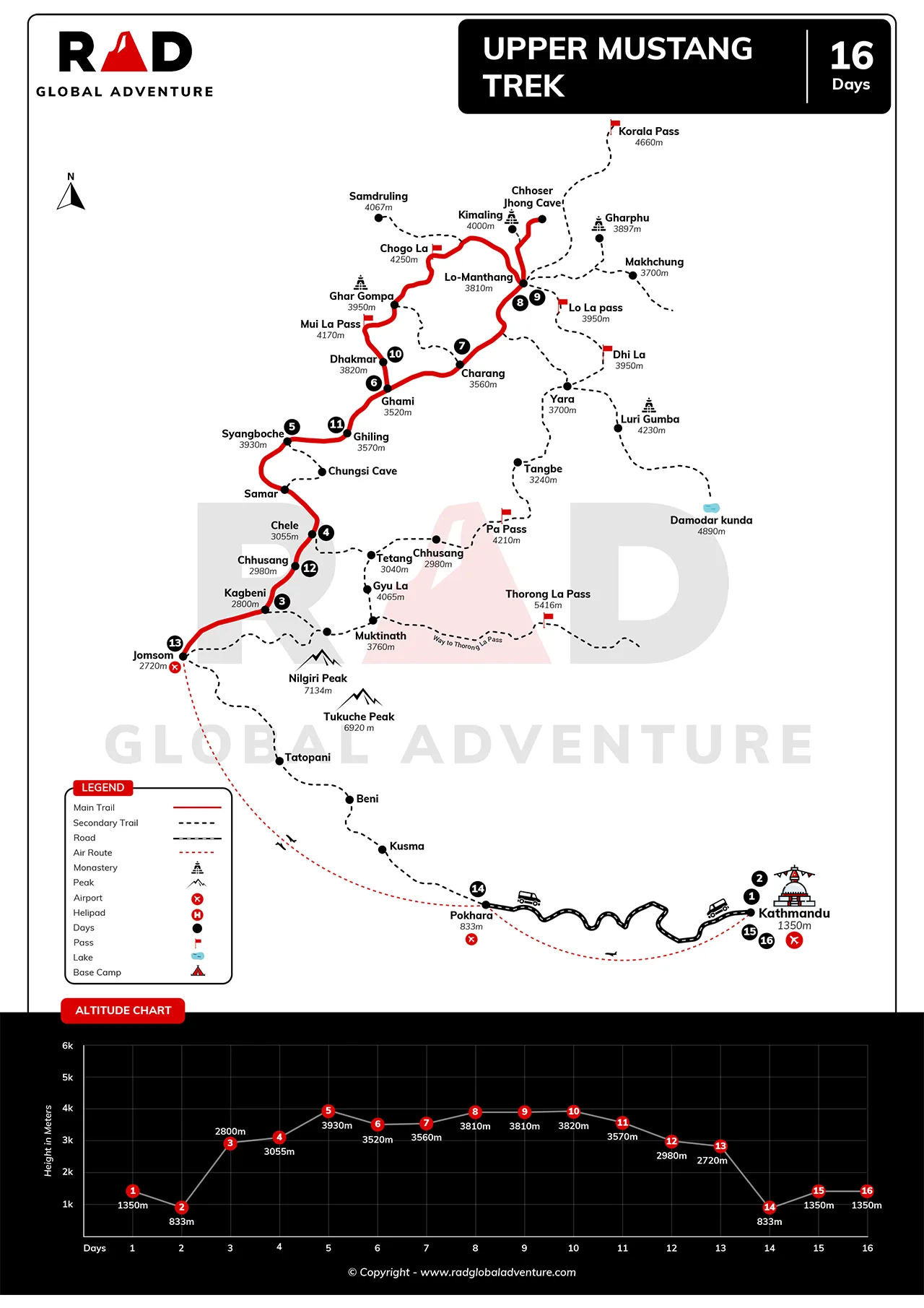
Route Map & Altitude Chart

Attractions and Highlights of Upper Mustang Trek

Explore Kagbeni & Old Villages

We will visit Kagbeni located on the bank of Kali Gandaki River at about 2800 m the official gateway to the Upper Mustang. It is a fusion of old Tibet architecture; its narrow alleys, mud-brick dwellings, and red monasteries bring to the fore this aspect of Tibetan architecture. A former vital trading post between Tibet and India, Kagbeni still feels like a museum on stilts because chortens border the lanes, prayer wheels turn in vestibules and carved windows look into centuries-old homes.

The fertile floodplain surrounding the village gives an opportunity to locals to cultivate barley, buckwheat and apples. Other nearby villages like Tangbe, Samar and Dhakmar have the same mediaeval appeal where their homes are white washed with mani stones carved and also they have their own common grain mills. By spending time in these villages we will get a rare glimpse of how people have lived in the region in an unspoilt manner over several decades.

Discover Hidden Sky Caves & Ancient Monastic Sites

One of the most surprising adventures of Mustang will be the revelation of sky caves of Chhoser, cut in the high cliff walls. These caves are five-story caves and more than forty chambers used by people to bury their dead, meditate or seek refuge were constructed. The chambers are directly linked by narrow tunnels and wooden ladders, the ceilings in the soot-blackened rooms, storage rooms and fading paintings also remain.

Archeologists trace some of these caves back to 2,500 years old and have retrieved pottery, manuscripts and human remains. The visit is a touch of a living museum where silence states about devotion and survival. We will see monasteries like Ghar Gompa and Namgyal Gompa on the hills which are waiting to be seen with their deities, ornaments and relics of Mustangs deep spiritual past.

Lo Manthang, the Walled “Forbidden Kingdom”

We will go to Lo Manthang the cultural and historical nucleus of upper Mustang. First established in the 14th century and surrounded by 20-foot-high mud-brick walls, this walled city holds on to ancient practice of the Tibetan Buddhism. It is within its narrow lanes where we will find other monasteries, like Thubchen, Jampa and Chode Gompa that are covered in holy images and relics.

In the middle of the royal palace we may see the houses and courtyards whitewashed where locals perform their daily ritual. Lo Manthang was the seat of Kingdom of Lo until 2008 and it has become a perpetuated example of legacy and piety. If our trip is in the spring, we will observe the three-day festival of Tiji, when the masked dances and rites are the retelling of the legend of Dorje Jono. Strolling through Lo Manthang we will sense the distinctive vibe of a thousand-year-old kingdom breathing in the present.

Spectacular Panoramas of Nilgiri, Dhaulagiri & Annapurna Ranges

Throughout the Upper Mustang trek, we will enjoy breathtaking panoramas of the Himalayas. Wide open vistas across canyons On high passes like Dajori La, and Nyi La, we will view the snow-covered mountains of Nilgiri, Annapurna I, Tukuche and Dhaulagiri set above the drying gorges. This great contrast between hilly landscapes of barren terrain and the mountains of shiny summits makes the landscape to captivate the eyes.

At Dhakmar the red cliffs blaze marvellously in the evening sun rays and the wide plateau in between Lo Manthang stretches into views of a 360 degree Himalayan spread. Even during the trek to the caves of Chhoser one would spot windows cut in the rock and catch a peep into the distance through the touch of the twilight mountains. Such memories will not leave us and we will have best opportunities to take photographs.

Authentic Tibetan-Influenced Culture & Festivals

We can enjoy a culture in Upper Mustang being closely associated with Tibet since the centuries. Once belonging to the Kingdom of Lo and an important trade route connected Nepal and Tibet, the region continues to be driven by ancient traditions of Tibetan Buddhist. Most of them are the descendants of people who have fled their homeland Tibet in 1959 and they like to preserve their cultural norms, clothing, language.

The most popular cultural phenomenon is the Tiji Festival, a three days festival in Lo Manthang in which the monks put on a mask and act out the story of Dorje Jono overcoming his demon father. The festival does not only safeguard the tradition of Mustang but also tightens the relationship within the community as well as the economy.

In addition to festivals, traditions will be witnessed in day to day life-tasting butter tea, watching carpets being made, or prayer wheels being made. In a homestay or a turn of a prayer wheel every communal meal connects us in a relevant manner to the Tibetan past of Mustang.

Encounters with Mustang’s Tibetan Buddhist Way of Life

We will observe how the Tibetan Buddhism is rooted in the life of Upper Mustang. Monasteries play the role of focusing on prayers, education, and heritage safeguarding whereas monks in Lo Manthang perform practices that they have been doing since the past.

Townships are decorated with mani walls which are carved with sacred prayers and the chortens act as landmarks to the spirituality. Tourists tend to do the circumambulation of monasteries or even turning the prayer wheels and are guided by the karmic and compassionate ideology. As visitors we will be able to participate in prayer ceremonies, benefit and pray to lamas and the Buddhist philosophy.

By respectfully observing and joining in when invited, we will be able to experience first hand a spiritual tradition that to the people of Mustang transcends nearly every part of their society.

Experience Silence Like Nowhere Else

We will find silence like no where when trekking the rough locations in Upper Mustang. Large valleys, red-brown hills, and endless skies makes the environment very different to a modern noise. There are no dense forests; no traffic and the few people inhabiting the place mean one only hears sounds of wind, steps through gravel and the cry of goats.

The silence of the ancient Chhoser caves is almost palpable and there is an increased sensitivity to every breath. Even Lo Manthang full of life in and during festivities States a feeling of pensive tranquility. Such loneliness will grant us some reflections and even will allow us to find some space into the peacefulness, an experience as unforgettable as the remarkable scenery of the region.

Tiji Festival: Color, Masks & Sacred Rituals

We will be immersed in color and devotion if our journey coincides with the Tiji Festival,the most colorful event of the year at Lo Manthang then we will be submerged in color and devotion. Then, over the course of three days, monks re-enact the legend in sacred Cham dances, using elaborate masks and costumes, about Dorje Jono who fought his demon father in order to bring peace to Mustang.

Rituals will be the presence of a giant thangka painting, ritual prayer, and rhythm of traditional instruments. The festival does not consist only of a performance but saves ancient traditions, gathers the community, and attracts tourists which benefit the local economy. By being at Tiji we can experience a manifestation of Tibetan Buddhist rite in a place enhanced by the energy of Lo Manthang as the setting of faith and color.

Kagbeni: Gateway Village on the Old Salt Trade Route

We will step back in time as we explore Kagbeni, the historic gateway village to Upper Mustang. The village of Kagbeni is located at the point of confluence between Kali Gandaki and Jhong Rivers; it used to be a trade center where caravans used to pass wool, salt and grain taxes would have been imposed at Kagbeni fortresses. With sacred Buddhist scriptures still resident there, the red monastery was built back in the 15 th century.

It embodies rich soil and grows the barley, buckwheat, and apples as well as gullies with mud-brick homes exemplifying well-maintained Tibetans architecture. The would-be-visit to Kagbeni itself is a interesting way backward into the past, and the preface to the great step onward into the still-prehistoric Forbidden Kingdom.

Trip Information of Upper Mustang Trek

Is this trip beginner-friendly?

This trek is moderately challenging but achievable for trekkers with good fitness. We walk each day distances of 10-18 km with altitudes of 2,800 m as well as 4,230m. The upper limit of sleeping is 3,810 m, so there is opportunity to acclimatize easily. Although there is no technical climbing, days will be long and the dusty winds can be wearing.

Adequate preparation, hydration, and acclimatization make the trek very rewarding even to the first time high-altitude trekkers. Since permits require at least two people, so we will always have companions on the journey. Travelers with heart or lung conditions  are advised to consult a physician prior to travelling on this trip.

Private Trip vs. Group Joining

There is an option of a group trek or a private trek between them Our customized private Upper Mustang trek package has a higher level of flexibility: we can travel at our own pace, take days off in case of any need and get more of the individual attention of guides. This is a good option to take if you are traveling with family, taking photographs, or traveling leisurely sightseeing.

Group treks, however, are economical and also more sociably-oriented than leaving on our own as we have a large group to share the experience with. Since the Restricted Area Permit demands a number of two, individuals who choose to do solo travel have the option of joining a group trekking. Both variants have the same direction in itinerary and the same services included but due to various reasons (budgetary, safety, company) we can choose which one is preferable.

Trip Extension

We will have opportunities to extend our journey beyond the standard itinerary. And there is the option of several days around Lo Manthang to enjoy Tingkhar village, Namgyal Gompa, and the remotely located Yara and the sacred Luri Gompa cave temple. More adventurous trekkers can join the trek with the Annapurna Circuit or pass over the Thorong La Pass to reach Muktinath.

A third alternative is to make use of a 4WD Jeep tour to Lo Manthang, and trek back out, cutting down days of walking but not omitting the village life experience. Helicopter flights between Lo Manthang and Pokhara also provide breath taking air views of the landscape. Any extensions will be organized with our guide and any additional permits will be acquired.

Solo Trek

Under the government regulations, solo trekking in upper mustang is not allowed. The number of people should be no less than two to get a Restricted Area Permit as it is crucially necessary to be safe and preserve the culture. In case we are an individual traveller, we can get a part of a group departure organised by RAD Global Adventure.

Additional guides and porters will accompany us throughout the trek, but they help to organize logistics, transport luggage, assist with communication. Flexibility is also an option with private trek as the requirements of permits are addressed. When travelling, be sure to bring appropriate permits and stay away of solo expeditions.

Photography and Drone Regulations

We will be in a position to take pictures walking along the trail, however, we should obey local requirement. Photography is occasionally not permitted in some monasteries and caves and in some temples of Lo Manthang. We should not take pictures of monks or the neighborhood people without asking permission. Must apply to the Civil Aviation Authority of Nepal (CAAN) beforehand and local authorities can deny even with CAAN permit.

To show respect, we must not use drones in the festivals because the sound depends on the ceremony and also the wildlife. One vital activity is not only to carry additional batteries and memory cards but also ensure that we save power carefully since there are not many places to charge the devices.

Cultural Festivals on the Trail

We can get the opportunity to attend certain cultural festivals other than the renowned Tiji Festival. Yartung Festival held in both the places of Kagbeni and Muktinath and the festival involves horse racing and archery and the harvest festivals consist of prayer and enjoyment by communal eating of food along with music. The Tibetan New Year or Losar is filled with rituals and family celebrations.

Most events conform to the lunar calendar and thus they keep on changing with each year. On discussing with our guide we are able to have our trek coincide with a festival. The festivals enhance our cultural experience but we ought also to be ready to encounter more people on the trail and difficulty of securing places during the occasion.

Useful Tips to Visit Nepal first time

We will facilitate our travelling by approaching it carefully. Carry multiple passport-sized photos and carry cash in small Nepali rupees as ATMs are not available beyond Jomsom. Wear layers in order to deal with the chilly morning, strong sun, and windy afternoons. A scarf or a buff will help against dust and refillable water bottle with either purification tablets or a filter is an essential.

Simple phrases such as “Namaste” in Nepali or “Tashi Delek” in Tibetan are important as an expression of acknowledgement of local people. We should take the footwear off before going to a home or monastery, trash should be properly arranged and single use plastics should be avoided. Trekking with licensed guides is both safe and creates a meaningful interaction with the culture.

Typical Daily Routine on the Trek

In the morning we start at 6:30 AM on most days with a hot beverage and breakfast. By 7.30 AM we depart as early as possible when the air is still cool and fresh. We will make a stop after a 3-4 hours walk to have a tasty lunch and relax. The second hiking is going to be shorter and in the afternoon, we would get to the next village in 3 PM.

Afternoons give plenty of time to relax, tea and sometimes its discovery. Dinner will be at around 6 PM after which there will be time to socialize with fellow trekkers or with our hosts. At 9PM, the majority of trekkers will go to rest to continue the trek next day. This practice assists us to adjust, save energy, and acclimatize at ease.

Mental conditioning & Trekking Bang

We will take trekking in Upper Mustang with patience and endurance. High winds and dry air and even the altitude of the region can be a challenge and flight delays or basic accommodation may be a test of patience. By embracing the hours or days it will take, luxuriating in the quiet, and hanging up our smart devices we will find the trek to be highly rewarding.

Stay with the local gathering and keeping ourselves open minded will enable us to explore what the guides and the villagers will teach us. Recognizing both small and minor victories, such as the point where we cross a high pass or enter Lo Manthang will create confidence and happiness. By keeping in mind that this trek is more of a cultural journey as opposed to it being a physical accomplishment, we will have a healthy and fruitful state of mind.

Frequently Asked Questions

Spring (March-May) and autumn (September-November) are the best seasons. The spring season is mild weather, clear sky and opportunity to view the colorful festival Tiji in Lo Manthang. Autumn is a great season to visit Nepal because of the clear air, visibility and magnificent scenery of Himalaya.

Yes. You have to procure a Restricted Area Permit (USD 500 in first 10 days and USD 50 daily thereafter) and an Annapurna Conservation Area Permit (ACAP). Such permits can only be obtained through registered trekking agencies

The upper mustang trek is regarded to be moderately difficult. Daily hikes take place in 10 to 18 km at a distance of 2,800 m to 4,200 m. The high altitude, dry climate, and winds can become a challenge but there is no technical climbing involved. The trek is quite possible with a good acclimatization level and normal fitness.

The Tiji Festival is a 3 days Buddhist festival held at Lo Manthang. It commemorates the victory of good over evil in terms of masked dances and other sacred rituals by monks. Maintaining the culture of Mustang, enhancing the unity, and drawing tourist’s world over, the festival ensures the existence of the culture of Mustang.

No. Solo trekking in upper Mustang is not permitted. According to regulations set by the Government of Nepal, at least two trekkers are required to obtain the Restricted Area Permit. Single travellers are free to participate in a group trip or rent an escort, organized by a registered agency

Accommodation is in teahouses and homestays that offer basic twin room facilities and in some it is also shared. In places like Lo Manthang electricity is limited and a hot shower can be expensive. Groups can also camp, in case they need greater flexibility.

The route to Chhoser Cave complex is about two hours hike or 30-minute jeep drive away, which can be accessed via Lo Manthang. These five-story-caves have more than forty compartments that were used as a meditation point, storage, and shelter.

Photography is generally allowed along the trail but forbidden in some monasteries as well as caves. Always get permission to photograph people, monks, religious rituals. The usage of drone needs specific permits in Nepal Civil Aviation Authority and it may be prohibited in cultural places.

You should bring warm clothes, windproof jacket, hiking shoes, sunhat, sunglasses and sleeping bag. Toiletries, light snacks for travel and purification method of drinking water, headlamp, power bank, and first-aid kit are necessities. Carry copies of your passport, permits, and insurance documents about, with you.

No. Pokhara and Jomsom have ATMs. It is advisable to take sufficient Nepalese cash before beginning to trek. Other expenses include extras like hot showers, device charging, Wi-Fi, and tips and required cash.

Food is also available in the teahouses and this is typically in the form of dal bhat (rice and lentil soup), noodle dishes, soups and local foods, including yak meat and apple pie. When it comes to drinking water, you ought to use boiled or filtered water that is supplied at lodges. Such as the provisions of safe water refill on the way your guide will help.

Yes. Insurance is mandatory; it should cover high-altitude trekking, medical treatment, and helicopter evacuation. In the event of emergency evacuation, this would be very costly without insurance and it is important to carry the evidence of the cover and offer information to your guide.

Wear respectful clothes, take the shoes off before visiting monasteries or houses and only take photos with permission. Do not point your feet at altars and be respectful during prayer times and cultural practices.

Trip Reviews

expert-image
Need Help? Ask to Travel Expert
Get a Trip Quote Customize This Trip Make an Inquiry
  • Best Deal
  • Flexible Schedule
  • Instant Booking
  • No Hidden Costs
trip-advisor
5.0
25 reviews