Trek Difficulty
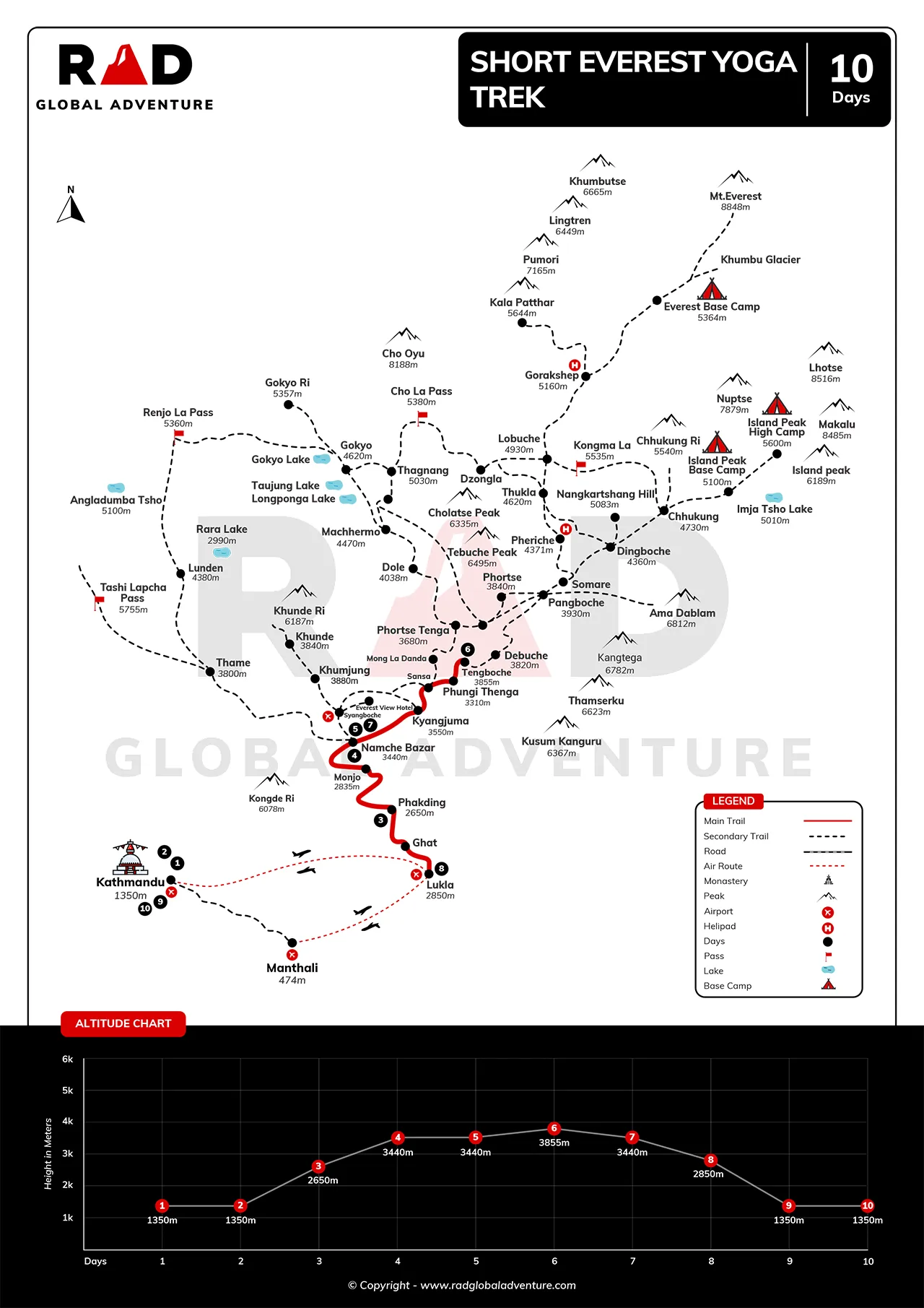
This Short Everest Yoga Trek is rated moderate level of difficulty. Daily hikes take about 3-6 hours on easy-to-use trails through the mountains. You stay in teahouses every night, and you carry only a daypack, and a porter carries your main gear. The highest point is Tengboche at 3,870m (12,700ft), but with acclimatization stops, we climb gradually.
The trek doesn’t involve any technical climbing or exposed terrain, so no special skills are required – just a good pair of boots. The regular yoga sessions help to stretch and strengthen the muscles, which helps in the recovery. In short, expect steady uphill sections, a few river crossings, and a comfortable pace suitable for hikers with basic fitness.
Weather and Best Season
There are different seasons in the Everest region. The best time for this trek is in the spring (March – May) and in the autumn (September – November). In these months, the skies are clear, the weather is stable, and the views of the mountains are spectacular. Daytime temperatures are about 10-20 °C (50-68 degF) with cool nights. The summer months of the monsoon (June – August) bring rain and clouds, which can restrict visibility along trails.
Winter (December – February) is cold, often below freezing at night, and may experience snow on higher trails. Afternoon showers are possible during the shoulder seasons, so bring a lightweight rain jacket.
Travelers on the Short Everest Yoga Trek should pack warm layers: T-shirts and a fleece for sunny hikes, and a down jacket and thermal layers for the cool mornings and evenings. Sunscreen and a sun hat are important throughout the year.
Food & Drink
Mountain teahouses along the trek serve mixed meals – Nepali and western. Typical dishes are dal bhat (lentils and rice), curries, noodles, eggs, and vegetables. High-protein lentil soup provides long-term energy for hiking.
Morning meals are often oatmeal, bread, and eggs. Along the way, there is tea or coffee with every breakfast and tea break. Packable snacks (nuts, granola bars) are useful for extra energy.
Avoid drinking untreated tap water – instead, use bottled or boiled water (available in villages) or purification tablets. Bring a reusable water bottle. Teahouse staff are used to hikers and can accommodate simple dietary needs (vegetarian, etc.), but menus may be limited. Overall, expect simple but nourishing food that keeps trekkers warm and fueled.
Altitude Sickness
Altitude sickness can affect anyone above about 2,500m. On this trek, you gradually ascend to about 3,870m at Tengboche. The typical effects of mild altitude sickness are headache, nausea, dizziness, and fatigue. To reduce the risk, ensure that you consume much water, take it slow, and have an easy time during the first day in the mountains.
An acclimatization day in Namche Bazaar (3,440m/11,286ft) will also be included in the itinerary to aid your body in adapting. Always make sure that you report to your guide if you feel unwell. They will promote additional relaxation or reduced speed where necessary.
If symptoms worsen (severe headache, shortness of breath), descend to a lower altitude immediately. Most trekkers on this beginner-friendly trek experience only mild discomfort that passes with rest.
Taking prophylactic altitude medicine (like acetazolamide) is optional – discuss it with your doctor. The combination of steady hiking, rest days, and daily yoga breathing exercises helps keep altitude issues at bay.
Preparation and Fitness
You don’t need to be an athlete, but being in good shape will make the Short Everest Yoga Trek more enjoyable. Aim for regular cardio workouts (brisk walking, jogging, cycling) in the weeks before your trip to build stamina.
Practice taking long hikes or walks on hills while carrying a loaded daypack. Don’t skip the yoga classes now, as they will boost your flexibility and core strength – a bonus for trekking. If possible, do some training with uphill climbs or stair-climbing.
Most important is an optimistic attitude: the daily hikes are well-paced and the guide sets a comfortable speed for the group. You’ll spend 3-6 hours walking each day, followed by relaxation.
By training physically and mentally, you’ll enjoy every step of the journey and feel confident on the trail. Even beginners who complete a little training are often surprised at how well they can handle the mountain terrain and altitude on this short trek.
Visa and Permits
Most nationalities can get a Nepal visa on arrival at Kathmandu airport. As of 2025, tourist visas cost USD $30 for 15 days, USD $50 for 30 days, and USD $125 for 90 days (fees may change), payable in USD cash. Bring two passport-size photos for faster processing. Make sure that you have at least 6 months’ validity on your passport.
In the Everest region, you need to have an entry permit for Sagarmatha National Park and a local entry permit for Khumbu Pasang Lhamu Rural Municipality. Sagarmatha National Park permits cost around USD $30 (about NPR 3,000), and the Khumbu Pasang Lhamu Rural Municipality permit is also around NPR 3,000 for foreign trekkers; these fees are usually arranged by your trekking operator.
Carry these permits and copies of the passports along with you while undertaking the trek for park checkpoints. Your trekking company will generally take care of the procedure of the park permit and the TIMS card in advance. Always carry with you a photocopy of your passport or a photo ID in case it is needed during the trek.
Health & Safety
Health is a priority for having fun on the trek. Consume bottled or boiled water to avoid stomach problems, and have a personal first-aid kit to treat minor injuries or pains. Wear sunscreen of high SPF and wear UV-blocking sunglasses because the sun is more intense at the elevations. Mosquitoes are not an issue at higher elevations, so you don’t need mosquito nets.
Ensure routine vaccines are up to date (tetanus, polio, etc.). In Kathmandu, eat from reputable places to avoid food poisoning. Overall, Nepal is generally safe, and people are friendly. Follow your guide’s instructions (e.g., on river crossings, trail safety) and hike in the group. Avoid walking alone after dark.
It’s wise to have a photocopy of your passport with you at all times. Traffic in Kathmandu can be busy and chaotic; always use seat belts in vehicles. By taking these standard precautions and listening to your guide, you’ll have a safe and smooth experience in the mountains.
Transportation
On this trip, transportation includes domestic flights and local ground transfers. You will fly between Kathmandu and Lukla at the start and end of the trek (approximately 35 minutes each way). These small-plane flights are scenic but can be delayed by mountain weather – patience is important.
In Kathmandu, you’ll travel by private taxi or van between the airport and hotel. Within the trek itself, all travel is on foot through Sherpa villages and valleys. Your large duffel bags are carried by porters.
In case Lukla flights are canceled due to fog, flights may be rerouted via Ramechhap (about a 4–5 hour drive east of Kathmandu). Rest assured, RAD Global Adventure handles all transfers and logistics, so you only need to focus on trekking and yoga.
Travel Insurance
Travel insurance is a must on this trek. Your policy should specifically cover high altitude trekking up to at least 4,000m as well as emergency medical evacuation. Helicopter rescue is costly, but critical if someone cannot make it any further. Standard travel policies do not usually cover the mountains by default – ensure that you add mountain rescue coverage.
Bring a printed-out copy (or screenshot) of your insurance policy and emergency number. Medical care in the Everest region is very basic. You should know that insurance will give you peace of mind, knowing that you can get help if needed.
Remember, travel insurance is not part of the cost of the trip, so ensure that you look into this prior to departure. Once you have suitable coverage, you can relax and just enjoy the trek.
Alternative Routes
If you have extra days or wish to experience the Everest region in a different way, there are quite a few great alternatives to choose from. The classical Everest Base Camp trek lasts about two weeks and will allow you more time to enjoy the views of the high mountains and the famous Everest Base Camp famous Kalapatthar viewpoint.
Another beautiful option is the Gokyo Lakes trek, which takes you to a row of turquoise glacial lakes and the summit of Gokyo Ri for a beautiful view of Everest from a different angle.
For something gentler and closer to Kathmandu, the Langtang Valley Yoga Trek offers peaceful days of walking, stretching, and enjoying the mountain scenery at a lower altitude. If trekking is not your preference, you can also go on a scenic helicopter tour instead.
Many travellers opt for a one-day experience of a helicopter flight to Everest Base Camp or other high viewpoints. These options offer you a lot of flexibility, and you can select what best fits your time, fitness level, and travel style. Each route reveals a different side of the Himalayas.
Your Extra Expenses
Although most of the major costs are already covered in your trek package, it is good to plan for a few expenses on your way. Drinks such as bottled water, soda, or alcohol are not covered, so you may want to purchase boiled water in the teahouses or purification tablets for safety. Many Teahouses also have small fees for hot showers or WiFi, and the internet might be slow, but still useful for quick messages.
Tipping your guide and porter is a normal part of the trekking culture in Nepal, and most trekkers pitch in a little bit at the end to thank the team for their help. You might want to buy snacks, chocolate, batteries, or small souvenirs in places like Namche, so it’s handy to have a little extra cash.
If you come to Nepal without some of the basic necessities, you can rent or purchase them in Kathmandu, for example sleeping bag, a warm jacket, or trekking poles.
Finally, it is a good idea to have a bit of extra cash with you in case your trip is delayed due to the weather, particularly in case flights in or out of Lukla are cancelled. Having a couple of hundred dollars as a backup makes the whole experience smoother and worry-free.
Language & Communication
Nepali (Devanagari script) is the official language. In the Everest region, Sherpa people speak Sherpa (a Tibetan dialect) and Nepali. However, guides and teahouse staff speak good English, especially on trekking routes. Namaste is the common greeting (press palms together). You will get by easily with English; learning simple Nepali phrases (thank you, hello) can be fun, but it isn’t necessary.
Nepal’s currency is the Nepalese Rupee (NPR). You can exchange USD in Kathmandu or use ATMs there. On the trek, only small shops in Namche Bazaar may accept credit cards, but most places are cash-only.
Carry enough NPR for personal spending, tipping, and souvenirs. Telephone coverage is limited – hand-off details can be arranged once you’re back to civilization. In summary, communicating is straightforward, and locals are very welcoming to visitors.
Mobile Network, Internet & Charging
You can expect mobile signal in most main villages along the Everest trail, especially places like Lukla, Namche, and Tengboche. Nepal Telecom and Ncell both operate in the area; however, the connection may drop when you enter deep valleys or forested areas. If you need data, you can purchase a local SIM card in Kathmandu, although the speed will be slow and unreliable the higher you go.
The internet is available in some teahouses for a small fee. In Namche, for example, you can purchase an Everest Link card giving limited access to WiFi. It works, but it can be slow and sometimes expensive. So it is better to expect very basic connectivity and not to rely on daily online communication.
Most teahouses allow you to charge your devices, but they often charge a small fee for electricity. It is a good idea to bring along a power bank due to the prevalence of power cuts in the mountains.
Solar chargers are functional on sunny days without clouds. Make sure you have all of the charging cables you need, and try to save your battery for important use, as electricity may be limited in higher altitudes.
Don’ts on this trip
There are a couple of things that you should avoid during this trip so that you can travel responsibly and respectfully. Try not to use single-use plastics, as many areas in the mountains in Nepal do not allow plastic bottles and bags. Carrying around a reusable water bottle is the best option.
Please do not fly drones without a special permit because they are not permitted inside the Sagarmatha National Park, and noise can disturb the animals and monasteries. When you are walking through villages, be aware of the local culture.
Ask before taking photos of people and dress modestly, and behave while around shrines and prayer wheels. For your safety and the environment, stay on the marked trails and don’t go off on your own. By following these “don’ts,” you show respect for the environment and local customs, making your journey smoother and more meaningful.
Is this trip beginner-friendly?
Yes. The Short Everest Yoga Trek is specifically aimed at hikers with little or no high-altitude experience. The daily treks are fairly short (3–6 hours) on well-trodden paths. You climb gradually, with acclimatization stops (like spending an extra day in Namche Bazaar) to minimize altitude stress.
There are no technical sections or dangerous exposure. Each day includes yoga sessions to help your muscles recover. Experienced guides set a comfortable pace, and teahouses at night mean you don’t carry heavy equipment.
If you can walk 5–6 hours a day at home, you’ll likely handle this trek fine. Many participants have been first-time trekkers or casual hikers. As long as you have a reasonable level of fitness (cardio workouts before travel are helpful) and the willingness to adjust to slower mountain hiking speeds, you will enjoy the journey. The structured schedule of hiking, rest, and yoga ensures that even beginners can succeed and feel proud of completing the trek.
Photography & Drone Rules
Photography is not only allowed but also enjoyed on this Short Everest Yoga Trek. Take landscapes, villages, and monasteries, you are welcome to do it, only remember to ask people before taking pictures of them. There are, however, certain limitations. Drones are highly controlled in Nepal, particularly in the Everest National Park (Sagarmatha).
No unlicensed flights of drones; in order to fly a drone, you would have to seek a special permit from the Civil Aviation Authority of Nepal and the government of Nepal national parks beforehand. It’s safest to leave drones at home. When it comes to people and temples, please be respectful. Inside monasteries (like Tengboche), photography is usually prohibited; simply enjoy the experience.
Also, be mindful during yoga and cultural ceremonies – sometimes it’s best to just participate rather than take pictures. In general, feel free to take stunning photos of the scenery and village life.
Colorful culture and beautiful mountains may be excellent on camera, yet never disrespect: do not take pictures without permission and pay attention to any rules in religious places. Your guide can suggest in case you are not sure. Through courtesy, you can have a great time and at the same time respect local traditions.
Cultural Festivals on the Trail
If your trek dates align, you can witness fascinating Sherpa festivals. The two major events in the Everest region are Losar and Mani Rimdu. Losar (Tibetan New Year, usually in Jan–Feb) is celebrated by Sherpas with dances, feasting, and new-year rituals. Namche Bazaar and other villages often hold small Losar festivities with traditional songs and attire.
Mani Rimdu is a colorful 2–3 day festival of masked dances and blessings held at Tengboche Monastery in autumn (around Oct–Nov, dates follow the Tibetan lunar calendar). It draws villagers from all over who join in prayer rituals and masked performances by the monks.
There are other occasions too: the Sagarmatha (Everest) Festival in May is a celebration of the national park’s creation, featuring music, archery, and cultural programs in Namche. Even if you don’t hit a festival, the trail has its own ceremonies – prayer ceremonies happen in monasteries quite often.
Nepali national holidays (like Dashain or Tihar in Oct–Nov) might not be celebrated in the mountains, but you’ll see festive lights in cities. If you’re lucky to trek during a festival, it’s a unique treat; if not, you’ll still experience local culture through daily life, prayer flags, and warm Sherpa hospitality every day.
Tips for First-Time Nepal Visitors
Welcome to Nepal! For first-time visitors, here are some practical tips: Pack clothing in layers – it can be hot during day hikes and cold at night. Also carry sunscreen and a warm hat. Be conscious of local culture: never enter monasteries or temples without taking off shoes, and wear modest clothes in villages (a knee-length and shoulders robe is always nice).
Know some Nepali words, such as Namaste (hellohandshake) and Dhanyabad (thank you) – people will be glad to hear the attempt, but English is frequently used in the tourist hubs. Local purchases can be made in Nepalese rupees; there are plenty of ATMs in Kathmandu, but they are unreliable on the trail itself, so always carry cash.
Familiarize yourself with common Nepali foods (dal bhat, momos) and try to keep an open mind. Be ready for slow and unpredictable aspects: Nepali government offices (for permits) can be technical, and mountain flights depend on the weather. Maintain flexibility: if a flight is delayed, it’s part of the experience. Lastly, allow yourself to live the local lifestyle.
The road in Kathmandu may be a busy one, and you had better cross the streets. Use hot lemon-ginger tea or local juices to remain healthy. Having an open mind and a respectful attitude will make you easily fit in and enjoy all that Nepal has to offer in this trek.
Everyday Routine of the Trip
Every day tends to have a regular routine. You will also wake up early at approximately 6-7 am and do morning yoga and meditation (around 30-60 minutes). The breakfast is offered approximately at 7-8 am at the teahouse. We will enter the trail at 8-9 am and walk steadily till midday.
We will take lunch at midday (or 1 pm) at a teahouse along the path (generally 1-1.5 hours). Lunch is followed by hiking till mid-afternoon (mostly by 34pm). Later in the afternoon, we may have a rest, tea or snacks, and possibly a short walk. Dinner will be served at about 6 pm, and at night with an evening meditation or yoga stretch (particularly on rest days).
Then you can rest next to the fireplace in the teahouse, talk to the other trekkers or people in the area, and go to bed early (around 8-9 pm) and sleep well. On an acclimatizing/rest day, you may rise somewhat later (78am) and have more things to do, such as sightseeing, little hikes offered as optional, or even meditation. In Kathmandu and Lukla, the schedule is not so strict (no trekking that day).
The evening before each guide will provide you with a rough plan, which can be altered by weather or group requirements. On the whole, the arrangement is similar: yoga and breakfast, morning walk, lunch break, afternoon walk, yoga evening, and dinner. This rhythm is a perfect combination of hard work and rest.
Mental Preparation & Mindset
It is equally important to prepare mentally, like physically. The high altitude trek involves being patient and persevering, and having a positive attitude. Aim to know that not all days are going to be like clockwork, flights can be delayed, the weather can change, or a trail might be a trail longer than you thought it would be.
At this point, keep in mind the reason why you have come: scenic views, cultural attractions, and the adventure of challenge. Has a sense of humor and keeps an open mind. Don’t overestimate yourself: you will get some fatiguing days, and the altitude might prove worse than life in the city, but that is normal. Embrace the slower pace.
Learn to celebrate small goals (with every village you enter, with every new peak you can see). Mental exercises, yoga, and meditation are useful, although they not only stretch the body, but also relax the mind and allow you to focus on the moment. Travel at your own pace: in Nepal, plans can change, and you should be flexible.
Lastly, interact with other trekkers and locals; exchange memories and support, since it feels more comfortable on the trip. Remaining positive, honoring your body, and enjoying every move and every stretch will get you to the finish line with a stronger body and soul.
 English
 Dutch
Dutch Japanese
 Hindi
Hindi Italian
 Spanish
 French
 German
 Chinese
 Korean
 Arabic
 Hebrew
 Russian
 Portuguese
 Danish
 Czech
Czech Polish
 Swedish