Trek Difficulty
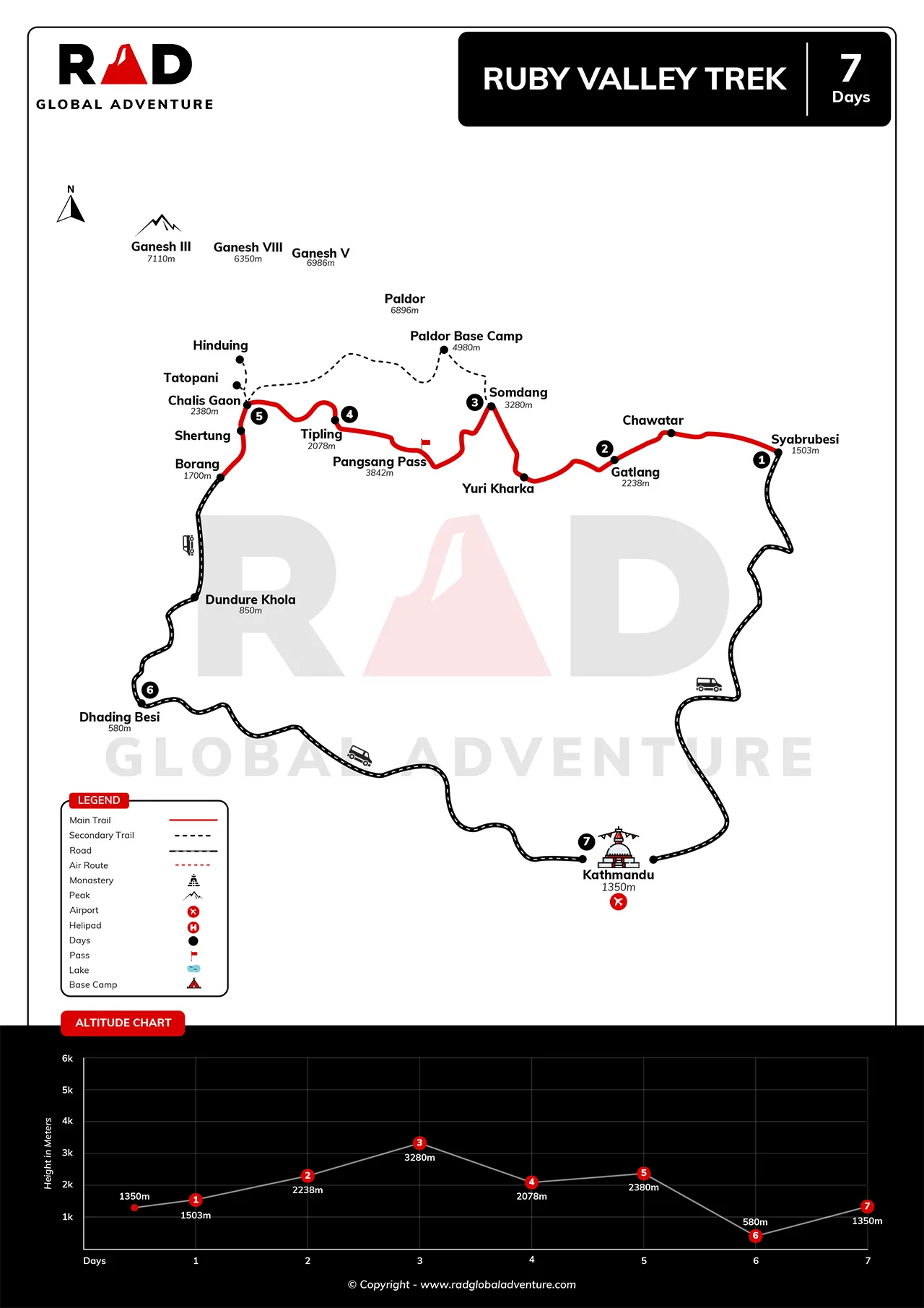
The trek in the Ruby Valley is a moderate one. The path also contains a fair share of lengthy ascending stages like the track to Pangsang La Pass at 3,842 meters (12,602 feet), though much higher altitudes of the higher Himalayan treks are not present.
One should be of good fitness, and some trekking experience will be required. The walkers should be comfortable with walking 5-7 hours a day over a rugged path.
The diverse up and down hikes contribute towards acclimatization, even though the lengthy walking days may be exhausting. Footwear, trekking poles, and a daypack that is easy to manage are necessary. Generally, the hike is moderately challenging, but it can be completed by those with adequate preparation who are interested in active travel.
Weather and Best Season
The most favorable months to take the trek in the Ruby Valley would be during the spring (March-May) and the autumn (September-November), when the skies are clear, and the mountain scenery is breathtaking.
During monsoon summer (June-August), it rains heavily, so the trails are slippery and leeches are present, whereas during winter (December-February), it may be cold and snow may form at the higher altitudes.
Daily temperatures tend to be warm during the valleys and cool during the nights in certain areas, such as passes, such as Pangsang La, which is 3,842 meters (12,602 feet) above sea level.
Layered clothes allow one to cope with the temperature changes. Spring, with blooming rhododendron flowers, and autumn with crisp air, are two of the most beautiful.
Food & Drink
Food on the Ruby Valley trek is mostly traditional Nepali food, which is served in the local lodges. It also serves breakfast, lunch, and dinner, including dal bhat, curries, noodles, eggs, and vegetables of the season.
Villages on the way usually have fresh produce. It is essential to remain hydrated, so that any boiled water or filtered water is usually available, but it is advisable to have purification tablets. It is advised to limit alcohol, caffeine, and dairy in higher altitudes.
Fruits, chocolate, and snacks such as biscuits are served in bigger villages and give people energy to travel long distances on a trek.
Altitude Sickness
Pangsang La Pass is the peak of the trek, which lies at 3,842 meters (12,602 feet). Altitude sickness is uncommon but can occur it is on higher Himalayan routes. It is best to go slowly to avoid risk, ensure that one drinks water, and take breaks when necessary.
To respond to the symptoms connected to the ailment, such as headache or nausea, guides have simple first-aid packs and pulse meters to check the oxygen saturation. You should report at once if you feel sick. Through slow and steady progress, the challenges of the altitude can be managed on this moderately challenging hike.
Preparation and Fitness
It is essential to be physically ready to have a good time with the Ruby Valley trek. Cardio exercises are taken routinely, combined with leg strengthening exercises and practice hikes (daypack) to increase endurance for 5-7 hour walks over hilly terrain.
Increases in conditioning of 3-4 hours before take off should be offered. Arriving at the trek in a relaxed and relatively physically fit state guarantees greater strength and pleasure. Comfort is enhanced by the use of proper footwear, trekking poles, and a light daypack. Pre-trek training helps to decrease fatigue and increase the experience on this medium trail.
Visa and Permits
A tourist visa to Nepal is required for all foreigners except Indians. Other foreigners can obtain it on arrival at Kathmandu Airport with 2 passport photos and a fee of USD 50 in order to stay in Nepal for 30 days.
The trek in the Ruby Valley also needs a Langtang National Park entry permit and a Trekking Inverted Media (TIMS) card to trek into the protected areas. The trekking firm does everything related to permits, and all the travelers need to do is ensure they send copies of their passports beforehand.
It is also necessary to have such documents with you when trekking, since the officials might be inspecting permits along the way.
Health & Safety
Full travel insurance is required and should include helicopter rescue up to a maximum of 4,000 meters (13,123 feet). Always bring some personal items and a first aid kit. Health is mostly affected by altitude, and thus, continue to report symptoms promptly. Animal dangers are also limited because tigers and leopards are very uncommon, and they will never leave your group.
Time spent at lodges is simple, and therefore, water and food hygiene should be observed in order to prevent illness. Prudent personal care (following guide advice and exercising good personal care) keeps the risks down to a minimum and makes the trek in the remote Ruby Valley an enjoyable and safe event.
Transportation
The Ruby Valley trek starts with a 7-9-hour bus or jeep ride from Kathmandu to Syabrubesi at 1,503 meters (4,931 feet). It is a picturesque road that passes through Trisuli Bazaar, Dhunche, and Langtang Park and is about 120km long.
When you are through with the trek, you are carried to Dhading Besi by a jeep at the end of this trek, and then by a bus (4-5 hours) back to Kathmandu.
To make the whole experience comfortable, a private vehicle can be arranged at an additional fee. The surface of the road is coarse yet easily passable, and one has time to see rivers, terraced slopes, and mountains on the path.
Travel Insurance
Medical evacuation travel insurance is necessary when doing the Ruby Valley trek, ideally up to 4,000 meters (13,123 feet). Never forget helicopter rescue, it is the only quick method of escape in high terrain that is far.
The trek package does not come with insurance, and it should be purchased by the traveler in advance. Having adequate coverage is a relief in that case of any medical emergency or any other accidents in remote locations, the situation can be addressed without undue risk or procrastination.
Alternative Routes
The usual program is based on the Ruby Valley loop, which could be extended. Ganges Himal Base Camp can be added by trekkers either at one end, or built up with other treks, or can also be included with other touring options, such as a Chitwan jungle safari. The walk is also possible in reverse, beginning and finishing at Dhading Besi.
The adjustments will involve permit and logistical changes, which the trekking company will be able to handle. These packages can be personalized, whether based on time, interest, or fitness level, without getting a core experience of the Ruby Valley.
Your Extra Expenses
Extras are personal expenses, including snacks, hot showers, soft drinks, souvenirs, and tips. Shoe-string $15 USD in incidentals. Lodges can take a little charge in electricity and wifi. Guiders and porters are expected to receive voluntary tips.
Other expenses are Kathmandu hotel nights, Visa, and Rental Gear. Any payment occurring in the trekking areas should be paid in Nepali Rupees; hence, carry enough cash. It is necessary to plan these additional expenses and be able to make a pleasant and comfortable journey without any surprises.
Language & Communication
The official language is Nepali, but in the remote villages, they use Tamang, Gurung, or dialects related to Tibetans. Guides, porters, and younger installation villagers are usually conversant in English. It is advisable to purchase a domestic SIM card in Kathmandu beforehand.
It has poor phone coverage with 2G/3G access in bigger villages and signal blackouts beyond approximately 3,000 meters (9,843 feet). Guides call out to clients every day to make sure that they are safe; hence, you can be connected to your team even when in low-signal zones.
Internet, charging, and mobile network
A majority of lodges have charging facilities and Wi-Fi, albeit at a small fee. In such villages as Gatlang and Tipling, there are charging ports, but no outlets are available outside lodges. Keep additional supplies of batteries or a power bank. The Internet is also not fast and is unreliable; hence, do not rely on it.
The expedition is mostly off-road and provides an opportunity to leave the world of technology and the Himalayan environment and be less distracted by the virtual world anywhere on the trip.
Don’ts on This Trip
- Don’t drink untreated water. Always purify or boil mountain water.
- Don’t travel without travel insurance. (Helicopter rescue is vital at high altitude.)
- Don’t wander off alone. Stay with your group and guide.
- Don’t smoke or litter. Help keep villages and trails clean.
- Don’t disrespect local customs. Always ask before photographing people or temples.
- Don’t overpack. Keep your daypack light; porters carry the heavy bags (up to 9kg each).
Is this Beginner-Friendly Trek?
Ruby Valley is a moderate-level trek, so it is not very demanding, and adventure can be engaged in doing this trek. In this case, there is no experience in high-altitude trekking skills, and a good level of fitness is suggested. The trail remains mostly under 3,000 meters, including the day crossing of Pangsang La Pass.
The trek should be manageable by Trekkers with a comfortable hiking distance of 6-7 hours in hilly terrain with frequent rests. This is the best experience in the first high altitude trek due to the moderate altitude, silent trails, and at your own speed under the supervision of an experienced trekking guide.
The trek is a journey of adventure and an opportunity to spend time in the Himalayas without being unnerved or hurried by the time it is over.
Group Joining vs Private Trips
Ruby Valley is a privately run venue. This involves walking with your own group and a headman who is not mixed up in large groups. Otherwise, private trips provide the flexibility of the schedule, pace, and itinerary. Guides will offer personalized service, which will be adapted to your needs or stamina.
Conversely, here they do not provide group-joining tours in which trekkers are a combination of a fixed departure. A private trip is a better choice because you get to spend more time with them and get to know them better, and they can actually give you the attention it deserves, as they can spend time and see the sights and the villages with you.
Trip Extensions
The combination of the Ruby Valley trek and other experiences in Nepal is possible with ease. Most trekkers supplement their trip with a Chitwan jungle safari, Kathmandu Valley sightseeing and culture tour, Pokhara sightseeing, or further treks like Everest View or Annapurna circuits. It is also possible to organize scenic flights or helicopter rides.
These extensions are flexible and can be offered through private trekking, which depends on your interests and time. In case you are interested in spending an extra couple of days sightseeing in Nepal cities or spending the extra time in the other parts of the Himalayas, the itinerary can be tailored to your needs.
Solo Trekking
This is also an adventure that is good when an individual wants to walk alone. As all the departures are exclusive, one will be able to rent the adventure individually, so the guide will pay individual attention to the customer. Another guest can share a porter in case it is free.
Ruby Valley can be safely visited on a solo trek, as it allows one the liberty to concentrate on the self-experience, yet the presence of an adept guide ensures the availability of support. Being a small and intimate trek, one can easily balance her solitude and social life at the homestays in the villages.
Photography and Drone Regulations
The Ruby Valley trek is highly photographic and has camera-perfect landscapes. Trekkers are at liberty to make shots on the path. Nonetheless, strict permission has to be issued by the Civil Aviation Authority to the drones in Nepal, particularly around trekking trails and conservation zones.
The drones should not exceed a height of 120 meters. Provided there are drones involved, the permits must be organized long beforehand. To the majority of travellers, a good camera is enough to remember the breathtaking scenery. There is a mixture of forests, meadows, rivers, and high mountains daily, which contribute to the variety and stunning photography.
Cultural Festivals along the Trail
Villages in Nepal have a great number of festivals. During the trek of the Ruby Valley, you can also experience the Tibetan New Year- Losar, in the Tamang and Gurung villages, unless you are travelling during January or February. Dashain and Tihar are great Hindu festivals, which are celebrated in October and November.
Other minor pujas and ritual dances are also held in smaller villages. In case your expedition takes place during a festival, you can be involved in the celebrations of the villagers, becoming better acquainted with their traditions.
Although no festival currently takes place, the cultural richness is still present in everyday life, whether it is the flags of prayer and monastery bells or rituals and community meetings of the villages.
Tips for First-Time Nepal Visitors
Nepal is very affordable and secure, on the other hand, where middle-income travelers spend about 30-60 dollars per day. Nepalese people are easy-going and friendly, and even a simple greeting such as Namaste will get you a long way. Watch traffic, particularly in such cities as Kathmandu and Pokhara, and watch crowds.
Wear simple clothes out in the tourist destinations, do not take tap water, and use bottled or filtered water. Try the local food, such as dal bhat and fresh Nepali cuisine, and think about purchasing a local SIM card to stay connected.
By thinking and strategizing in advance, adhering to the customs, and being patient in using the services that are slower, you will experience smooth sailing in the services.
Typical Daily Routine
The days regarding the Ruby Valley trek typically begin at about 6-7 AM in the morning with breakfast taken at the lodge. Once warmed up or chatting by the fire, trekking will then commence, lasting 3-4 hours, then lunch is given at a lodge or packed stop, after which people take time to rest and rehydrate.
The second part of the afternoon is 2-3 hours of hiking to the next village in the middle or at the end of the afternoon. They have evenings when nothing is announced, and they get time to shower and eat, mostly at 7 PM. The next day is briefed by the guides, and lights-out is generally at around 9-10 PM, to get the days off properly timed.
This schedule provides a mix of hiking, resting, and cultural engagement while maintaining the energy levels at the optimum level.
Mental Preparation and Trekking Mentalities
Hiking is not only a physical matter, but also a matter of the mind. There are also long durations of isolation and times of exhaustion. Establish small but achievable daily targets to divide the trek into small, reachable bits, like getting to the next village or a pass.
When mountain climbing or in bad weather, avoid focusing on the difficult situation but on the surroundings or the milestone that is coming. Or go simple and the road less travelled, with little hot water and other amenities.
One must be positive, patient, and flexible. This is not just physical achievement, but also to relax, engage in introspection of the culture, and relate with nature. Every single valley, smiling face, and scenic view makes the mental and emotional experience worthwhile.
 English
 Dutch
Dutch Japanese
 Hindi
Hindi Italian
 Spanish
 French
 German
 Chinese
 Korean
 Arabic
 Hebrew
 Russian
 Portuguese
 Danish
 Czech
Czech Polish
 Swedish