expert-image
Talk to a Travel Expert +977 9818264758

Booking open for Nepal Trek 2025 & 2026

View Details
Pikey Peak Trek

Pikey Peak Trek

Based on 25 reviews
duration
Duration

9 Days

difficulty
Trip Difficulty

Moderate

max-altitude
Max. Altitude

4,065m

destination
Destination

Nepal

group-size
Group Size

2-16 People

meals
Meals

Breakfast, Lunch & Dinner

accommodation
Accommodation

Hotel, Teahouse

expert-image
Need Help? Ask to Travel Expert
Get a Trip Quote Customize This Trip Make an Inquiry
  • Best Deal
  • Flexible Schedule
  • Instant Booking
  • No Hidden Costs
trip-advisor
5.0
25 reviews

Overview of Pikey Peak Trek

The Pikey Peak Trek is a nine-day Himalayan adventure which combines high altitude panoramas and genuine cultural experiences. This trail will take you into the Solu south of Everest, a region that Sir Edmund Hillary loved. As soon as you leave the busy and noisy city of Kathmandu, you go into a quieter world of rhododendron forests, terraced hillsides and rushing rivers. Each turn reveals new views, villages nestled beneath towering ridges, yaks grazing on alpine meadows and prayer flags flying in the wind. The trek ends at Pikey Peak summit at 4,065 m, a viewpoint that offers a 360-degree panorama of giants like Everest, Makalu and Kanchenjunga.

The Pikey Peak Trek is not just a climb, it’s about experiencing Sherpa life up close. We will stay in family owned teahouses, meals of dalbhat, momos and Sherpa stew and visit monasteries with their ancient murals and prayer wheels. Thupten Chyoling Monastery at Junbesi and Chiwong Monastery standing high above Phaplu welcome trekkers to get an insight into Tibetan Buddhism and local traditions. Since this route remains at a lower altitude than many Himalayan treks, it is suitable for beginners while it still offers the great views of the mountains. With road connections to the start and finish points, you avoid the flight uncertainties of Lukla and complete the trek comfortably in just over a week.

Good To Know

The Pikey Peak Trek is considered moderate in difficulty. Daily treks range from 8–15 kilometers with 400–800 m of ascent. Trails consist of both smooth dirt tracks as well as rocky, tree-rooted tracks; some steep ascents are challenging for stamina, especially near Pikey base camp. No technical climbing skills are required but a basic measure of fitness and positive attitude is recommended. Breaks are scheduled frequently to rest, take pictures and adjust to altitude. Hikers who exercise regularly and are able to carry a daypack will comfortably handle the route.

Food along the Pikey Peak Trek is very hearty and nourishing. Breakfasts usually contain porridge, pancakes, omelettes, Tibetan bread with tea or coffee. For Lunch and dinner they have dalbhat (steamed rice, lentil soup and seasonal vegetables), chow mein, thukpa (noodle soup), fried rice, potato etc. Rildok (mashed potato soup) and shapta (spicy meat) can be found in some teahouses. Teahouses can adjust to dietary needs, with plenty of options for vegetarians and vegans.

Trekkers are advised to carry water purification tablets or filter because plastic bottles are expensive and are harmful to nature. To support proper acclimatization, trekkers are strongly advised to avoid alcohol and tobacco. Both can dehydrate the body, interfere with sleep, and reduce your ability to adapt to high altitude.

Although the highest altitude is 4,065 m, serious AMS is rare but still possible. Symptoms like headache, nausea and dizziness indicate the need to rest or descend. Our Pikey Peak Trek itinerary follows a gradual ascent, so it allows acclimatization. Since most trekkers descend from the 4,065 m summit back to around 3,500 m on the same day, the risk of serious AMS is further reduced.

Drink at least three to four liters of water every day, consume carbohydrate-rich meals and don’t climb too steeply. Consult your doctor before using preventive drugs such as acetazolamide before you go for a Pikey Peak Trek. If severe symptoms develop, descend immediately. Our guides continuously monitor your health during the trek and use pulse oximeters to check oxygen levels. Always follow their advice, as they are trained to recognize early signs of altitude sickness.

Training starts two to three months before leaving for Pikey Peak Trek. Concentrate on cardiovascular fitness like hiking, jogging, cycling or swimming. Strengthen your legs and your core by climbing stairs, performing lunges, squats and planks. Practice walking with a heavy backpack to simulate the trek. Mental preparation is equally important, anticipation of early starts; simple food, basic accommodation and unpredictable weather help build patience and flexibility.

Most travelers receive a 15 to 30 day tourist visa on arrival at Kathmandu. Bring passport photos, completed immigration form and USD cash for fees. For the Pikey Peak Trek, permits depend on the starting route: from Dhap, only a local (municipality) permit is required; from Jiri/Shivalaya, both the Gaurishankar Conservation Area Permit (GCAP) and a local permit are required; and if the route enters Sagarmatha National Park, then a Sagarmatha National Park Entry Permit is also needed.

Bring copies of your passport and permits with you at all times, as they might check on the way. Trekking with a licensed guide makes the process easier since the agencies handle the paperwork.

Accommodation at Pikey Peak Trek is in simple teahouses with twin beds and common toilets. A sleeping bag rated to at least 0°C is recommended for extra warmth. Guides carry first aid kits painkillers, rehydration salts, bandages and blister treatment are available when needed.

Sunscreen, lip balm and sunglasses are useful as it protects from the strong sunlight at altitude. Trekkers with pre-existing conditions should see their doctor and carry prescribed drugs. Comprehensive high altitude trekking insurance including helicopter evacuation is required.

The convenient way to reach this trek is via road which further means the flights are not needed. From Kathmandu, a shared jeep takes about seven to eight hours to cover the 248 km long journey to Dhap with the Sunkoshi River and gradually climbing its way into the hills.

At the end of the trek in Phaplu, you can return to Kathmandu by jeep (around eight to nine hours) or by short flight (if available). Please consider that the roads are sometimes rough and dusty so motion sickness medication may be useful. For more luxury, you can also prefer a private vehicle, which will give you more freedom with rest breaks and capture photos during the journey.

Mobile coverage along the Pikey Peak Trek improves each year but remains inconsistent. NTC and Ncell network is available intermittently in larger villages such as Jhapre, Junbesi and Phaplu. Some lodges also offer paid Wi-Fi, which is usually enough to message and do light browsing, but not so much to stream or upload large files. As the supply of electricity can be uncertain, it is recommended to carry a power bank or solar charger. Charging services are available at most lodges; the fee typically ranges from NPR 200-600 per device, and in some high altitude or remote lodges up to NPR 700+, depending on altitude and lodge amenities.

Adventurous trekkers can extend the Pikey Peak Trek in many ways. One of the routes begins in Jiri, and follows the classic trekking route to Everest, passing through agricultural villages. Another continues from Junbesi to Namche Bazaar and further on to Everest Base Camp, which takes another week or more. Trekkers can also combine the trek with a visit to Dudh Kunda, a sacred alpine lake, or the Numbur Cheese Circuit for further exploration of Solu’s natural landscapes.

While most trekking packages include accommodation and three meals per day, personal costs can add up. Teahouse rooms range from USD 5–15 which is about NPR 700–2,100, and meals typically cost USD 5–10 which is about NPR 700–1,400. Snacks such as hot drinks and safe drinking water (using purification tablets or filtered water) can add to the costs. Charging electronic devices, hot showers and Wi-Fi typically cost USD 2–5 which is about NPR 280–700 per use. Bring sufficient cash in Nepali rupees, as there are no ATMs along the trail.

Detail Itinerary

Your Pikey Peak Trek starts with your arrival at Kathmandu Tribhuvan International Airport. A representative of RAD Global Adventure is waiting to greet you outside with a sign bearing your name. Once the immigration formalities are done, you drive to your hotel in a private vehicle, a ride that will take 15-20minutes depending on the traffic.

The afternoon is then free to relax after the journey. You can take a walk down the bustling streets of Thamel, where we will find trekking establishments, cafes and handicraft stores. You can visit the close-by attractions like Durbar Square or Boudhanath Stupa. At night, join your guide and other trekking staff in briefing about the Pikey Peak Trek itinerary. In this session we will check equipment, review the acclimatization plans and learn about the culture and trek plan. Local restaurant Dinner is a way to familiarize with Nepali cuisine.

meal-small

Meal: Dinner

altitude-small

Max Altitude: 1,400m/4,593ft. ()

If our standard itinerary doesn't fully meet your needs, we are happy to tailor it to your specific preferences and requirements.

Includes and Excludes

What’s Included?

Transportation

  • International airport transfers
  • Private vehicle drive Kathmandu – Dhap & Phaplu – Kathmandu

Food and Accommodation

  • Full meals: breakfast, lunch & dinner on your choice.
  • Supplementary snacks: energy bar and cookies
  • Seasonal fresh fruits deserts every day
  • Unlimited chlorine treated safe drinking water
  • Accommodation: Lodge (twin room)

Guide and Support Staff

  • An experienced english-speaking trekking guide
  • Porter service for luggage (one porter for every two trekkers)

Permit and Expenses

  • Local Municipality Permit
  • Gauri Shankar Conservation Area Permit
  • Trekkers’ Information Management System (TIMS) card
  • All local and government taxes
  • Guide and porter salaries, insurance, equipment, transport, food and lodging

Medical and Gear

  • Oxi-meter: To check , heart rating and oxygen saturation
  • A comprehensive first aid kit
  • Emergency rescue in case of severe illness or injury (costs covered by your insurance)
  • Trekking equipment: down filled sleeping bag, walking poles and duffel bag
  • Free luggage storage in Kathmandu

Others

  • Farewell dinner in Kathmandu
  • Certificate of appreciation
  • Trekking route map and company t-shirt

What is not Included?

International Flights and Visa

  • International flights and visa

Food and Accommodations

  • Meals in Kathmandu (except farewell dinner)
  • Any hotel stays in Kathmandu before or after the trek

Travel and Medical Insurance

  • Comprehensive travel and medical insurance
  • Emergency rescue evacuation

Other Expenses

  • Personal expenses
  • Tips and gratuities
  • Personal trekking equipment
  • Unexpected expenses due to weather, flight cancellations, strikes, or natural causes

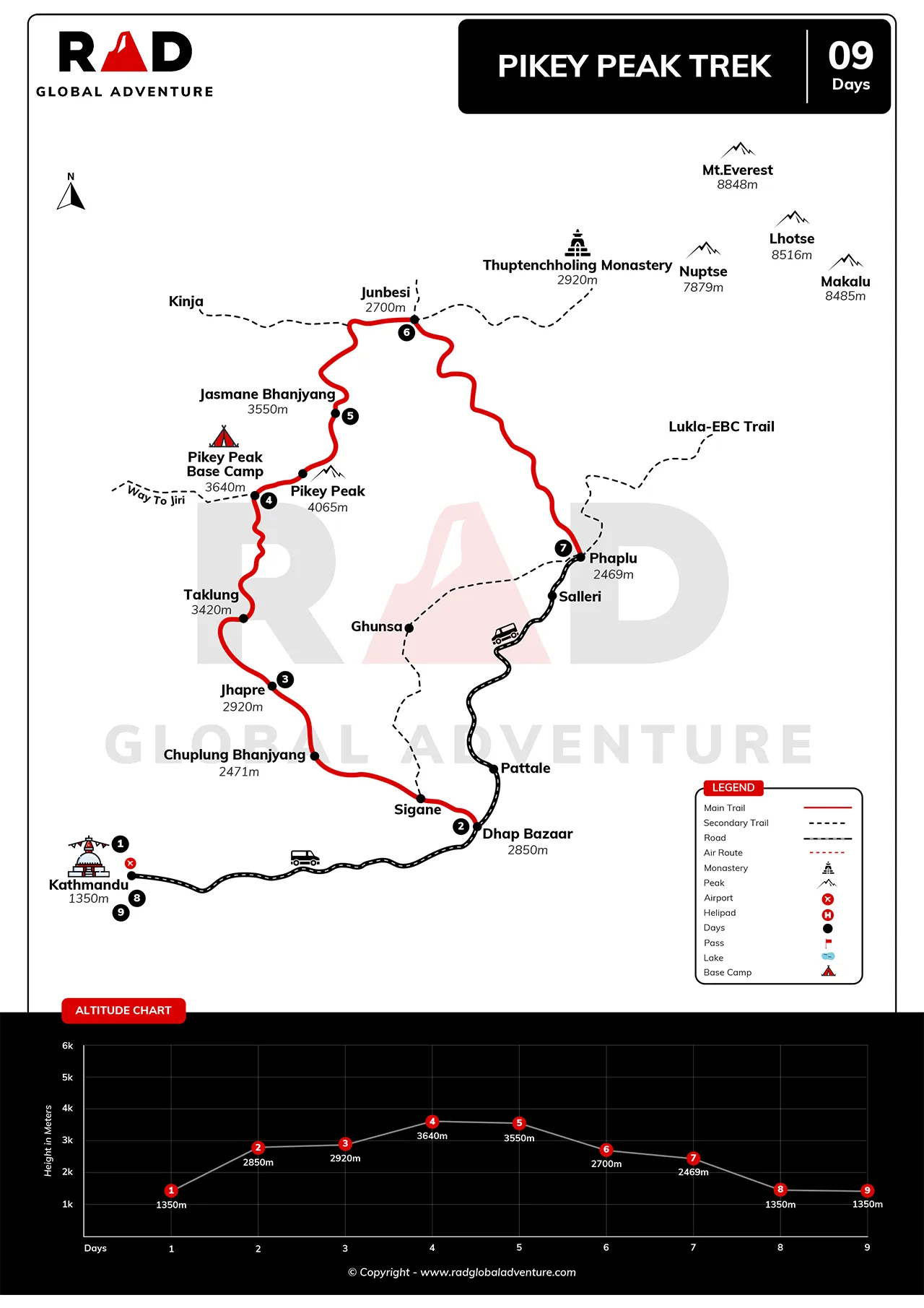
Route Map & Altitude Chart

Attractions and Highlights of Pikey Peak Trek

Scenic Drive Kathmandu – Dhap

Kathmandu to Dhap highway is attraction in itself. Coming out of the city, we will see rice terraces and banana groves. The road goes up through green forests and then transitions to alpine scenery. It is along the Sunkoshi River, which flows down through deep gorges with turquoise-colored water. Tons of people sell fruit by the side of the road and little girls wave at our jeep. Langur monkeys are also spotted in the trees. We usually stop for lunch at Ghurmi. Along the way, we will get our first glimpses at snow-capped mountains.

Tamang and Sherpa Villages with Monasteries

The trekking route goes through Tamang and Sherpa communities. In Tamang villages such as Sigane, houses are made of stone, and decorated with prayer flags. Sherpa villages like Jhapre and Junbesi have monasteries, mani walls and chortens with butter lamps. A visit to these places provides us with an opportunity to learn about Himalayan Buddhism. We can meet villagers, hear folk songs and try butter tea. Homestays and teahouses provide more interaction with the culture.

Forest Trails and Alpine Meadow

The trail winds through a number of natural areas. Lower trails are through pine and sal forests with the chance to see monkeys and birds. Higher up, rhododendrons bloom in spring, and juniper and bamboo add fresh scents. Between Jasmane Bhanjyang and Junbesi, the road passes into wide meadows where yaks graze. In summer the fields are covered in wildflowers and in winter the meadows become snowy white.

Base Camp and Summit Pikey Peak

Base camp at 3,640m has some simple teahouses and open views of the Solu region. At night the sky shines with the stars. The ascent to the summit is a short but steep climb, and usually takes place early in the morning. The mountains are all around at 4,065 m, and prayer flags flap in the wind. From this point, we can see Everest, Makalu, Lhotse, Manaslu, Annapurna and Dhaulagiri. To the south the plains are boundless. This panorama is one of the primary reasons why trekkers prefer the Pikey Peak route.

Sunrise Himalayan Panorama

One of the most memorable options for watching sunrise in Pikey Peak is the view from the peak itself. The sky shifts from dark blue to pink and the peaks are gradually revealed. Soon the sun illuminates Everest, Kanchenjunga, etc. Sir Edmund Hillary once said this was his favorite view of Everest. Eight of the highest mountains in the world can be seen on clear days. Every minute the colors change, so photographers love this spot.

Quiet and Peaceful Route

The Pikey Peak Trek is less popular than the Everest Base Camp trek. We usually walk in silence, only listening to birds and wind. This peace allows more time to meet the local people and enjoy nature. The less traffic also has a positive impact on the environment.

Junbesi village and Monastery

Junbesi is the traditional Sherpa village which has stone houses and prayer flags. It contains the Junbesi Monastery and the Hillary School, which was constructed in the 1960s. Nearby is Thupten Chyoling Monastery where hundreds of monks and nuns reside. It is a special experience to hear them chanting in the monastery hall. Junbesi also has small bookshops, small bakeries, and handicraft stalls.

Cultural and Traditional Practices of the Locals

Along the way, there are mani walls, stupas and prayer flags. Farmers use oxen to plough fields, women weave on handlooms, and children look after animals. Drinking tea with families, eating local food or putting on traditional Sherpa dresses make the experience even more meaningful.

Comfortable Trekking Days

Most trekking days are four to six hours in length though Day 4 and Day 5 are longer and more strenuous compared to others. This offers time to rest, take photos and visit monasteries. There are also several days before and after the summit to allow for acclimatization. Guides encourage walking at a slow pace which makes the trek easier and safer.

Return Drive Phaplu – Kathmandu

The return journey from Phaplu goes through terraced fields, Sherpa and Rai villages, and views of the disappearing Himalayas. We can stop at Okhaldhunga to have a look at the local markets. Along the Sunkoshi River we can see fishermen cast nets and children play in the water. This last drive is a good time to reflect on your trek before you arrive at Kathmandu.

Trip Information of Pikey Peak Trek

Is this trek suitable for beginners?

Yes. Pikey Peak Trek is ideal for the beginners. The peak height is 4,065 m, which is lower than most other treks. Daily trekking is not too long and does not involve any technical climbing. With basic fitness and a comfortable pace, even families with teenagers can share in this journey.

Private Trek vs Group Trek

A private trek offers flexibility. You can pick the starting date, speed, and can spend more time sightseeing in villages. It is expensive but you will receive more attention. Group trekking is more affordable and enjoyable if you like to meet people. The speed is predetermined and you will share costs with other people.

Trip Extension

If you have more time you can make your trek longer. From Junbesi, the route goes north to Namche Bazaar and even Everest Base Camp. It is also possible to start your trip from Jiri for a longer trek through the countryside. Side treks to Dudh Kunda Lake or to Taksindu Monastery are possible. Many trekkers also combine this trek with Chitwan safari or Pokhara to see the lake and for paragliding.

Solo Trek

Though it is possible to do it solo, it is highly recommended to hire a guide. Guides make arrangements for permits; provide orientation and information on local culture. Furthermore, they ease the process of choosing places to stay and keep you safe. Travelling through a guide or group will help local economy and enrich the journey.

Photography & Drone Rules

The trek is good for photography so carry extra batteries and memory cards. Always ask for permission before taking photos of people. Drones need special permission from Civil Aviation Authority and National Parks. Without them, you might have to pay fines or lose your drone. Always respect privacy and wildlife.

Cultural Festivals on the Trail

Festivals make your trek more colorful. Mani Rimdu festival is also celebrated at Chiwong Monastery near Phaplu in autumn. The Tibetan New Year or Losar comes in February or March with feasts and games. In May or June, the Dumji festival is celebrated in honor of Guru Rinpoche with traditional dances and communal feasting. If your trek coincides with this time, it’s well worth staying an extra day or two to experience it.

Tips for First-Time Visitors

Study a little bit about Nepali traditions before your trek. Do not wear a shoe while temple visits, Avoid disposable plastic items such as bottles and bags, and exchange your money in Kathmandu. Bargain nicely in markets, but pay appropriate prices for handmade goods. Always ask before entering homes or taking photos inside monasteries. Use safe water and eat freshly cooked meals to prevent stomach issues.

Daily Routine on the Trek

Each day of trekking is done at a leisurely pace. We generally wake up at about 5.30 or 6.00 AM with a warm cup of tea. After breakfast at 7:00 AM the trek starts when the air is fresh and cool. By mid morning we will stop for a short tea break before continuing on the trail. Lunch is around noon, usually in a village or near a beautiful site. The afternoon walk is lighter and shorter and we normally reach the lodge by early afternoon. This allows us some time to rest, explore the village or simply enjoy the views of the mountains. Dinner is around 7:30 PM and evenings are spent chatting with other trekkers, writing your journal, or gazing up into the clear Himalayan sky.

Mental Preparation

Positive mindset makes the journey easy and pleasant. Be prepared for primitive circumstances like communal bathrooms, simple meals and lack of luxury. Weather in the mountains can be a changing environment, so be flexible and patient with plan changes. Focus on the beauty around you – the sound of prayer wheels turning, the scent of pine forests and the taste of fresh yak cheese. Notice the little things such as children playing in the villages or praying flags floating in the wind. Remember, the journey is not just about standing on the summit, but also about enjoying the culture, nature, and quiet moments along the way. Take your time, breathe the air, and be in the moment and each day will be fulfilling.

Frequently Asked Questions

No. The Pikey Peak Trek is suitable for first-time trekkers who have basic fitness and enthusiasm.

The standard itinerary requires nine days including arrival and departure; walking days span six days.

Aim to carry no more than 7-9kg, including water, snacks, extra clothing and a camera.

Yes. Small shops sell biscuits, chocolate, noodles and soft drinks in villages. Prices rise with altitude.

Sturdy, well-broken-in trekking boots with ankle support are essential. Pack light sandals for evenings.

Limited Wi-Fi is available in larger villages for a fee Mobile network works intermittently.

Yes. You can hike to the cliff-side Chiwong Monastery from Phaplu or explore a cheese factory near Junbesi.

Tipping is discretionary but appreciated. A guideline is USD10 per day for a guide and USD5 per day for a porter, shared among group members.

You may experience light sleep and vivid dreams at higher elevations. Stay hydrated and avoid caffeine late in the day to improve rest.

Hand-woven scarfs, prayer flags, yak cheese and hand-carved wooden crafts make meaningful souvenirs. Always purchase from local artisans.

Trip Reviews

expert-image
Need Help? Ask to Travel Expert
Get a Trip Quote Customize This Trip Make an Inquiry
  • Best Deal
  • Flexible Schedule
  • Instant Booking
  • No Hidden Costs
trip-advisor
5.0
25 reviews