Kathmandu World Heritage Sites of UNESCO
Seven UNESCO World Heritage monuments are located in the Kathmandu Valley, and you will see several of them on this tour. One of the largest stupas in the world, Bouddhanath is home to a large number of pilgrims who walk along the base of the stupa rotating prayer wheels. Pashupatinath Temple is regarded as a Hindu cremation ground and is also helpful for understanding religious rituals.
Newar craftsmanship is found in the intricate temples and royal courtyards of Patan Durbar Square, and Bhaktapur’s palaces and pagodas have the appearance of ancient city states. These sites showcase how architecture, religion, and daily life have intertwined for centuries, making the valley a living museum of Nepalese culture.
Bhaktapur Heritage & Nagarkot Sunset
Bhaktapur, once a flourishing Newar kingdom, remains incredibly intact with cobblestone lanes and ornately carved shrines. The Nyatapola Temple, a five-storey pagoda constructed in 1702, stands proudly above Taumadhi Square. Potters still craft terracotta using traditional methods, and visitors can try their hand at the wheel.
After exploring Bhaktapur drive to Nagarkot, a hill station known for breathtaking Himalayan views. On clear evenings you can see Everest, Langtang, and Dhaulagiri glows a golden hue as the sun sets. The contrast between the medieval feel of the valley and the broad expanse of the sky at Nagarkot makes this day a highlight.
Scenic Himalayan flight to Paro
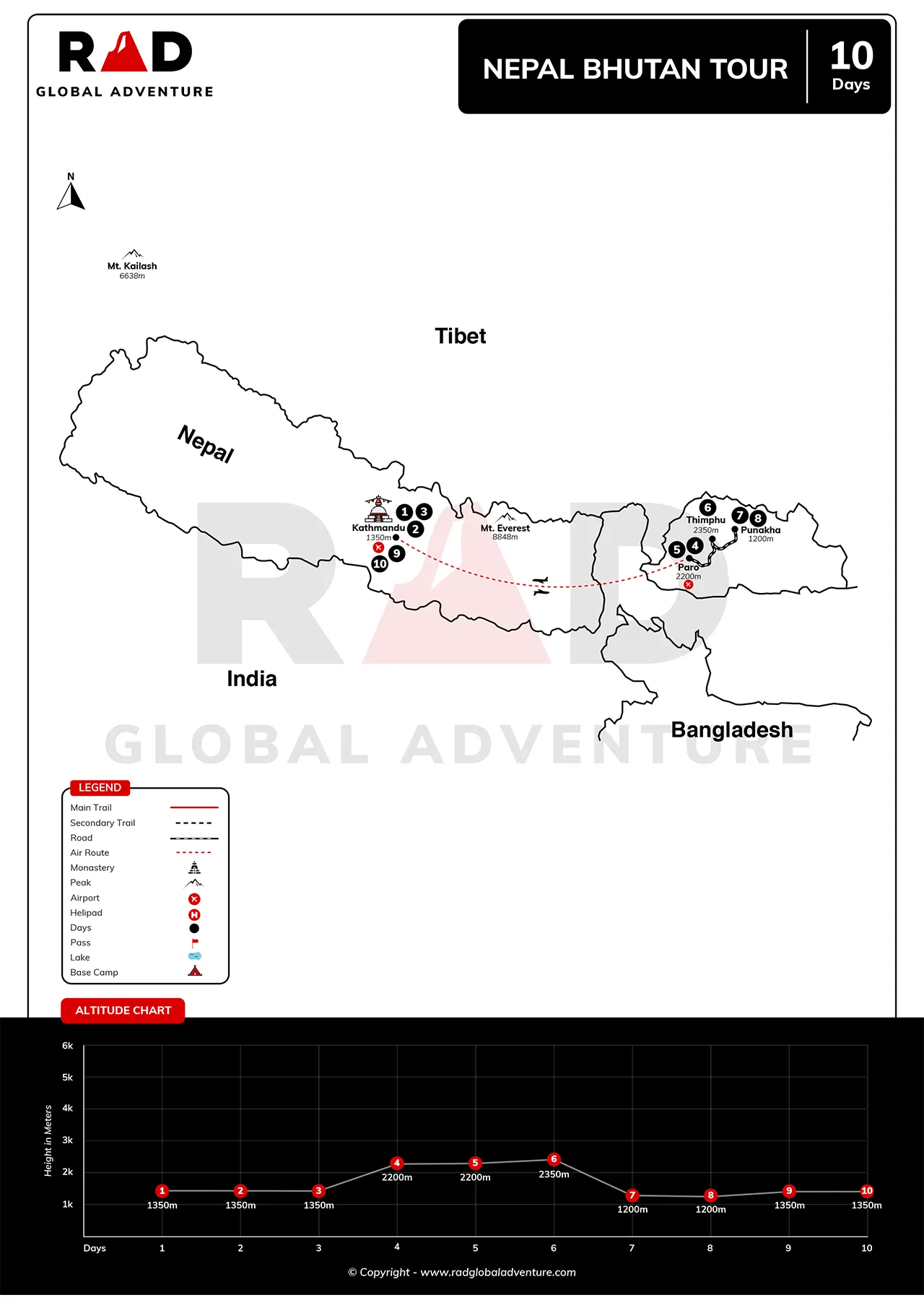
Few flights are as beautiful as the one that links Kathmandu and Paro. As the aircraft traces the Himalayan ridge, passengers get a view of Mt. Everest, Kanchenjunga, Makalu and the huge fluted peak of Jomolhari. In an hour’s drive you can go from the plains of Nepal to the valleys steeped in the forests of Bhutan.
The landing in Paro is like a fairy tale – green hillsides dotted with dzongs and farmhouses. For those travelers who wish to see the Himalayan views, but who do not wish to walk for days, this flight provides a front-row seat to the world’s highest peaks without the physical exertion.
Paro’s Rinpung Dzong, Kyichu Lhakhang & Ta Dzong
Paro is the gateway to the culture treasures of Bhutan. Ta Dzong, a 17th-century watchtower converted into Bhutan’s National Museum in 1968, houses collections of thangkas, masks, and centuries-old weapons. Nearby, Kyichu Lhakhang dating back to the 7th century is one of the oldest temples in Bhutan and is believed to have pinned down a demoness beneath the Himalayas.
Rinpung Dzong was built in 1646 and is still used by the local government as the administrative headquarters and a monastery. Its whitewashed walls and elaborately designed woodwork are the products of Bhutan’s sense of spirituality and defence. Together these sites give a deep insight into Bhutanese history, art and folklore.
Hike up to Taktsang Monastery (Tiger’s Nest)
Taktsang Monastery sits on a cliff 900 m above the valley and is the symbol of the mystical atmosphere of Bhutan. According to a legend, Guru Rinpoche flew here riding on a tigress and meditated in a cave for three months.
The hike is a rite of passage for visitors and rewards them with sweeping views, prayer flags fluttering in the wind and a chance to enter sacred shrines. Passengers always stop at a teahouse halfway to rest and enjoy the scenery. To reach the monastery is difficult but possible, and it is often the spiritual high point of the trip.
Thimphu Big Buddha, Memorial Chorten & Museums
The capital of Bhutan is a rare fusion of tradition and modernity. At Kuensel Phodrang, a 169 foot bronze Buddha statue gleams over the city and is a symbol of the country’s devotion to Buddhism. The third king is memorialized by the Chorten – a monument constructed in 1974, which is now an object of daily prayer.
The Takin Preserve provides a wonderful introduction to the national animal of Bhutan, a goat-antelope-hybrid animal. Museums like the Textile Museum and a traditional paper factory give an insight on the Bhutanese arts and crafts. When walking through the city of Thimphu, You’ll see crimson-robed monks alongside teenagers hanging out in cafés, and it’s this blend of old and new that makes Thimphu unique.
Dochu La Pass with 108 Chortens
The drive to Punakha from Thimphu passes up to Dochu La Pass (3100 m) where there are 108 chortens in three concentric circles. These were constructed by Queen Mother Dorji Wangmo Wangchuck as a commemoration of the soldiers that lost their life defending Bhutan in the year 2003.
On clear days the pass has panoramic views of snow clad mountains and prayer flags flutter in the breeze. In the winter, the chortens are often covered in snow, presenting a scene straight off a postcard. A short trail leads to the Lungchutse Monastery through rhododendron forests with rewards of quiet reflection and expansive vistas for the hikers.
Punakha Dzong and Fertility Temple
Located on the confluence of Pho Chhu and Mo Chhu rivers, Punakha Dzong is the second largest fortress in Bhutan and was constructed in 1637. The six story structure was the seat of government until 1955, and still contains important religious relics and administration offices.
People visit it for its golden spire, painted woodwork, and tranquil courtyards. Nearby, Chimi Lhakhang, the Fertility Temple, founded in the late 15th century by the crazy saint Drukpa Kunley, is popular among couples seeking blessings. Though the phallic symbols in the temple’s iconography may surprise visitors, they reflect Bhutan’s unique blend of humor and spirituality.
Gangtey/Phobjikha Valley Tour
Phobjikha Valley (Gangtey) is a glacial valley at an altitude of ca. 3,000 m. It is a winter shelter for more than 600 endangered black necked cranes that migrate from Tibet each November. Bird watchers can go to the Gangtey Monastery, and then walk on a boardwalk through the wetlands to see these graceful birds.
Beyond wildlife, the valley’s open landscape provides a window into Bhutanese rural life: farmers tend barley and potatoes, children walk to school, and yaks graze on undulating hills. Conservation attention for cranes has stimulated the development of sustainable, environmentally conscious management practices that protect the birds while supporting agricultural and tourism activities.
Mixed Culture of Nepalese and Bhutanese
The Nepal Bhutan tour demonstrates cultural contrasts, as well as commonalities. Nepal’s religion is a fusion of Hinduism and Buddhism, and as a result, temples devoted to Shiva stand next to stupas dedicated to Buddha. Festivals include masked dances, colorful processions and ringing of bells.
Bhutanese culture is based around Mahayana Buddhism, which can be seen in the dzongs with their colorful murals and chanting monks. Yet, both societies respect mountains and elders, and have a strong sense of community. By engaging in these traditions side by side, travelers gain a deeper understanding of the Himalayan heritage, where spirituality and daily life remain intertwined.
 English
 Dutch
Dutch Japanese
 Hindi
Hindi Italian
 Spanish
 French
 German
 Chinese
 Korean
 Arabic
 Hebrew
 Russian
 Portuguese
 Danish
 Czech
Czech Polish
 Swedish