expert-image
Talk to a Travel Expert +977 9818264758

Bookings Now Open for Nepal Treks, Tours & Climbing – 2026 & 2027

View Details
Phoksundo Lake
duration
Duration

17 Days

difficulty
Trip Difficulty

Moderate

max-altitude
Max. Altitude

5,190m

destination
Destination

Nepal

group-size
Group Size

2-16 People

start-end
Start / End

Kathmandu / Kathmandu

meals
Meals

Breakfast, Lunch & Dinner

accommodation
Accommodation

Hotel, Teahouse

transportation
Transportation

Tourist Bus, Flight

expert-image
Need Help? Ask to Travel Expert
Get a Trip Quote Customize This Trip Make an Inquiry
  • Best Deal
  • Flexible Schedule
  • Instant Booking
  • No Hidden Costs
trip-advisor
5.0
25 reviews

Overview of Lower Dolpo Trek

The Lower Dolpo Trek welcomes tourists to one of the untouched Nepalese frontiers. Hiding behind the grand Dhaulagiri range in western Nepal, the region had been closed off until the 1990s, which has still preserved its ancient ways, remote villages, and wild Himalayan sceneries.

Part of the historic trans-Himalayan salt trade route, Dolpo is still reminiscent of a Tibetan touch. Such villages as Tarakot, Tokyu, and Ringmo are examples of traditional culture where prayer flags, whitewashed houses, and Buddhist monasteries mingle in the windswept valleys and terraced farm lands carved by decades of stability.

The trip traverses the Shey Phoksundo National Park, where the turquoise Phoksundo Lake and wild animals such as snow leopards, musk deer, and blue sheep can be found. Hiking across the high passes like Numa La and Baga La displays alpine meadows, roaring waterfalls, and dramatic gorges.

Along with its wilderness, Dolpo provides cultural integration and genuine solitude that is not experienced in the masses of Everest and Annapurna. Spending nights under the starry skies, watching monks chant, trekkers experience Dolpo’s warm hospitality, leaving a lasting impression of stark Himalayan adventure and true human interaction.

Good To Know

The Lower Dolpo Trek is rated as a moderate to strenuous walk. Most of its high passes, such as Numa La and Baga La, are over 5,000 m above sea level and require prolonged ascents over rough rock. The trekking days can be 5-7 hours of consistent walking.

Although previous experience of multi-day trekking is beneficial, good cardiovascular condition and willpower are the most important. A progressive itinerary that involves acclimatization is safe in ensuring the trekkers get used to it. This Lower Dolpo trek itinerary is rewarding to committed adventurers because of the slow pace, adequate rest, and the perseverance.

In the rain shadow of the Dhaulagiri and Kanjirowa ranges, Lower Dolpo forms the dry conditions in spring and autumn. The seasons of March-May and September-November offer predictable weather, warm climatic conditions, dry trails, and breathtaking clear mountain sceneries to hikers.

It is pleasant in early June and at the end of August, with occasional showers. Passes during winter are not accessible due to snow, whereas during the monsoon season, flights are missed because of the rain. The suggested trekking season would guarantee the trek to be safe, comfortable, and the most spectacular Himalayan experiences across the trek.

Food in the Lower Dolpo Trek is nutritious, and it is meant to sustain prolonged trekking. The staple is still dal bhat, which consists of rice, vegetable curry, and lentil soup. Regional delicacies are the red marsi rice, buckwheat, barley, and potatoes.

Teahouses and camp will also serve momos, noodles, soup, and porridge. Trekkers must rely on boiled water, purification tablets or portable filters for drinking purposes.

Acute mountain sickness may strike anyone who is above 2,500 m. The symptoms are nausea, fatigue, and headache. In order to minimize risk, walk at a slow speed, drink a lot of water, and do not climb to a high altitude all at once. It is essential to have a proper pace in Himalayan trekking to be safe.

Above the 3,000 m, the limit sleeping altitude increases by 500 m /day and includes an extra night of rest with each 1,000 m gain. This trek program of Lower Dolpo has a healthy adjustment in acclimatization days.

The Lower Dolpo trek is enjoyable if you prepare in advance. Develop aerobic fitness and leg power by hiking, stair climbing, and walking around with a backpack. Regular cardiovascular exercises for months before departure are beneficial.

Any weekend hikes above 3,000 m are also a great practice and assist in the response to altitude. Psychological preparation is also essential – be prepared to work long hours, unpredictable weather, and isolated routes. This will ensure you arrive at Dolpo with its wilderness beauty that is rarely found.

The tourists require a tourist visa, which can be obtained on arrival or before arrival. The charges will be USD 30 for 15 days, USD 50 for 30 days, and USD 125 for 90 days. Always carry your documents. You can extend the visiting time in Kathmandu.

The hike needs a Restricted Area permit (USD 20 each for 4 weeks and USD 5 per day thereafter) and access to Shey-Phoksundo National Park (USD 30). Trekkers will need to go out with a licensed guide and one of their partners; the paperwork is screened at Dolpo checkpoints.

Bring a personal first aid kit containing medicines, blister care, antiseptics, and prescriptions. Wear coats during cold nights and carry a sleeping bag that is fit to be used in sub-zero temperatures. Wear sunscreen and sunglasses when exposed to the Himalayan intense UV rays.

When a licensed guide is hired, it becomes safer, since he or she will be looking at the health of the trekkers and will be familiar with the procedures in case of an evacuation. Protect cultural sites, wildlife, and nature from littering, campfires, and unnecessary noise. Responsible trekking safeguards the pristine environment.

Dolpo can be reached by a Kathmandu-Nepalgunj flight, and then by means of a short flight to Juphal. Scheduling can be changed by the weather, thus it is advisable to have buffer days. At Juphal, the trek starts and is enhanced by the assistance of the porters or pack animals.

No roads, ATM, or trusted shops after Dunai. Supplies must be carried in. It is remote, and thus makes the Lower Dolpo trek a difficult, but rewarding one, giving one the opportunity to glimpse the unspoiled Himalayan solitude.

Network coverage is minimal. Weak Nepal Telecom or Ncell connections might be detected in Dunai and Tarakot, though service is lost further into Dolpo. Sometimes, lodges offer costly, slow satellite-based Wi-Fi to support the simple communication requirements.

Little camps and high passes are still out of touch. Trekkers must inform their family members about the itinerary to remain connected. You can bring a satellite phone in case you need constant connectivity at high altitudes.

To extend the trek, the trekkers may enter Dolpo at Jumla through the Kagmara Valley. This path does not pass through big passes until reaching Phoksundo Lake. Well-travelled adventurers can proceed north to Shey Gompa or leave by Jomsom, over to Mustang.

All these other paths will require more permits and days of hiking. But the reward is new vistas, monasteries, and cultural experiences off the beaten trail, and this will add new experiences to your Lower Dolpo adventure.

Keep additional budget for snacks, drinks, and personal shopping. There are no ATMs after Dunai, therefore it is significant to carry Nepalese rupees. Plan before going into the Dolpo wilderness. Also, keep extras for tips to guides and porters (usually ~10% of trek cost is allocated).

Additional costs are optional, which involve Wi-Fi, charging the battery, use of hot showers, tips to porters, and giving money to the monastery. The national park entry is not included in the permit fee. There should always be a setback fund in case of weather delays or flight cancellations that come out of the blue.

In eastern Dolpo villages, the residents speak Khaam, which is related to Tibetan, and in Middle Dolpo village like Tarap Valley, the Tarali people speak Kaike. In lower valleys, Nepali mixed with Hindi is found. Outside Kathmandu, there is a paucity of English, but guides do offer translation services.

It is possible to learn simple words in the Nepali language, such as Namaste (hello) or dhanyabad (thank you), which allows establishing a rapport. The cultural immersion of this Lower Dolpo trek itinerary will be promoted by smiling and giving gestures of respect, which will fill communication gaps.

Electricity is limited. Micro-hydro or solar power is used in some villages, although an outlet is not always present. Having a power bank or solar charger will ensure that the devices, such as cameras and phones, last through the trek.

Trekkers use satellite-based communication, which is expensive, and untrustworthy. First, charge the necessary stuff, turn off all devices at night, and anticipate poor connectivity. Power management is an important factor in the remote Dolpo location.

Detail Itinerary

Welcome to Nepal! When you land at Tribhuvan International Airport in Kathmandu (1,400m), our representative welcomes you and takes you to your hotel. You can relax, visit the local streets, and get used to the hectic life in the capital. You are free to walk around Thamel, taste Nepali food, and gear up for the Lower Dolpo Trek.

accommodation-small

Accommodation: Hotel

meal-small

Meal: Breakfast

altitude-small

Max Altitude: 1,400m/4,593ft. (Kathmandu)

If our standard itinerary doesn't fully meet your needs, we are happy to tailor it to your specific preferences and requirements.

Includes and Excludes

What’s Included?

Transportation

  • International and domestic airport transfers
  • Domestic flights: Kathmandu – Nepalgunj – Juphal (round trip)
  • Private vehicle transfers for sightseeing in Kathmandu Valley
  • All private ground transport for sightseeing

Food and Accommodation

  • Full meals: breakfast, lunch & dinner on your choice during Trek
  • Breakfast in Kathmandu and Nepalgunj hotels
  • Seasonal fresh fruits deserts every day
  • Unlimited chlorine treated safe drinking water
  • Accommodation: Lodge / Teahouse (twin sharing) during trek
  • Hotel accommodation in Kathmandu and Nepalgunj after trek
  • Farewell dinner

Guide and Support Staff

  • An experienced English-speaking trekking guide
  • Porter service for luggage (one porter for every two trekkers)

Permit and Expenses

  • Lower Dolpo Restricted Area Trekking Permit
  • Shey Phoksundo National Park entry permit
  • Trekkers’ Information Management System (TIMS) card
  • All local and government taxes
  • Guide and porter salaries, insurance, equipment, transport, food and lodging

Medical and Gear

  • Oxi-meter: to check , heart rating and oxygen saturation
  • A comprehensive first aid kit
  • Emergency rescue in case of severe illness or injury (costs covered by your insurance)
  • Trekking equipment: down filled sleeping bag, walking poles and duffel bag
  • Free luggage storage in Kathmandu

Others

  • Certificate of appreciation
  • Trekking route map and company t-shirt

What is not Included?

International Flights and Visa

  • International flights and visa

Food and Accommodations

  • Meals in Kathmandu and Nepalgunj(except those included during trek)
  • Any hotel stays in Kathmandu before or after the trek

Travel and Medical Insurance

  • Comprehensive travel and medical insurance
  • Emergency rescue evacuation

Other Expenses

  • Personal expenses
  • Tips and gratuities
  • Personal trekking equipment
  • Unexpected expenses due to weather, flight cancellations, strikes, or natural causes

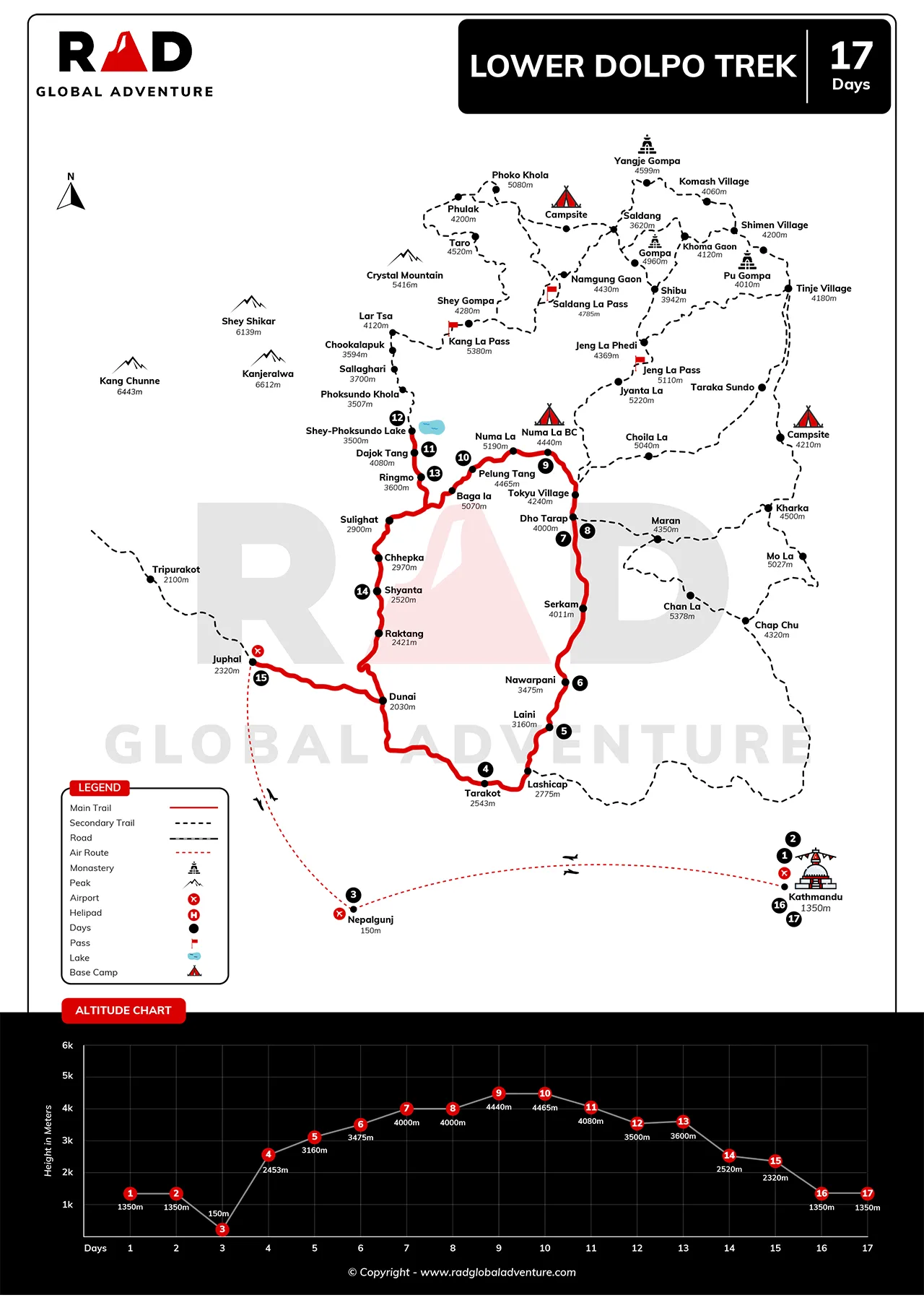
Route Map & Altitude Chart

Attractions and Highlights of Lower Dolpo Trek

Cultural sightseeing of UNESCO World Heritage Sites in Kathmandu

Kathmandu is a spiritual introduction before heading to the wilderness of Dolpo. In the holiest Hindu temple, Pashupatinath, there are rituals that take place day and night on the Bagmati River. Sadhus and pilgrims throng together, making a very holy ambience.

Close to the area, there is the Boudhanath Stupa, which is a Tibetan refugee site that is surrounded by Tibetan refugees chanting mantras. The Monkey Temple is also a mixture of Buddhist and Hindu cultures and is also called Swayambhunath, which is a hill-top with panoramic views of the valley. Newari woodcarving, metalwork, and eternal architecture are available in Patan and Bhaktapur Durbar Squares.

Scenic mountain flights to Nepalgunj and Juphal

The flight between Kathmandu and Nepalgunj is itself an adventure. The initial airline flies over fertile Terai plains, then the mountains rise. The mood is growing as the sceneries are transformed within several minutes.

The second leg of a small STOL aircraft follows small valleys and touches down on a strip of land on the hillside. The horizon is filled with snowy mountains, deep gorges, and meandering rivers. These are the flights that sustain the locals and lead to Dolpo’s remoteness.

Exploration of the Do-Tarap Valley and its ancient monasteries

The road goes through Tarakot, Laini, Nawarpani, and Dho Tarap, where some of the stone houses and flat roofs indicate a Tibetan background. The area is covered with Bon and Buddhist monasteries, and prayer flags are blowing over the fields of barley, buckwheat, and potatoes.

Salty and wool caravans of yaks continue to travel along time-honored trade routes. Long chubas and colorful aprons are worn by locals, integrating culture and landscape into everyday life. The Dolpo village balance of nature and tradition stands out as a result of every single village experience.

Acclimatisation day with cultural encounters in Do-Tarap

One additional rest day will guarantee healthy adaptation to the high altitude, as well as deepening cultural impressions. Tourists can study the art of weaving, indigenous medicine, and polyandrous marriage, or attend meditation classes and have monks reciting ancient texts in darkened gompas.

The break also gives scenic climbs to the valley views. There are snow-capped ridges and expansive villages that merge to create a fascinating scenery. Such rest days enrich the itinerary of the Lower Dolpo trek and make it safer.

Crossing high Himalayan passes like Numa-La and Baga-La

The two twin passes of Numa-La and Baga-La are above 5,000m. It is not easy trekking here; there are steep ascents, thin air, and varying weather, but the panoramic views are unmatched, which spread across Dolpo and Mustang.

The prayer flags are colored, and they are waving on the summits. Even in summer, you can see snow, and the feeling of accomplishment is strong. At this stage, the trekkers experience the uncivilized force of the Himalayas, defining the Dolpo experience.

Stunning mountain panoramas and dramatic landscapes

The beauty in Dolpo lies in its contrasts. The path passes terraced fields, pine forests, windy plateaus, and deserted high passes. Next to it, raging rivers and waterfalls carved deep gorges to display coarse rock layers and concealed valleys.

The wildlife is abundant: the blue sheep roam on cliffs and elusive snow leopards blend into the rocky outcrops. Peaks such as Kanjirowa, Gurja Himal, and Dhaulagiri keep on providing a permanent backdrop to the trekkers as they take each step towards the expedition.

Visit to turquoise Shey Phoksundo Lake, the jewel of Dolpo

The deepest and most beautiful lake in Nepal is Phoksundo Lake (3,611m). Its waters are turquoise, glittering in the sun, and fed by glacial streams. There is a waterfall of about 167 m in height that contributes to the theatrics of the landscape.

Ringmo village sits on the landslide edge of the lake, which is guarded by a Bon monastery. Trekking in this area will treat the trekkers to magic sunrises and sunsets as color transitions across the Dolpo jewel of shiners.

Exploration of Ringmo village and its traditional lifestyle

Ringmo also has tiers of the stone buildings with a flat top, prayer flags, which are also reminiscent of centuries-old practices by Bon. You can see local people cultivating barley, raising the yaks, and spinning their wool into carpets. Hospitality is reflected in the locals offering butter tea and read tales.

Life here is a compromise between brutal highland life and strong traditions. Trekking to Ringmo introduces trekkers to the strong communities of Dolpo and how they become spiritually attached to the land around the Phoksundo Lake.

Walk through untouched wilderness, gorges, and alpine meadows

Outside the villages, some tracks wind off into uninhabited valleys overgrown with wildflowers. There are broad meadows in the Alps and narrow ravines with falling glacial rivers. Yaks are grazed beneath prayer flags, and this contributes to the feeling of eternal Himalayan wildness.

You can’t encounter any trekker on the trails for hours of walking. This isolation characterizes Dolpo – a rare luxury in contemporary trekking. Courteous, light-impact tourism will keep the scenery of the areas untouched so that the forthcoming adventurers can see it as it was originally.

Trip Information of Lower Dolpo Trek

Is this trip beginner-friendly?

The trek is physically challenging. Trekkers have to walk for five to seven miles on rough roads every day. Acclimatization and gradual increases in altitude are beneficial for beginners.

Amateurs who are ready to train and get mentally prepared can make it. Nevertheless, sharp ascents and primitive camping mean shorter treks may be better for those uncertain of endurance. Lower Dolpo rewards hard work with cultural richness and wilderness.

Private Trip vs Group Joining

Solo expeditions are flexible, as they include rest days and a customized itinerary. They are appropriate for families or friends wishing to have a unique experience. Individualized instructions make the journey more comfortable and free to customize.

The cost of group joining trips is also reasonable, as they provide companionship and experience. They have fixed schedules and predetermined departures. Both involve guides, porters, and permits. This will be based on budget, the kind of independence you want, and the type of travel.

Trip Extension

If you have enough time, you can extend the trip. Adventurers fly north to Dolpo Upper, Shey Gompa, or fly to Rara Lake to experience serene beauty. Others move southwards to the Pokhara lakeside beauty.

The wildlife in the Bardia National Park can be experienced through a safari, where Bengal tigers, rhinos, and elephants can be found. With every extension, new landscapes and cultures will be realized, and the Nepal experience will be more than Dolpo being remote.

Solo Trek

Individuals may come alone, but they cannot walk all alone because of limitations. Permits have a minimum requirement of at least two trekkers and a licensed guide. If solo, some agencies may arrange a second permit under special conditions, though joining a group is recommended for both cost and safety.

Solo trekking might increase expenses; thus, it is best to join a group. It is safer and more rewarding for solo trekkers to share porters, guides, and experiences. The friendship mitigates the hardships of the Dolpo remote and demanding trails.

Photography & Drone Rules

Photography is usually welcome; however, you should always ask for permission prior to photographing someone or sacred areas. Please respect cultural boundaries when entering monasteries or photographing rituals along the trail.

Drones require a special permit from the Civil Aviation Authority of Nepal and local park offices. Shey Phoksundo National Park charges extra fees for drone use, and flying is prohibited near monasteries, wildlife, and villages. It is critical that drone use is done responsibly in order to preserve Dolpo’s fragile environment.

Cultural Festivals on the Trail

Festivals bring Dolpo alive. Sonam Losar is a festival of the Tibetan New Year that is celebrated by dancing and feasting. Every twelve years, the Shey Festival is celebrated, where pilgrims come to Crystal Mountain to circumambulate and renew their spirits.

The other events, such as Yungney, Chaigu, Chaite, and Keja, show some distinctive rituals of Upper, Middle, and Lower Dolpo. The festivals are also a part of the trek because Hindu festivals such as Dashain and Tihar give the place variety.

Tips for First-Time Nepal Visitors

Bring Nepalese rupees in small amounts, as credit is hardly accepted in the countryside. One should never enter the temples or houses with their shoes on. Additionally, eat or present things with your right hand because the left hand is considered unclean.

Wear decently, with shoulders and knees covered. Keep off the affection, and greet locals politely with “namaste”. Even simple Nepali words and deferential gestures go a long way in establishing cordial relationships on your hike.

Typical Daily Routine on the Trip

The days begin at approximately 6 am with tea and breakfast. Trekkers will typically walk for three to four hours until lunch at a riverside or meadow. Afternoons are short, and trekkers will reach camp mid-afternoon to rest or explore before dinner.

Dinner is served around 6:00 pm, followed by stories, reading, or reflecting. As the sun goes down, the night will begin earlier, allowing for good rest in preparation for the next day. This schedule is meant to build strength for the long expedition across Lower Dolpo.

Mental Preparation & Trekking Mindset

It is necessary to build strength and have physical training, but mental toughness will dictate success on the trek. You need to expect rapid weather changes, lengthy climbs, and basic facilities, among other things. Flexibility and patience will be most important in the remote, high-altitude environment of Dolpo.

Each barrier or situation can be treated as a part of the adventure. Embrace being separate from technology, nature, and remind yourself that the trip is about being on a journey. With this perspective, you will enjoy your trek across Lower Dolpo and not find it simply physically tiring.

Frequently Asked Questions

Previous trekking experience helps, but a good fitness level, determination, and your guide’s help are enough.

Days can be fairly warm, but temperatures in the evenings, particularly above 4,000 m, will likely fall below freezing in the cooler months.

ATMs can only be found in Kathmandu and Nepalgunj, so be sure you have enough cash with you.

Accommodation will be a mixture of city hotels, teahouses, and tents during the trek.

While the menu will be predominantly vegetarian, dal bhat, noodles, and soups will be options during the trek. However, you can enjoy non-veg foods in Kathmandu and Nepalgunj.

You must bring a power bank for charging, as the available time for charging will be limited.

Weather delays on any of the days are normal; you will not be impacted due to having buffer days or coverage for rescheduling.

Yes, you must bring a four-season sleeping bag rated to -10 °C for nights above 4,000 m.

Teahouses provide boiling water, but you must bring filtration tablets or a filter bottle for tap water.

Yes, you can witness blue sheep, tahr, marmots, or signs of leopard while trekking.

Yes, but visas need to be sorted in Kathmandu before starting the trek.

Groups are typically 2 to 12 and catered as such to allow for personal experiences with social engagement.

Trip Reviews

expert-image
Need Help? Ask to Travel Expert
Get a Trip Quote Customize This Trip Make an Inquiry
  • Best Deal
  • Flexible Schedule
  • Instant Booking
  • No Hidden Costs
trip-advisor
5.0
25 reviews