expert-image
Talk to a Travel Expert +977 9818264758

Booking open for Nepal Trek 2025 & 2026

View Details
Langtang Village

Langtang Valley Trek

Based on 25 reviews
duration
Duration

11 Days

difficulty
Trip Difficulty

Moderate

max-altitude
Max. Altitude

4,773m

destination
Destination

Nepal

group-size
Group Size

2-16 People

meals
Meals

Breakfast, Lunch & Dinner

accommodation
Accommodation

Hotel, Teahouse

transportation
Transportation

Tourist Bus

expert-image
Need Help? Ask to Travel Expert
Get a Trip Quote Customize This Trip Make an Inquiry
  • Best Deal
  • Flexible Schedule
  • Instant Booking
  • No Hidden Costs
trip-advisor
5.0
25 reviews

Overview of Langtang Valley Trek

This Langtang Valley Trek is a classic Himalayan trek, which is usually defined by its landscape, moderate walking, and the satisfaction of cultural life. This trek begins with a drive to Syabrubesi, then continues up the Langtang Khola through bamboo forest and villages of the Tamang people to reach high alpine pasture and glaciers.

Due to lower traffic in comparison with the Everest and Annapurna routes, it presents the amazing, breathtaking scenery and attractive cultural experiences. The Trekkers access places like Lama Hotel, Langtang, and Kyanjin Gompa, with some insight into the rural life in the mountains.

The trail twists through rhododendron, oak, and pine trees, in which red pandas, musk deer, and Himalayan black bears are present. The trekkers can have a wide panoramic view of Langtang Lirung, Dorje Lakpa, and other mountains.

The Langtang Valley Trek can be rated as moderate because it goes above the 4,900 m mark to Tserko Ri but is still within the reach of fit trekkers. All the inhabitants of the valley are Tamang people who speak a Tibeto-Burman language. They have infused Tibetan Buddhism with animism and shamanism.

You will observe monks chanting at monasteries, prayer flags in the wind, and you will be told about such rituals as Dumje and Lhosar festivals. Homestays and teahouses offer basic but plentiful food supplies of dal bhat, dhindo, and yak butter tea.

These 11 days provide time to readjust to the altitude, see interesting highlights of culture and nature, and enjoy the serene splendor of the valley. The route is more suitable for those hikers who prefer experiencing the Langtang Valley Trek without a crowd of tourists around them.

It does not take long to inspire such hikers to embark on a 10-day Langtang Valley trek plan by modifying or fusing some of the days. The budget shall include the Langtang Valley trek cost in planning transportation, lodges, lodge facilities, and landing cost of food.

Good To Know

The Langtang Valley Trek is moderate in nature and is suitable for trekkers with basic fitness. Every day, walks are of 5-7 hours on an irregular path, and the steps are made of stone. It is an ascent along the trail between Syabrubesi (1,500 m) and Kyanjin Gompa (3,830 m) and Tserko Ri (4,984 m).

There is no technical climbing involved, but the altitude may make breathing quite difficult. Prepare by doing cardiovascular training and leg strength building at home by walking or hiking with a weighted pack. The novices will be able to undertake the hike provided that they take precautions with regard to their pace, keep themselves hydrated, and observe the rules of acclimatization. A guide assists in matters of logistics and in making the trek safe.

Spring (March-May) and autumn (September-November) are the only seasons when the Langtang Valley Trek would be expected. These months have generally clear skies, rhododendrons, and clear mountain views.

However, rain and muddy paths during the monsoon season (June-August), and freezing, and extremely low temperatures are characteristics of winter (December-February).

High-altitude trails can also be snowy. Daytime temperatures at lower elevations in spring and fall are between 10-20 °C and, during the night, drop to freezing temperatures. Pack layering and waterproof attire because mountain weather is fickle.

Food that is offered along the trail is basic but substantial. Almost every trail has teahouses that offer such food items as dal bhat, chapati, and dumplings, along with noodle soups. In the Tamang community, dhindo (corn or millet porridge) and gundruk soup are available.

Yak butter tea, yak cheese, and fermented apple brandy are typical products. Boiled or filtered water is available in most of the lodges, which can be refilled. To prevent wasting plastic, use a bottle and purification tablets. It is important to hydrate and consume carbohydrates in this 10-day Langtang Valley trek itinerary to help you acclimatize and sustain energy levels.

Anyone at altitudes greater than 2,500 m is susceptible to altitude sickness. The trek to Langtang ascends very rapidly, so to fit in, it is necessary to have acclimatization. To minimize the altitude sickness risk, ascend slowly, consume plenty of water, as well as avoid alcohol.

Avoid over-ascending more than 1,000 m and have rest days. Your itinerary is designed with an acclimatization day in Kyanjin Gompa to enable your body to acclimatize. However, you must bring medicine such as acetazolamide on prescription from a physician. In case of worsening of symptoms, go down immediately and notify the guide.

Enjoyment increases with preparation. Start training 2 or 3 months before the departure. Emphasis on cardiovascular work such as running, biking, climbing stairs, and walking step by step, carrying a climbing backpack. Tone the legs with the help of squats and lunges, and enhance core stability.

You should consider spending time at a high altitude before trekking. Wear in new hiking shoes to avoid blisters. Pack lightly -the fewer things you take, the easier the hiking. It is advised to bring basic trekking gear, including trekking poles, waterproof clothing, a headlamp, and a first aid kit.

To trek in Langtang, you require a Nepal tourist visa, a Langtang National Park entry permit, and a Trekkers Information Management System (TIMS) card. Individual trekkers are required to have a guide and a TIMS card since April 1st, 2023. Park permit is approximately NPR 3,000 and NPR 1,500 in case of foreigners and SAARCs, respectively.

A separate permit is required to enter Shivapuri Nagarjun National Park; entering the park by alternative routes would require a permit (about NPR 1,000). The permits can be obtained in person only; no purchase can be made online. Bring passport photographs, an original passport, and money (NPR) to pay fees.

Healthy habits make you comfortable. Take safe drinking water and prevent uncooked or raw food. Take personal medication with you, which includes a pain reliever, rehydration tablets, disinfectant, and blister plaster. At high altitude, it is important to wear sunscreen, sunglasses, and a hat to avoid sunburn.

Wear in layers to regulate the changes in temperature. Go hiking under the direction of an experienced guide, who makes sure you are safe. Helicopter access to emergency rescue is possible but is costly; buy an insurance policy covering helicopter rescue and high altitude hiking.

The trip just began with the drive from Kathmandu to Syabrubesi. This is a 120 km road that winds through terraced hillsides, wooded areas, and along the Trishuli River valley. It takes 7-8 hours to do it, spanning a combination of paved and bumpy sections.

On the return, you will drive from Dhunche or Syabrubesi in a very similar manner to your drive into Kathmandu. Public local buses are cheap but likely crowded; most trekkers hire a private jeep to avoid crowds and allow for comfort.

On the whole trail beyond Syabrubesi, there are no ATMS or banking facilities. Mobile coverage (Ncell or NTC) is patchy. Wi-Fi can be found at selected lodges, but it is slow and costly.

Use the trek to detox digitally. Keep in touch with family and complete all online work before departure. Bring additional batteries or a power bank, because charging your devices often is an extra cost.

Many trekkers extend the Langtang Valley Trek to visit Gosainkunda Lake or the Helambu region. From Thulo Syabru, you can ascend to Sing Gompa and cross Laurebina Pass (4,600 m) to reach the sacred Gosainkunda Lake.

Beyond the pass, the trail continues to Helambu, a valley known for Sherpa villages and terraced fields. These extensions add 3–5 days, require extra permits, and acclimatisation. If time is limited, the 110-day Langtang Valley trek itinerary ends in Syabrubesi or Dhunche without side trips.

Most packages include accommodation, meals, and permits, but have extra budget for personal expenses. A few hundred more will get you hot showers, Wi-Fi, charging your mobile battery, and bottled drinks.

It is also customary to tip your guides and porters: a typical tip is 10 % of the total trek cost. Additionally, keep an extra penny for purchasing local crafts.

The languages spoken in the Langtang area include Tamang and Nepali (national language), and a little English in tourist spots. Tamang culture is of Tibetan origin, so there are prayer wheels, stupas, and Tibetan-style structures. Find some simple greetings (ex, Namaste) and make some contacts.

Guides mediate the difference between the cultures and translate words. Communication is also non-verbal, as a smile and gestures can help a lot. Mutual respect makes your experience of Tamang traditions more complete in the course of the Langtang Valley Trek.

Solar panels or micro-hydro are sources of electricity in the mountains. Lodges hardly have any power points, so it would probably cost you NPR 200 to 300 to charge your phone or camera.

Due to the lack of electricity at the higher camps, bring a power bank or additional batteries. Public Wi-Fi can be found, but are slow and often weather-dependent. Save battery by switching your device off when you are not using it. Read more about how to carry a mobile solar charger on longer hikes.

Detail Itinerary

The trip starts after you arrive at Tribhuvan International Airport. Our staff will pick you up and transfer you to one of the hotels in Thamel. After having some briefing and rest, you will visit the UNESCO heritage sites around Kathmandu, including Pashupatinath, Swayambhunath, and Bouddhanath Stupa.

In the evening, it is possible to spend free time or try the Nepali cuisine, where a briefing session is done on Langtang Valley Trek logistics and permits.

activity-small

Activity: 45 mins drive

accommodation-small

Accommodation: Hotel

meal-small

Meal: Dinner

altitude-small

Max Altitude: 1,400m/4,593ft. (Kathmandu)

If our standard itinerary doesn't fully meet your needs, we are happy to tailor it to your specific preferences and requirements.

Includes and Excludes

What’s Included?

Transportation

  • International airport transfers
  • Private drive Kathmandu – Syabrubesi & Dhunche – Kathmandu

Food and Accommodation

  • Full meals: breakfast, lunch & dinner on your choice.
  • Supplementary snacks: energy bar and cookies
  • Seasonal fresh fruits deserts every day
  • Unlimited chlorine treated safe drinking water
  • Accommodation: Lodge (twin room)

Guide and Support Staff

  • An experienced english-speaking trekking guide
  • Porter service for luggage (one porter for every two trekkers)

Permit and Expenses

  • Langtang National Park entry permit
  • Trekkers’ Information Management System (TIMS) card
  • All local and government taxes
  • Guide and porter salaries, insurance, equipment, transport, food and lodging

Medical and Gear

  • Oxi-meter: To check , heart rating and oxygen saturation
  • A comprehensive first aid kit
  • Emergency rescue in case of severe illness or injury (costs covered by your insurance)
  • Trekking equipment: down filled sleeping bag, walking poles and duffel bag
  • Free luggage storage in Kathmandu

Others

  • Farewell dinner in Kathmandu
  • Certificate of appreciation
  • Trekking route map and company t-shirt

What is not Included?

International Flights and Visa

  • International flights and visa

Food and Accommodations

  • Meals in Kathmandu (except farewell dinner)
  • Any hotel stays in Kathmandu before or after the trek

Travel and Medical Insurance

  • Comprehensive travel and medical insurance
  • Emergency rescue evacuation

Other Expenses

  • Personal expenses
  • Tips and gratuities
  • Personal trekking equipment
  • Unexpected expenses due to weather, flight cancellations, strikes, or natural causes

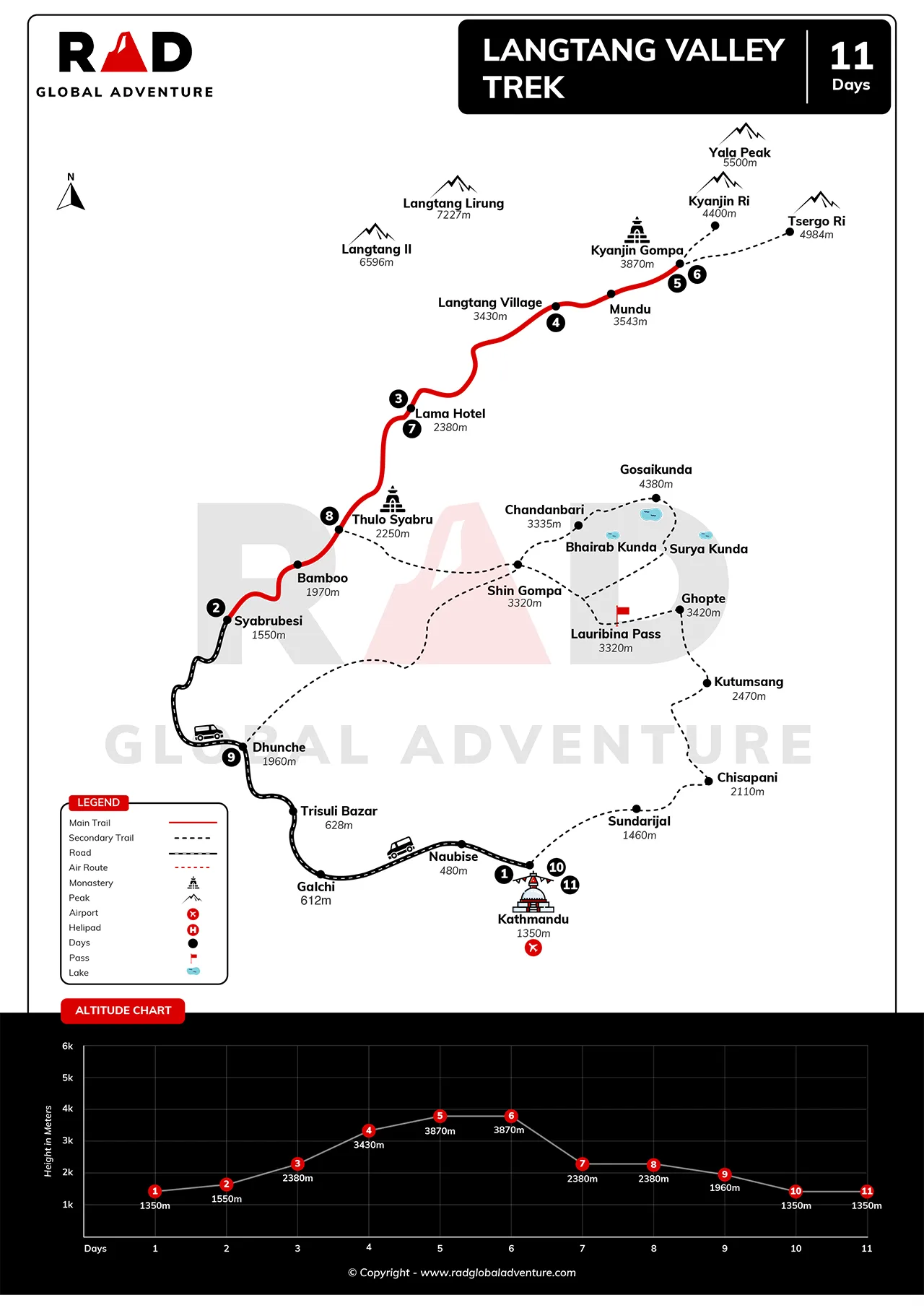
Route Map & Altitude Chart

Attractions and Highlights of Langtang Valley Trek

Cultural Richness in Kathmandu

Kathmandu isn’t just some other stop for trekkers, but also an ever-functional museum of ancient art and spirituality. The Pashupatinath Temple, Nepal’s largest Hindu temple dedicated to Lord Shiva, sits on the banks of the Bagmati River.

People flock to it, drawn by its two-tiered pagoda roof and bronze-plated doors, visitors witness daily Hindu cremation ceremonies along the river that provide a moment of understanding about Hindu funeral practices. Close by is the Swayambhu Nath Stupa (the Monkey Temple) that towers over the city. According to legend, in the beginning, when the Kathmandu Valley was a lake, a lotus flower flourished here.

To visit the stupa, you climb 365 steep steps to reach into the stupa, and are rewarded with marvelous panoramic views of the city. To the northeast, the Boudhanath Stupa – one of the largest stupas in the world – has an octagonal mandala base, and is surrounded by Tibetan monasteries.

You can walk around its great white dome spinning prayer wheels as you slurp Tibetan butter tea. Each of these UNESCO sites uniquely interact with the Hindu and Buddhist cultures, and provide an exterior style of peace that is welcome before your trek to Langtang Valley.

Drive to Syabrubesi through Langtang National Park

The drive from Kathmandu to Syabrubesi is a trip within a trip. Once you are past the city limits, you will see terraced farming with farmhouses and villages at the tops of ridges. The highway will follow the Trishuli River, where you will see trout farms, pine forests and waterfalls.

As you head north, the snowcapped peaks of Ganesh Himal, Manaslu and the Langtang range will come into view. The last stretch is narrow and part unpaved for some added adventure.

Once we entered Langtang National Park, you will have to go through military checkpoints and pass Narayan Tar, where the Tamang people were selling fruit on the roadside. The scenic drive shows the stark contrast from subtropical valleys to alpine heights and is a nice preparation for the trek ahead.

Trekking Through Ancient Forests and Hidden Valleys

The Langtang Valley Trek’s lower reaches wind through unpaved forests.  Paths wind among rhododendron, oak, and bamboo trees.  Orchids dangle from branches and rhododendrons burn pink and red in the spring.

Wildlife can be found in these old forests: the bamboo groves close to the Lama Hotel are home to Himalayan black bears, musk deer, and red pandas.  Birdsong fills the air, with eagles, pheasants, and Himalayan monals calling from the canopy.

Hidden valleys with prayer-flag-draped chortens and yak pastures can be found between wooded peaks.  Streams and waterfalls that drains into Langtang Khola giving thick and lust ferns and moss.  One of the trek’s greatest delights is strolling through this natural tapestry, which has a meditative quality.

Insight into Tamang Culture in Traditional Villages

The Tamang people are the chief constituents of the Langtang region. Their ancestors moved west from Tibet centuries in the past, and their language, clothing, and religion are all redolent with that various legacy.

You will see prayer wheels, carved mani stones, and houses embellished with yak horns at Lama Hotel , Langtang Village, and Thulo Syabru. Many Tamang people are farmers or yak herders. There is a yak cheese industry in Kyanjin Gompa, and this makes some good money for several locals.

There are events and festivals like Lhosar (Tamang New Year) and Dumje that consist of masked dances and drum music. Women wear brightly embroidered striped aprons (pangden) and men wear bakku robes. The local foods we eat, for example, dhindo, gundruk soup and yak butter tea, help keep you warm in the mountain highland.

A visit with the Tamang people will deepen your appreciation of the valley in ways that you cannot illuminate in the similar observational way of a cancellation giant expanse of land.

Visit Kyanjin Gompa & the Yak‑Cheese Factory

Kyanjin Gompa is located on an elevated plateau surrounded by tall peaks. The village has a monastery which serves as a cultural and spiritual center, colorful prayer flags wave in the breeze and monks chant their prayers.

The old yak-cheese factory is still there in the village, established in the 1950s to teach locals how to process yak milk into hard cheese for export and for local consumption. Trekkers are welcome to visit the cheese factory, observe the cheese made, and taste some fresh slices.

The cheese made in Kyanjin is creamy and mild with a subtle flavor, and goes well with Tibetan bread. The village also has a small bakery offering apple pie and cinnamon rolls which is a wonderful treat after several days of trekking. When night comes, the stars feel close enough to touch. Kyanjin Gompa is a lovely spot which combines culture, food and scenery, and serves a great purpose on the memorable Langtang Valley Trek.

Panoramas from Tserko Ri or Kyanjin Ri

From Kyanjin Gompa, several ridges offer breathtaking views. Tserko Ri (4,984 m) is the highest and requires a steep climb but rewards you with a 360‑degree panorama of snow‑covered giants. Peaks visible include Langtang Lirung, Gangchenpo, Dorje Lakpa and the Tibetan border mountains.

On a clear day, you can even see Shishapangma (8,013 m) in Tibet. The sunrise paints the peaks pink and gold, while midday reveals glaciers and the dramatic Langtang Lirung icefall. A shorter alternative is Kyanjin Ri (4,773 m), accessible within a couple of hours.

Both viewpoints are perfect for photography and remind trekkers how high they have climbed. Standing on these ridges surrounded by Himalayan giants is a moment to treasure.

Rich Flora & Wildlife of Langtang National Park

Langtang National Park preserves ecosystems traversing subtropical forest to alpine meadow. There have been over 250 bird species recorded here, and some lists have reported a count of 479 species due to migratory visitors.

There are many animals that you can spot on the trail, including red panda, musk deer, Himalayan black bear and grey langur. You might also see Himalayan tahr and goral traversing the rocky slopes along the Langtang Khola.

In alpine zones around Kyanjin Gompa, you will see yaks, both domesticate and wild, grazing; and with a bit of luck, you may even see a snow leopard’s tracks. There are also medicinal plants and colorful flowers located in the varied habitats throughout the park.

To respect wildlife, maintain your distance and be quiet. Birdwatchers should bring binoculars and be prepared to wake early; sunrise is the best time to hear the forest come alive.

Trip Information of Langtang Valley Trek

Is this trip beginner‑friendly?

Yes. The Langtang Valley Trek nearly reaches 5,000 m, but it is possible for first-time trekkers if you are prepared and have reasonable fitness. The trail is well-marked, and distances that needs to be covered each day is moderate.

Along with safety, guides are great for language and cultural interactions. First-time trekkers should take it slow, stay hydrated, and rest when necessary. You will have a day at Kyanjin Gompa to get used to the thin air and help reduce altitude related risks.

That said, you should train in some way (hiking with a backpack, doing cardio) before to make the trek more enjoyable. The silence of the mountain and welcoming local people offer a nurturing environment for beginners.

Private trip vs Group Joining

Trekking options include private and group treks. A private trek gives you more freedom, you determine the pace, choose your accommodations, and make most of the itinerary.

It’s good for couples, families or those who want a unique experience. Private guides and porters cost more but maintain the level of privacy you prefer. Group treks are budget-friendly and socially enjoyable.

You will share the cost of guide(s), porters and transport with other trekkers while trekking as a group. Group members can motivate each other on physically demanding days, and friendships may develop. Group departures will have rigid start and end dates and little flexibility in scheduling side trips.

These options will provide you with the same scenery, and you will be required to have the same permits and guides. Choose the format that fits into your travel style and budget.

Trip Extension

If you can spare a little more time and are consider extending your trip after the Langtang Valley Trek. You can trek from Thulo Syabru to Sing Gompa and hike up to Gosainkunda Lake, an important Hindu and Buddhist pilgrimage site. The lake is surrounded by barren hills, and usually frozen in winter.

Cross Laurebina Pass (4,600 m), and you enter the Helambu region with its Sherpa villages and beautiful terracing. You could add the Tamang Heritage Trail or do a side trip to Briddim village for a homestay and learn about culture.

These extensions will be an additional 3–6 days on your itinerary, with added altitude for an extended period requiring further acclimatization and permits. Alternatively you could shorten your itinerary to a 10 days Langtang valley trek itinerary, and depart directly to Syabrubesi after Kyanjin Gompa.

Solo Trek

Solo trekking in Langtang cannot be done legally without a licensed guide. Trekking without a guide was little restricted a year ago, it became illegal in 2023. If you are going to travel alone, it’s recommended that you hire a guide and more often than not, a porter to carry your bag.

A guide is important because you will have someone to handle permits, navigation and communication with locals. The advantage of solo trekking is that you are free to hike at your own pace and have much desired quiet reflection. On the trail, keep in mind that there are no ATMs and very little connectivity, so plan your finances accordingly, and do update someone of your itinerary and routing.

For women travelling alone, hiring a trekking guide can help ensure their safety and provide cultural insights that are always recommended. Additionally, solo trekkers are notorious for joining groups on the trail for company. Make sure to assess your confidence level and be sure to choose the safest and most responsible option.

Photography & Drone Rules

The photography opportunities in Langtang are absolutely stunning. A lightweight camera with some extra batteries is recommended, as the cold definitely drains battery life quickly.

Always ask permission before photographing locals, particularly monks. Drones are highly regulated in Nepal – in order to fly a drone legally, you will require permission from the Civil Aviation Authority and the National Park Office – a process that can take several weeks and might not be granted at all.

Undocumented drones are punishable with fines or confiscation. The use of a drone can be a disturbance to both wildlife and communities; most trekking agencies discourage their use on this basis. Either way, forget the drone and concentrate on documenting the landscapes – in particular, sunrise from Tserko Ri and the yak pastures above Kyanjin, are especially photogenic.

Cultural Festivals on the Trail

Attending festivals also adds a greater cultural context. Tamang New Year, or Lhosar (in between January and February) includes masked dance, drum music, and food. Dumje takes place in Kyanjin Gompa, and it is meant to honour the Guru Rinpoche.

There are masked dances and prayer as part of Dumje. Buddha Jayanti, or Buddha Birthaday, is when the local villagers celebrate the cause of the Buddha by lighting butter lamps and pilgrimage to monasteries. Chyamgi Puja or Horse Festival are to honour the ancestral warrior and has horse races.

During all the festivals time, the local people will wear their ceremonial (not everyday) clothes which they are proud of, and also give homemade local foods. If your itineraries dates line up, your guide can help you calculate a respectful way to observe the some festivals time. Festivals also means large village populations, so make sure you pre book your accommodations.

Tips for First‑Time Nepal Visitors

Bring a good supply of Nepalese rupees, with a variety of small notes. You can exchange money in Kathmandu and Pokhara, but there are no ATMs in Syabrubesi, or along the way.

Keep your passport and valuables somewhere safe and secure. Bring layers as it will be cold in the mornings and evenings, but warm in the afternoons. Bring a reusable water bottle and some purification tablets. You will be able to refill your reusable water bottle in most lodges, and this helps cut down on plastics.

Ensure you are drinking treated water, and eating cooked foods. When entering temples or people’s homes, it’s highly recommended. Dress modestly in the villages. Learn some basic greetings in Nepali such as “Namaste” to help connect with local people. Get good travel insurance that covers high-altitude trekking and evacuation. Respect local customs, local wildlife, and support small businesses by buying crafts and foods that are locally made.

Typical Daily Routine on the Trek

Your daily itinerary involves getting up early. Often before 6 AM, and enjoying tea before breakfast. Getting ready and getting walking by 7:30 AM. It is cooler in the morning and great for climbing. You can only carry a small daypack with water, snacks, camera and clothes layers.

After walking for around 3-4 hours, we have our first long break at a teahouse for lunch – and our meals are usually dal bhat or noodle soup. Usually, you would refuel for the afternoon walk around 1 PM and set off again until arriving at the next village around 3 PM to 4 PM.

Upon arrival we would settle into our hostel. Order ginger tea. Wash our clothes. Explore the village. Dinner is around 6 PM. We are usually reading, chatting, playing cards, etc near the fireplace. At 9 PM, it is lights out and off to sleep so we can recharge for the next day. This rhythm to your day helps your body adjust to the altitude and it allows you to maintain a comfortable pace.

Mental Preparation & Trekking Mindset

Mental resilience is equally as critical as physical fitness. Prepare for long climbing days, basic accommodations and ambivalent weather conditions. It’s essential to keep a positive mindset, you have to perceive these challenges to be part of your adventure.

We would suggest dividing the trek into manageable pieces where you keep your eyes fixed on the next village, not your final destination. Celebrate the minor victories, crossing a bridge or climbing to the ridge. Also, practice being mindful by appreciating the mountains, forests and surrounding people.

When you are feeling tired, breathe loudly and slow down instead of pushing too hard. Trekking in a group is great for the encouragement gained via communal experience, but it is also nice to have alone time for reflection. Journaling each day also helps you process your experiences and feelings. A calm, flexible and open-minded approach to a trek in the Langtang Valley will make your experience productive and an adventure that you will remember.

Frequently Asked Questions

The standard itinerary is 11 days, excluding arrival and departure times. The journey can be shortened by not acclimatizing or not visiting villages to fit them within the 10-day Langtang Valley trek itinerary.

The peak is the highest point is Tserko Ri, at 4,984 m. There are overnight stays below 4,000 m in order to acclimatise.

It is moderate. Hikes are done daily, and last between 5-7 hours on steady up and down inclines. One just has to be reasonably fit and experienced in basic hikes to do it.

The Langtang Valley Trek costs between $40o $1,500 per person, and the cost may increase if you choose the luxury option

Trekking requires a licensed guide and a TIMS card since 2023. Porters can be optional, but if you want to carry a light daypack, you can find these porters useful.

Teahouses have simple twin bedrooms with common toilets. When you go lower in elevation, some lodges do offer hot showers (semi-paid). On top, when it gets very cold, a sleeping bag is a good idea.

Cell phone coverage is erratic; wherever it exists, it is only possible in Syabrubesi, Kyanjin Gompa, and Thulo Syabru. Some lodges have Wi-Fi, but it is slow. Expect to work without the internet much of the trek.

Yes. The woodsy areas are inhabited by red pandas, musk deer, and monkeys. Along the rivers, you can see Himalayan tahr and goral. Birdwatching is also good, especially in the morning.

Spring and autumn have stable weather, good views, and flowers blossom. Trekking is possible in the monsoon and winter, but more difficult.

You need good hiking footwear, multiple layers, a down jacket, some rain protection, trekking poles, a hat, gloves, sunglasses, a headlamp, personal medication, and a power bank. Make your pack as light as possible and do not carry too many extras

No, carry Nepalese rupees. Stores and hotels in Kathmandu accept credit cards; there are no ATMs on the trek.

Yes, but it is going to be snowing and extremely cold at night. Trails may also be icy in places, and certain lodges may be closed. It requires appropriate equipment and experience. Spring and autumn are not so difficult.

The trek in Langtang is more peaceful than as compared to the Everest or Annapurna. It is near Kathmandu and highlights the Tamang culture.

Ensure that you consult your physician concerning routine immunizations and altitude illness medication such as acetazolamide. Don’t forget to bring first aid items in a rudimentary kit.

Yes, at lodges, at a fee. Power connections are either scarce or are generally solar. Pack a power bank or spare batteries.

Not necessarily, but better physical shape, training, and a mindset are more essential.

Use a refillable bottle, avoid the use of disposable plastic, stay on trails, and carry back rubbish in towns

Yes, villages and trails have been re-established. Local guides guide conditions, and infrastructure is well developed.

Yes, you can see Tserko Ri, Langtang Lirung, and other mountain glaciers on this trek.

All the guides are trained in first aid and will organise a helicopter evacuation if any emergency occurs. It is imperative to have travel insurance against such expenses.

Trip Reviews

expert-image
Need Help? Ask to Travel Expert
Get a Trip Quote Customize This Trip Make an Inquiry
  • Best Deal
  • Flexible Schedule
  • Instant Booking
  • No Hidden Costs
trip-advisor
5.0
25 reviews