expert-image
Talk to a Travel Expert +977 9818264758

Bookings Now Open for Nepal Treks, Tours & Climbing – 2026 & 2027

View Details
gosaikunda

Langtang Gosaikunda Trek

Based on 25 reviews
duration
Duration

16 Days

difficulty
Trip Difficulty

Moderate

max-altitude
Max. Altitude

4,984m

destination
Destination

Nepal

group-size
Group Size

2-16 pax

accommodation
Accommodation

Hotel, Tea House

expert-image
Need Help? Ask to Travel Expert
Get a Trip Quote Customize This Trip Make an Inquiry
  • Best Deal
  • Flexible Schedule
  • Instant Booking
  • No Hidden Costs
trip-advisor
5.0
25 reviews

Overview of Langtang Gosaikunda Trek

The Langtang Gosaikunda Trek is one of the most remote trekking destinations that you can visit in Nepal. It is also one of Nepal’s most stunning trekking routes. It combines the stunning protected areas of the Langtang National Park with the revered alpine lakes of Gosainkunda, which is 4,380 m above sea level.

The enchanting Gosainkunda Lake, at 4,600 m above sea level, and the stunning Langtang Valley, surrounded by numerous glacial high-altitude lakes, are the highlights of the Langtang Gosaikunda Trek. This is a stunning trek that passes through Langtang National Park and several ethnic villages and settlements. Before rising and continuing on towards the highlands, the trail winds alongside the Langtang River through dense rhododendron trees. After that, it passes through a glacial moraine and reaches the rebuilt Langtang village.

The cattle grazing area way up above the valley’s inner region makes for a dramatic setting for Kyanjin Gompa, a remote monastery that has been the religious center of the region for more than a hundred years. The acclimatization hike to Kyanjin Ri or Tserko Ri offers sweeping scenes of the nearby peaks, including the dominating Langtang Lirung, which rises to a height of 7234 m. An extended trip to Langtang and Gosainkunda can be the ideal option for those who want to experience Nepal’s traditional communities and enjoy its stunning landscape.

Buddhists make up a significant portion of the ethnic populations. If you are traveling to the area in February/March, you might be able to see their amazing festival, Losar. Langtang and Gosainkunda regions have a couple of regional festivals throughout the year. You might get to witness the celebrations if you are just at the right time.

This trip travels through scenic valleys that are home to a diverse range of plants and animals, winding up and down rocky and steep slopes. In addition to having above-average physical stamina and mental preparation, trekkers must be able to walk through difficult terrain for up to seven hours a day.

Good To Know

Officially, this trek has been graded as a moderately difficult experience with lots of ascents and remote daily stops. While most parts of the trail are easily manageable, there are some exhausting ascents that add a touch of difficulty. In addition to that, the high altitude also makes it a little difficult for trekkers to cover daily distances.

The best season for the Langtang Gosaikunda Trek is undoubtedly autumn. This season brings out the best possible scenes with the best weather conditions, which is the most reliable of any other season. The daytime temperature stays mild, and the chances of rainfall are very minimal.

During the trekking days, the Langtang Gosaikunda Trek package will cover 3 meals per day: breakfast, lunch, and dinner. While drinks are not a part of the trek package, you will be served tea along with your breakfast in the morning. Meanwhile, we will only provide breakfast during your time in Kathmandu.

The highest point of the Langtang Gosaikunda Trek is 4773 m above sea level, unless you choose to climb up all the way to Tserko Ri, reaching 4983 m. However, we will only spend one night above 4000 m. Altitude sickness starts at 3500 m of elevation, but the effects are kind of minimal until we cross 4500 m or 5000 m above sea level. So, the risk of altitude sickness on this trek is lower in comparison to treks that feature multiple nights at elevation above 4500 m.

As we previously stated, this trek is moderately difficult. This calls for a training period of at least 14 to 16 weeks, depending on your current physical form. If you are someone with an active lifestyle, preparing for this trek will be a breeze. You just have to focus on building your endurance and a little bit of strength training to harden your lower body.

To do this trek legally, trekkers are required to obtain a Langtang National Park Entry Permit. The Langtang Gosaikunda Trek guide will help you obtain the permit, while the trek package will cover its fees. Meanwhile, your visa fees are considered a personal expense that you must pay for separately. The trek package will not cover this expense under any circumstances.

There are a couple of different types of altitude sickness that trekkers can get on this trek. However, following the preventive measures, we will stay far away from the sickness. The trails are very safe, even for solo trekkers. Crime rates are basically non-existent in the highlands.

Every bit of transportation that the Langtang Gosaikunda Trek requires will be covered by the trek package. This includes driving from Kathmandu to Nuwakot, Sundarijal to Kathmandu, and airport pickups and dropoffs. No flight expenses will be covered by the trek package.

SIM card networks are available for the most part, but you can expect them to be spotty at some highland destinations like Sing Gompa, Thulo Syabru, etc. We recommend getting an NTC SIM card if you want better coverage in the hills. Internet connectivity is available at most of the tea houses throughout the Langtang Gosaikunda Trek itinerary.

The Helambu-Langtang-Gosaikunda trek is one of the best alternative routes to choose from, perhaps the best. On this itinerary, we will continue trekking from Chisapani towards the Helambu Valley instead of ending at Sundarijal. You get to explore villages like Sermathang and Tarkeghyang. You can also take the Ruby Valley route from Syabrubesi, experiencing more Tamang culture.

Although the Langtang Gosaikunda Trek package covers most of the daily and major expenses, there are some tiny amounts that are not practical for us to cover. Your travel insurance, flight to and from Nepal, tips for the crew members, extra meals, visa fees, additional nights, personal trekking equipment, etc., are your extra expenses.

Our guides are proficient in communicating in English, while a few of them also know how to speak many European and Asian languages. However, the primary language used in this trek will be English. If you want to communicate with the locals, you can simply ask the guide to act as a translator.

WiFi connections are available at every tea house, but it will cost you a dollar or two. Do not expect to get high-speed internet connectivity; it will be average at best. Charging your devices might not be possible at times, due to power outages that happen all across Nepal.

Detail Itinerary

On the first day of the Langtang Gosaikunda Trek, we will have you arrive at the Tribhuvan International Airport in Kathmandu. You are supposed to obtain a tourist visa before leaving the airport, or you can apply for an e-visa before leaving for Nepal. One of our reps will locate you at the terminal and drop you off at the accommodation for the night.

activity-small

Activity: Arrival and rest

accommodation-small

Accommodation: Hotel

altitude-small

Max Altitude: 1,400m/4,593ft. (Kathmandu)

If our standard itinerary doesn't fully meet your needs, we are happy to tailor it to your specific preferences and requirements.

Includes and Excludes

What’s Included?

Transportation

  • International airport transfers
  • Private drive Kathmandu – Nuwakot – Syabrubesi & Sundarijal – Kathmandu

Food and Accommodation

  • Full meals: breakfast, lunch & dinner on your choice.
  • Supplementary snacks: energy bar and cookies
  • Seasonal fresh fruits deserts every day
  • Unlimited chlorine treated safe drinking water
  • Accommodation: Lodge (twin room)

Guide and Support Staff

  • An experienced english-speaking trekking guide
  • Porter service for luggage (one porter for every two trekkers)

Permit and Expenses

  • Langtang National Park entry permit
  • Trekkers’ Information Management System (TIMS) card
  • All local and government taxes
  • Guide and porter salaries, insurance, equipment, transport, food and lodging

Medical and Gear

  • Oxi-meter: To check , heart rating and oxygen saturation
  • A comprehensive first aid kit
  • Emergency rescue in case of severe illness or injury (costs covered by your insurance)
  • Trekking equipment: down filled sleeping bag, walking poles and duffel bag
  • Free luggage storage in Kathmandu

Others

  • Farewell dinner in Kathmandu
  • Certificate of appreciation
  • Trekking route map and company t-shirt

What is not Included?

International Flights and Visa

  • International flights and visa

Food and Accommodations

  • Meals in Kathmandu (except farewell dinner)
  • Any hotel stays in Kathmandu before or after the trek

Travel and Medical Insurance

  • Comprehensive travel and medical insurance
  • Emergency rescue evacuation

Other Expenses

  • Personal expenses
  • Tips and gratuities
  • Personal trekking equipment
  • Unexpected expenses due to weather, flight cancellations, strikes, or natural causes

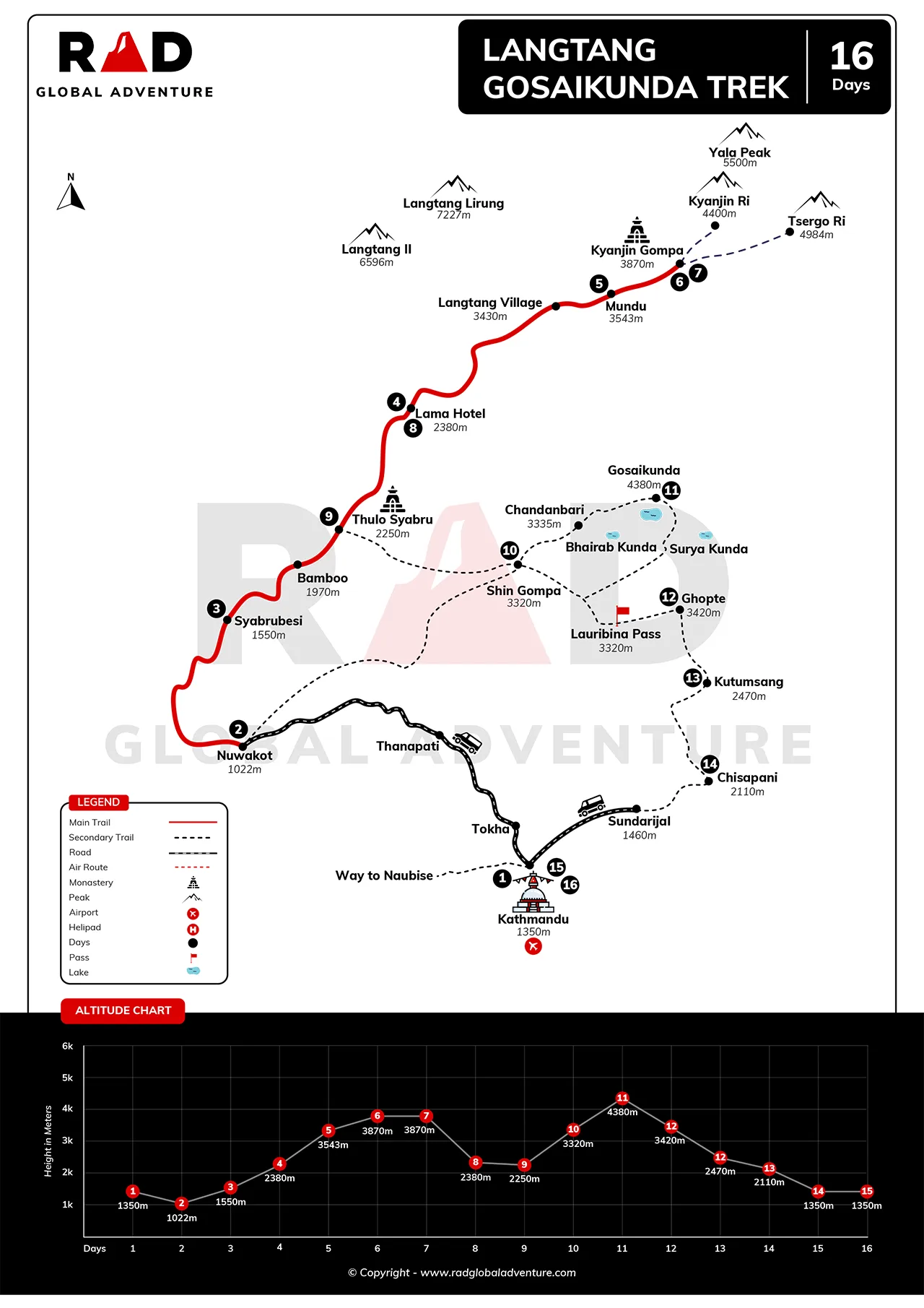
Route Map & Altitude Chart

Attractions and Highlights of Langtang Gosaikunda Trek

Visit the diverse Langtang National Park

Entering the Langtang National Park, you will transition from subtropical vegetation to high-altitude alpine zones as we keep ascending day after day. This park protects over 370 different species of birds, with around 46 kinds of wild animals. There are many endangered species, including musk deer, red panda, Himalayan tahr, and more. Although the chances of encountering them on the Langtang Gosaikunda Trek are low, it is not completely zero.

Admire the pristine Gosaikunda Lake System

Reaching 4380 m above sea level, the Gosaikunda lake is a sacred body of water that holds religious importance to the Hindus. It is believed that Lord Shiva quenched his thirst there, after drinking poison. Many pilgrims visit the lake during the festival of Janai Purnima. You can even take a holy dip in the icy water if you are feeling extra adventurous. The Gosaikunda Lake system is the source of the Trishuli River, which you can see on the way to Pokhara from Kathmandu.

Explore Kyanjin Gompa and hike up to Kyanjin Ri

Waking up at the village of Kyanjin, we will join the morning prayers at Kyanjin Gompa and see its intricately designed interiors and exteriors. After that, we will also visit the local cheese factory, followed by a hike to the viewpoint of Kyanjin Ri. This 3-hour climb offers a great panoramic view

of Dorje Lakpa, Yansa Tsenji, and Langtang Lirung.

Witness unforgettable, picturesque views of many peaks and the Himalayan ranges

Throughout the Langtang Gosaikunda Trek, you will get to enjoy many stunning scenes of peaks, including but not limited to Langtang Lirung, Dorje Lakpa, Naya Kanga, Yanda Tsenji, Ganchenpo, and Langtang Ri. On a very clear day, you will even see the Annapurna Himalayan range and a couple of peaks of the Manaslu range.

Expose yourself to the Tamang culture

As we will spend many days and nights at the Tamang villages throughout the Langtang valley, you will have plenty of chances to immerse yourself in their authentic local culture. You might even get to see some traditional dance performances during some festivals in the highlands. If you do this trek during the autumn season, you will have enhanced chances of witnessing traditional celebrations.

Cross the Lauribina La Pass and trek the Lauribina ridgeline

Reaching 4610 m, this is the second-highest point of the Langtang Gosaikunda Trek. Following prayer flags and stone cairns, we will follow the path to the top, to be rewarded with a grand view of Ganesh Himal and the Gosaikunda Lakes below. Also, crossing the Lauribina ridgeline, you get to witness a distant view of the Manaslu Himalayan range, along with the famous Annapurna peaks.

Trip Information of Langtang Gosaikunda Trek

Is this trip beginner-friendly?

While not specifically, it can be a good experience for beginners to join this trek as long as they are well prepared for the physical demands of the trek. The Langtang Gosaikunda Trek can be a bit too much for beginners with less experience; however, if they are ready to take on the challenge, they can get in on the adventure.

Private trip vs Group Joining

A private trip to the Gosaikunda and Langtang region can be one of the best experiences you can share with your close ones or alone. While this option is a bit more costly in comparison to group trek, it gives you the option to go on an intimate experience. You will be accompanied by guides and porters, as per the size of the group. Meanwhile, a group trek is the better option for solo travelers who want some company and eventually make some trekking friends along the journey. This is also the best budget option.

Trip Extension

We offer a flexible trekking itinerary that you can adjust and extend as per your preference. You can simply choose to spend extra nights at villages you like or add different destinations along the way. One of the best ways to extend this trek is to add the Helambu Trek, which adds about 5 to 6 more days to the standard Langtang Gosaikunda Trek itinerary we have discussed above. In addition to that, you can also explore the Langtang Valley extensively, crossing the Tilman Pass (5320 m) in the process.

Solo trek in the Langtang Gosaikunda region

Solo trek does not mean trekking all alone; you are legally not allowed to enter the Langtang National Park without being accompanied by a licensed trek guide. It is mandatory to have a guide, but you can skip hiring a porter if you are confident you can carry your own luggage throughout the journey. At the bare minimum, a solo trek to the Langtang region is paired with a trek guide.

Photography & Drone Rules

Visitors are freely allowed to take photos of the scenes, wild animals, peaks, temples, monasteries, chortens, and all the things you see with your naked eye in the Langtang Gosaikunda Trek. However, if you are photographing the locals, please make sure that they are fine with it; we do not want unnecessary situations on the trek. In addition to that, drone flying is not permitted unless you have the proper paperwork. It can be a hassle to get the permits, so we recommend visiting Nepal a couple of days before the start of the trek.

Cultural Festivals on the Trail

You can witness Hindus performing rituals at the Gosaikunda Lake during Janai Purnima, which falls in August or July. However, Lhoshar is the main festival of the region; it is the New Year of the Tamang and Sherpa people. This festival falls in February and is widely celebrated throughout the region.

Tips for First-Time Nepal Visitors

  • The Nepalese government has implemented an easy visa-on-arrival. You do not necessarily have to get a tourist visa before you take your flight to Nepal. You just need to have the proper documents, and you will have your visa in under an hour.
  • Carry a bunch of water purification tablets. Use the purification tablets every time you refill your reusable water bottle.
  • Flight delays are not common during the peak travel season, but you can expect some delays while traveling by ground.
  • The Tibetan Buddhism-influenced region of Langtang has many religious sites; regardless of whether it’s a Hindu Temple or a Buddhist monastery, you must always pass it in a clockwise direction, from the left.
  • Respect the local practices and beliefs, and always make sure that you are dressed modestly. Showing skin is not appreciated in the remote villages; their rural lives are very conservative.

Typical Daily Routine on the Trek

A typical trekking day on the Langtang Gosaikunda Trek starts with a hearty breakfast to fuel the body for the trail ahead. Ascending and descending along the way, we will trek for about 5 hours on average, passing by remote villages and forests. On the way, we will stop for lunch and take many rest stops in between. Generally, we will hit the final climb or descent of the day right after having our lunch.

Mental Preparation & Trekking Mindset

You will be spending almost two weeks in remote and barely accessible villages, where you will have to spend your nights at very basic accommodations. The services are usually bare minimum as they do not have the proper infrastructure to support high-standard services and facilities. You might even have to spend a couple of days without internet and connection to the outside world.

Showers are not a daily thing during the Langtang Gosaikunda Trek, as it can get very cold in certain places, and even hot showers can make you catch a cold. There are many things that make you uncomfortable throughout the trek, and even minor inconveniences can be a deal breaker over time. To overcome all the obstacles, you need to mentally prepare for a very basic life in the remote highlands.

Frequently Asked Questions

No, there are no seasonal rivers, but there are some seasonal streams that tend to dry up or freeze in the winter season. In addition to that, most of the rivers dry in winter and flow heavily during the monsoon and summer. Meanwhile, landslides are usually heard about during the monsoon season, which is why we recommend not doing this trek in that particular season.

Most of the stone stairs are not very long, so you can easily climb up those stairs without needing multiple breaks. It’s the long ascents over dirt trails that will be exhausting and even challenging to some. Overall, the Langtang Gosaikunda Trek features very manageable stone steps sections.

Yes, you can charge multiple devices at once, given that there are enough means to do so. Most of the tea houses do not provide extension plugs; you just have to work with the electric sockets that your room features. You might even be charged a couple of USD for charging your devices on solar power in times of power outages. Bringing along a solar power backup or power bank is recommended if you want to charge your electronics on the go.

Yes, toilets are available at every tea house along the Langtang Gosaikunda Trek itinerary. However, you are highly unlikely to find attached bathrooms during your stay in tea houses; it is just not a generic thing in the highlands. Most of the tea houses offer shared bathrooms and toilets. On a side note, hot showers are also not readily available; hot water is prepared on demand and usually costs about 2 USD.

No, there are no hot springs en route on this Langtang Gosaikunda Trek. If you really want to experience natural hot springs, the only possible way is to extend the itinerary and trek to Tatopani, reaching 1200 m above sea level. This village is located about half a day’s trek away from Thulo Sybaru village, en route to a village named Chilime. You can discuss the extension options with our trek experts.

No, there are no alternatives to emergency evacuation; the fastest and most reliable way is via a rescue helicopter. However, if things are not that serious, you can also take a ride on a horse or mule to get to the nearest health post or clinic. Even our porters can carry you at times, if the comes down to it.

The descent from Gopte to Kutumsangu is one of the steepest of the entire Langtang Gosaikunda Trek itinerary. The descent drops almost a thousand meters in elevation, which is a considerable figure. First, the trail drops to Thadepati, reaching 3690 m. Then, we have to reach Mangengoth village at 3285 m. From there, the trail steepens sharply, going over rocky trails full of loose rocks, most of the way to Kutumsangu.

Yes, stream water is generally considered safe in the highlands, as its sources are natural springs up in the hills. The locals of the region rely on it for daily drinking water and most household uses; they drink it just as is, untreated and unfiltered. However, we recommend trekkers to always use water purification tablets every time they fill their bottles. Taking unnecessary risks is not a luxury you can afford while you are deep in barely accessible regions.

Yes, there are a couple of viewpoints that we have not mentioned on this Langtang Gosaikunda Trek package. There’s one above Rimche village, one between Mundu and Kyanjin Gompa, and another at the upper ridges of Thulo Syabru. These viewpoints are not particularly stunning, and they also add extra trekking duration. So, we will generally avoid climbing every viewpoint along the way; it is just not practical to do so.

The highland people are one of the most heart-warming characters you will meet on your journey to Nepal. The Langtang Gosaikunda Trek goes through many Tamang communities; these people are known for their easy-going and helpful nature. As a solo female traveler, you can expect a warm welcome and helping hands all along the route.

After a heavy rain, the trails are usually muddy but not instantly slippery. However, during the monsoon season, when rain can be expected every day, the trails turn slippery and heavily muddy. You can expect the stone stairs to be the most slippery part of the trek.

Trip Reviews

expert-image
Need Help? Ask to Travel Expert
Get a Trip Quote Customize This Trip Make an Inquiry
  • Best Deal
  • Flexible Schedule
  • Instant Booking
  • No Hidden Costs
trip-advisor
5.0
25 reviews