expert-image
Talk to a Travel Expert +977 9818264758

Bookings Now Open for Nepal Treks, Tours & Climbing – 2026 & 2027

View Details
Khopra Danda Trek
duration
Duration

11 Days

difficulty
Trip Difficulty

Moderate

max-altitude
Max. Altitude

3,640m

destination
Destination

Nepal

group-size
Group Size

2-16 People

start-end
Start / End

Kathmandu / Kathmandu

meals
Meals

Breakfast, Lunch & Dinner

accommodation
Accommodation

Hotel, Teahouse

expert-image
Need Help? Ask to Travel Expert
Get a Trip Quote Customize This Trip Make an Inquiry
  • Best Deal
  • Flexible Schedule
  • Instant Booking
  • No Hidden Costs
trip-advisor
5.0
25 reviews

Overview of Khopra Danda Trek

The Khopra Danda trek is in the Annapurna region of Nepal on a less-traveled path. It is an 11-day adventure tour in nature and remote villages with amazing mountain views and a Himalayan experience.

The Khopra Danda Trek starts in Kathmandu and goes to Pokhara before the trek starts at Nayapul towards Ghandruk, a picturesque Gurung village. The path meanders slowly through rhododendron and alpine forests and small hamlets with views of Machhapuchhre, Dhaulagiri, and Annapurna mountains as it goes.

The Khopra Ridge is at 3,660 m and offers panoramic 360 views of the surrounding environment. Adventurers will have a sidewalk trip to Khayer Lake, an untouched high altitude, calm, and soothing environment with snow-ridden mountains, coated with Himalayan spiritual harmony.

The trips back go through Swanta and Ghorepani with a classical sunrise on Poon Hill. It combines mountain scenery, culture, and a continuous panoramic view, which is appealing to the tourist who would like to have something genuine of Nepal.

Good To Know

The Khopra Danda trek is moderate in difficulty and can be undertaken by trekkers with minimum experience in hiking. The walks taken daily would be between 3-7 hours with gradual ascents and descents. You will walk up to 3,660 m during the trek, but if you do not include the optional Khayer Lake (4,660 m) hike.

The majority of lodges are basic, yet comfortable, making the experience bearable to strong trekkers. The elevation will have an impact on an individual above 3,500 m, so it is better to take it slow and drink a lot of water. The hike to Khayer Lake is more difficult.

The ideal time for trek is in spring (March to May) and fall (September to November). The weather will be warm during the day with clear skies offering excellent mountain views, will be comfortable to walk around during the day.

Spring is full of the colorful rhododendrons and green foliage, while autumn has a crisp mountain clarity. Winter is cold in higher elevations, while the monsoon causes the trail to be slippery and the view to be obscured.

Teahouses along the trail offer Nepali and South Asian food. You will get Dal Bhat, noodles, soups, momos, porridge, and eggs. The trekking package is normally accompanied by all meals.

Drink boiled water or treated water to prevent stomach illness. Various lodges will offer bottled water or refill filters. Always make sure you have a pocket full of water purification tablets.

Khopra Danda trek reaches its maximum altitude at 3,660 m; therefore, altitude sickness is a potential danger during the trek. Above 2,900 m, there is a quick rise in altitude, demanding a slower pace and proper hydration.

The climb to the Khayer Lake (4,660 m) is more risky because it experiences high rates of elevation gain. Frequent rest, hydration, and quick descent when symptoms get severe are important. Guides often carry oxygen and basic altitude medication.

Hiking or stair climbing before the trek may be beneficial in developing stamina for walking 4-7 hours. Cardio and endurance training could also be emphasized, as the trail will include steep uphill and downhill travel through forests and ridges.

Make arrangements for good-quality trekking shoes, warm-up clothes, a raincoat, and a sleeping bag. The majority of your bag will be carried by porters, and the only one you have to carry will be a daypack.

International visitors will be required to acquire a tourist visa, which can be obtained online or on arrival at Kathmandu Airport. Fees for tourist visas are based on the length of stay and nationality. Bring along printed copies of the passport and passport-sized photo.

You will need a TIMS card and an Annapurna Conservation Area Permit (ACAP) for the trek. These can be obtained in Kathmandu or Pokhara, usually with the arrangement of your guide or trekking agency, before starting your trek.

The trek is safe, including the Khopra Danda trek, but you must still take all the standard mountain precautions. Eat only well-cooked food, and have on hand a painkiller, an antiemetic, and a small first aid kit.

Be sure you have travel insurance that covers high-altitude trekking and helicopter rescue. The lodges are basic and have squat toilets and little heat. Dress modestly in villages by covering shoulders and knees, as local communities appreciate respectful attire.

Most travelers take a tourist bus or private vehicle to reach Pokhara from Kathmandu. The distance is approximately 200 km, which will take 6-7 hours through winding hills and countryside.

Alternatively, you can take a 25-minute flight from Kathmandu to Pokhara. From Pokhara, you will take a Jeep to Nayapul, where the trek starts. The jeep will take you through rough, narrow mountain roads.

From Nayapul, you start the trek on foot. At the end of day 10, local jeeps take you from Tikhedhunga back to Pokhara (about 3 hrs). All major road transport, including the road travel from Kathmandu–Pokhara, is included in the itinerary cost.

Khopra Danda Trek is a loop trail that is an offshoot of the popular Ghorepani- Poon Hill Trail. Another alternative viewpoint route, instead of returning via Tikhedhung, is Mohare Danda (approximately 3,300 m).

The other alternative is to continue the trip by joining the route of Annapurna Base Camp at the start. Nevertheless, the majority of trekkers use a standard 11-day loop of Nayapul to Ghandruk, Dobato, Khopra, Khayer Lake, and Ghorepani.

It is a trail that goes across remote and serene places and has scarce alternative routes. Your guide will also keep watch on trail conditions and only recommend safe detours in case the weather, landslides, or other locally specific factors lead to route alterations.

Budget for liquor, snacks, or souvenirs in Kathmandu and along the trail. Teahouses charge a few dollars for bottled water, tea, and chocolate bars.

Hot showers are priced at about 1-2 dollars in some lodges, with extra charges for electricity or charging of devices. Internet or data may also add up, so it is beneficial to consider spending $5-15 a day on personal expenditure.

Bring enough USD or Nepalese rupees cash, since there are no ATMs on the trekking path. Pokhara and Kathmandu have the machines that will dispense the rupees before you go to the mountains.

Nepali is the national language, but other dialects like Gurung and Magar are spoken in the Annapurna region. Luckily, the majority of the guides and teahouse owners speak basic English, so communication with foreign tourists is not impossible.

It is recommended to learn a few phrases in Nepali, such as “Namaste” (hello) or “Dhanyabad” (thank you), since it is appreciated. Most lodges do not have English menus or signs, but every lodge is outfitted for visitors and ensures that you will be able to order food or ask questions without delay.

Sites such as Nayapul, Ghandruk, and Ghorepani are some of the major villages that can receive Ncell and Nepal Telecom signals, but once you get into the forested and high ridge areas, signals will drop out. Pokhara and Kathmandu are almost always going to have reliable 3G/4G coverage.

Many lodges now offer Wi-Fi — sometimes free or a very small charge, but slow speeds. Bring a power bank or a solar charger to the villages; electricity may run for only a few hours each evening.

Detail Itinerary

Welcome to Nepal! After you arrive at Tribhuvan International Airport, our representative will pick you up and drop you off at a hotel in Thamel. Once you have checked in, you can relax.

If you feel energized, you can visit the bustling Thamel Street and taste some Nepali food in a local restaurant. In the evening, you will meet your guide in a traditional restaurant, where you will have Nepali Dhal Bhat as dinner and a briefing of the next day’s adventure.

accommodation-small

Accommodation: Hotel

meal-small

Meal: Breakfast

altitude-small

Max Altitude: 1,300m/4,265ft. (Kathmandu)

If our standard itinerary doesn't fully meet your needs, we are happy to tailor it to your specific preferences and requirements.

Includes and Excludes

What’s Included?

Transportation

  • International and domestic airport transfers
  • Private jeep transfers Pokhara – Kimche/Nayapul – Pokhara
  • All private ground transport for sightseeing

Food and Accommodation

  • Full meals: breakfast, lunch & dinner on your choice during Trek
  • Breakfast in Kathmandu and Pokhara hotels
  • Seasonal fresh fruits deserts every day
  • Unlimited chlorine treated safe drinking water
  • Accommodation: Lodge / Teahouse (twin sharing) during trek
  • Hotel accommodation in Kathmandu and Pokhara after trek
  • Farewell dinner

Guide and Support Staff

  • An experienced English-speaking trekking guide
  • Porter service for luggage (one porter for every two trekkers)

Permit and Expenses

  • Annapurna Conservation Area Project (ACAP) entry permit
  • Trekkers’ Information Management System (TIMS) card
  • All local and government taxes
  • Guide and porter salaries, insurance, equipment, transport, food and lodging

Medical and Gear

  • Oxi-meter: to check , heart rating and oxygen saturation
  • A comprehensive first aid kit
  • Emergency rescue in case of severe illness or injury (costs covered by your insurance)
  • Trekking equipment: down filled sleeping bag, walking poles and duffel bag
  • Free luggage storage in Kathmandu

Others

  • Certificate of appreciation
  • Trekking route map and company t-shirt

What is not Included?

International Flights and Visa

  • International flights and visa
  • Domestic flights to/from Pokhara

Food and Accommodations

  • Meals in Kathmandu and Pokhara (except those included during trek)
  • Any hotel stays in Kathmandu and Pokhara before or after the trek

Travel and Medical Insurance

  • Comprehensive travel and medical insurance
  • Emergency rescue evacuation

Other Expenses

  • Personal expenses
  • Tips and gratuities
  • Personal trekking equipment
  • Unexpected expenses due to weather, flight cancellations, strikes, or natural causes

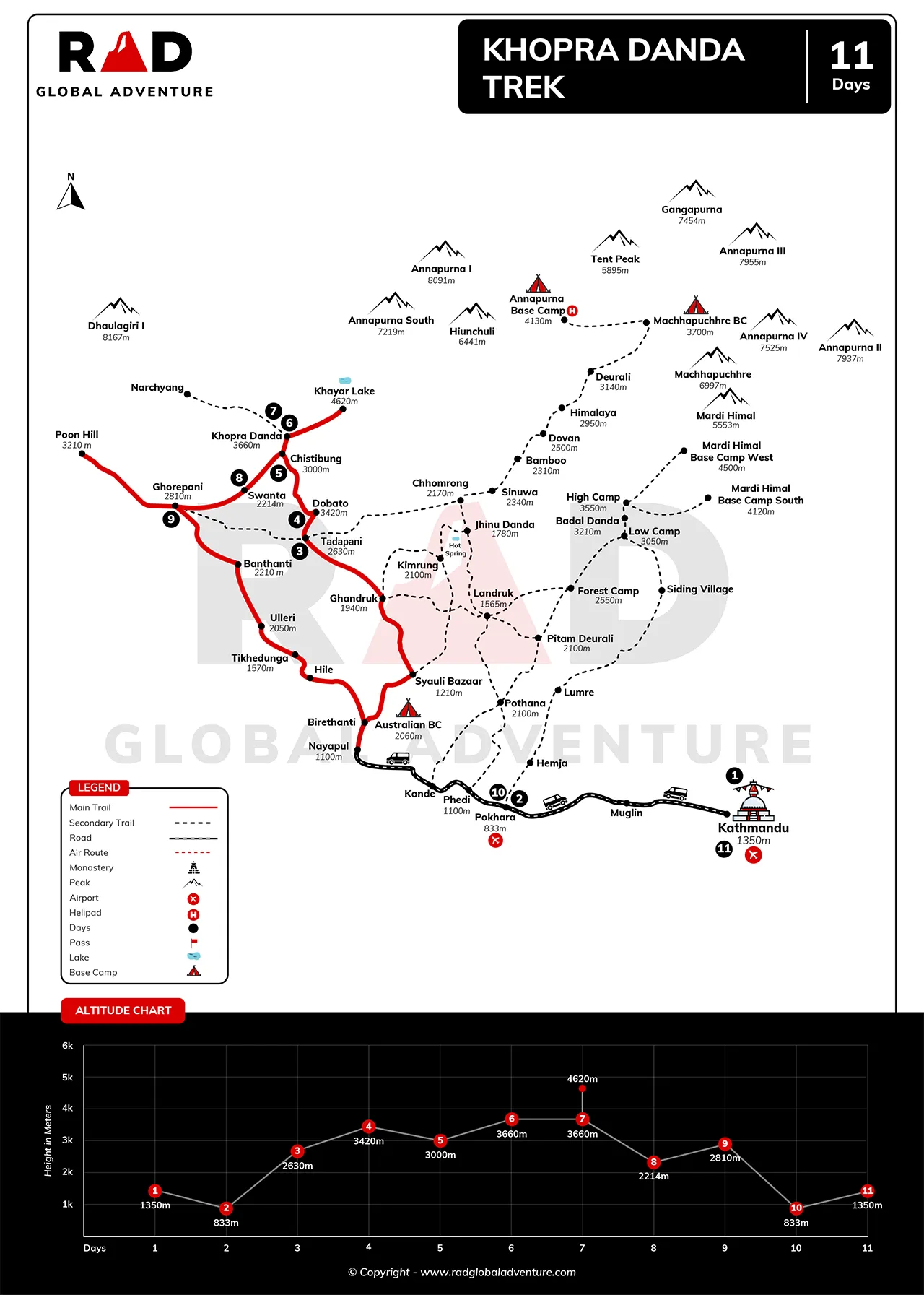
Route Map & Altitude Chart

Attractions and Highlights of Khopra Danda Trek

Pokhara Lakeside arrival:

Pokhara (820 m) greets trekkers with views of the Phewa Lake with the reflective images of Annapurna and Machhapuchhre. The lake is full of cafes, sprues, and guesthouses – ideal for relaxing or getting ready. When in Pokhara, never miss a sunrise or sunset boat ride.

Drive to Nayapul and the rural trailhead:

The route out of Pokhara is a 3-4 hour jeep ride that winds past villages and rice terraces. This is the gateway path to Ghandruk, which presents the culture of Gurung, houses made of stone, and peaceful farmlands that have the pure Nepalese countryside.

Beautiful forest walk to Ghandruk:

This path from Nayapul to Ghandruk takes up through oak and rhododendron forests with birdsong. Reaching Ghandruk (1,920 m), trekkers not only experience Gurung hospitality but also get a peek at the Annapurna peaks, which is a combination of nature and tradition.

Rhododendron bloom in Tadapani:

The section from Ghandruk up to Dobato goes through high-altitude woodlands. In the spring season, the trail is filled with crimson rhododendrons. Tadapani (2,730 m) is located in the midst of exotic forests that are home to birds and wildlife, and have a serene environment with a view of giant rhododendron trees.

Panoramic ridgeline to Dobato and Mulde Viewpoint:

Beyond Tadapani, the trail becomes steeper. After crossing Deurali ridge, you’ll reach Dobato, where the expansive Mountain View rewards you. A brief climb to Mulde Viewpoint (3,637 m) offers a panoramic view of Annapurna and Dhauligiri, which are ideal in terms of photography.

Scenic Khopra Danda ridge:

Khopra danda (3,660 m) has unrestricted 360-degree views of Annapurna, Dhaulagiri, and Machhapuchhre. It is blanketed with yak herbs, and the ridge is a place where you can enjoy mesmerizing sunsets together with clear night skies to view the stars.

Optional Khayer Lake excursion:

This walk is a 4-6-hour-long uphill stroll from Khopra to sacred Khayer Lake (4,660 m). This glacial basin is found beneath Annapurna and reflects on the solitary back before sending back to the calm tranquility and spiritual peace through the reflection of summits in calm water.

Descent through Swanta and traditional Magar villages:

The return path goes down to Swanta (2,214 m), a beautiful Magar village with terraced farms and wooden houses. You move back to the Ghorepani trail, where you cross forests and have one final Himalayan view.

Trip Information of Khopra Danda Trek

Is This Trip Beginner-Friendly?

The Khopra Danda Trek reaches high altitudes but remains suitable for active beginners. You don’t need mountaineering skills — only decent fitness, determination, and comfortable walking 4–7 hours daily on marked, scenic mountain trails.

The only tough day is the optional hike to Khayer Lake. If you’ve trekked routes like Poon Hill or Annapurna Base Camp, you’ll manage well. Train with light cardio and pace yourself for altitude.

Photography & Drone Rules

The Himalaya offers endless photo opportunities — landscapes, wildlife, and smiling locals. Always ask before photographing people. Bring a SIM card and a power bank since Wi-Fi and mobile coverage are limited.

Drone flying within the Annapurna Conservation Area requires both CAAN and ACAP permits. Foreign visitors must secure a drone permit in Kathmandu before flying. Many groups skip drones unless pre-approved, so always check current laws in advance.

Cultural Experiences on the Trail

On the trek, you will meet Gurung, Magar, and Pun communities who raise yak and buffalo in the region. The remote Himalayan passes are decorated with temples, shrines, and prayer flags.

During autumn treks, village festivals like Dashain or Tihar often bring music and dance. Most teahouses are family-run, offering insight into rural Nepali life. A friendly “Namaste” and small tips are deeply appreciated.

Tips for First-Time Nepal Visitors

Morning can be chilly, though afternoons are warm, so it’ll be wise to pack light but layered clothes. Cash is essential, as ATMs exist only in Kathmandu and Pokhara. Always treat water and avoid raw salads while trekking.

Try local dal bhat and Nepali tea for energy. Keep copies of your passport and tickets. Learn a few Nepali greetings as locals respond warmly to them. Expect unpredictable transport or weather and stay flexible throughout.

Typical Daily Routine on the Trip

Days begin early, around 6 AM, with tea and breakfast.  At 7 am, you begin trekking, so you walk four to seven hours before you arrive at the next teahouse. Lunch is served on the way with excellent mountain scenery.

Afternoons are free time – read, gossip, or see the village. Dinner is at about 7 PM, then stargazing. Electricity is used briefly for charging devices. Sleep comes early at 9-10 PM to rejuvenate.

Mental Preparation & Mindset

Himalayan trekking is a physical and psychological exercise. It is meditative to be walking quietly through forests and mountains. The experience includes tolerating things such as altitude, temperate weather, and simple comfort.

Speed is not so important as patience and positivity. The digital world is not the only thing that should be enjoyed. It is a blessing and a calm which is rarely equaled by any comfort in the present day to watch sunrise beyond misty ridges.

Frequently Asked Questions

The Khopra Danda trek starts officially at Nayapul after a short drive from Pokhara to Ghandruk towards Khopra Ridge.

The trek is moderate, with 4-7 hours of walking daily; the optional Khayer Lake day is the toughest.

The most appropriate times of the year are spring (March-May) and autumn (September-November) because of the Clear skies, nice weather, and rhododendrons.

Having a local guide is highly recommended because the trail is isolated, and guides guarantee safety and comfort.

You require to have an Annapurna Conservation Area Permit (ACAP) and a TIMS card, which can be obtained either in Kathmandu or in Pokhara.

You should be able to hike 5–7 hours a day on hilly terrain with a daypack.

Teahouses serve Nepali food such as dal bhat, noodles, curries, soups, and momos, including a lot of vegetarian options.

The drinking water should be boiled or treated, and it is highly advisable to carry purification tablets or a Steripen.

In locations such as Ghorepani and Pokhara, mobile networks and wifi are reliable, while slow and unreliable in remote locations.

To avoid altitude sickness, climb slowly, make sure you are well hydrated, eat well and make sure that you report to your guide as soon as you experience any symptoms.

Before commencing the trek, you will arrive at the trailhead either by a 2-3-hour jeep journey from Pokhara to Nayapul or Kimche.

When you are feeling ill, inform your guide immediately; they can evacuate you in case of an emergency, hence you need travel insurance.

Yes, it is certainly worth the Khopra trek because of its serene lanes, alpine vistas, and cultural genuineness.

Trip Reviews

expert-image
Need Help? Ask to Travel Expert
Get a Trip Quote Customize This Trip Make an Inquiry
  • Best Deal
  • Flexible Schedule
  • Instant Booking
  • No Hidden Costs
trip-advisor
5.0
25 reviews