expert-image
Talk to a Travel Expert +977 9818264758

Booking open for Nepal Trek 2025 & 2026

View Details
chitwan

Kathmandu Pokhara Chitwan Tour – 8‑Day Adventure

Based on 25 reviews
duration
Duration

08 Days

difficulty
Trip Difficulty

Easy

max-altitude
Max. Altitude

1,600m

destination
Destination

Nepal

group-size
Group Size

2-16 pax

accommodation
Accommodation

Hotel, Lodge

transportation
Transportation

Bus , Flight

expert-image
Need Help? Ask to Travel Expert
Get a Trip Quote Customize This Trip Make an Inquiry
  • Best Deal
  • Flexible Schedule
  • Instant Booking
  • No Hidden Costs
trip-advisor
5.0
25 reviews

Overview of Kathmandu Pokhara Chitwan Tour – 8‑Day Adventure

The Kathmandu, Pokhara Chitwan Tour lasts for 8 days to explore Nepal’s three most iconic regions. This trip starts in Kathmandu, the busy capital of Nepal, and passes to the tranquility of the lakeside city of Pokhara and the sub-tropical wildlife of the national park of Chitwan.

It is targeted to the type of travelers who seek an alternative between pure culture, natural beauty, and wildlife without all the effort of trekking in high altitudes. It is graded easily, as it includes the leisurely sightseeing walks, comfortable drive, and easy hike. During the week, you move in a private vehicle or by optional flights, stay in comfortable hotels and lodges, and experience genuine Nepali hospitality.

Kathmandu sits at some 1,350 metres above sea level and is a living museum with its medieval palaces and UNESCO-listed temples. You will be visiting known locations like the Swayambhunath (the Monkey Temple), Boudhanath Stupa, Pashupatinath, and the Durbar squares, and you will see centuries-old historical architecture and religious practices.

Pokhara is located to the west of Kathmandu on the edge of calm Phewa Lake and at the foot of the Annapurna mountain range. Here you observe sunrise in Sarangkot, check out the lakeside markets, and the World Peace Pagoda. The lake reflects snow-capped mountains, and a boat ride offers an on‑board journey to an island temple, Tal Barahi.

The last stage of the tour is in the south towards the lowland beginning of the Terai region and Chitwan, where the tropical forests hold rhinos, tigers, and elephants. This multi-destination tour is among the typical packages of RAD Global Adventure. It is a family, couple, and single-traveler-focused tour organizer.
This Kathmandu, Pokhara Chitwan Tour package is an ideal one for first‑timers as well as returning avid explorers, as it is a week-long activity and relaxation package, with knowledgeable guides, comfortable accommodation. During the week, your time in Nepal will have been filled with its golden temples, views of the Himalaya and lush jungle, a greater understanding of its culture, food, and conservation.

Good To Know

Though the Kathmandu, Pokhara Chitwan tour involves a visit to three separate areas, it is graded as easy. You will not walk at elevation as it will reach a maximum of 1,600 m in Sarangkot and 1,450 m around Kathmandu, so the risk of facing altitude sickness is minimal.

The activities involved during the day are sightseeing walks through city squares, some minor climbing to viewpoints, and a canoe ride in Chitwan. This tour can be joined by people of any age and families with children.

Casual clothing and comfortable walking shoes are all that is required. Tour guides do not rush and make sure that the entire tour is not stressful and is tailored to suit every individual.

Depending on the itinerary, the weather of the terrain actually changes as one moves in and out of the lowland Terai into the hill country. Kathmandu and Pokhara have pleasant temperatures throughout most of the year.

Spring (March-May) has flowers bloom all the way with clear skies, and autumn (September- November) crisp weather and brilliant festivals. Winter (December to February) is driest, cool, and there are cold mornings and warm days.

In the Terai, there is a tropical climate, with a maximum of 35°C and high humidity. Monsoon rain covers the period between June and mid-August and makes roads slippery and wildlife viewing harder. Thus, the Kathmandu Pokhara Chitwan Tour during spring and autumn is the most preferable as the weather is the most stable and the Himalaya can be seen the most.

The tour exposes tourists to Nepal’s diversity of food. In Kathmandu, you will taste Newari food, Nepali dal bhat, and Momo. Local fish found in Phewa Lake is readily found in menus and small cafes that offer Tibetan bread, noodles, and thukpa soup, which is a soup.

Typical breakfasts would be eggs, porridge, or toast with or without tea or coffee. In Chitwan, you can taste Tharu food with maize bread and piquant pickles. Drink filtered or boiled water to prevent stomach illness. In cities, alcohol is sold in shops and bars, in which inexpensive local raksi and beer can be found, which should be drunk in moderation.

The tour does not require one to stay above 1,600 m and thus no altitude sickness is expected. Visitors who come to sea level will feel a little out of breath when ascending the steps at temples, but there is no serious climbing and no altitude issues.

The best prevention is proper hydration, nutrition, and rest. Travelers with heart or lung problems should consult a physician before travelling. If you have other treks to higher altitudes before or after this trip, it is advisable to add extra time to your permits to acclimatize.

A tourist visa is needed by most foreign nationals to enter Nepal. Some visas are received in-destination at Tribhuvan International Airport or at land borders. The cost of the visit visa (valid 15 days) is about USD 30, and 30-day visas are about USD 50.

You will need a passport that has at least six months to expiry and a passport-sized photograph in passport size. No visa is required for Indians. Special trekking permits are not needed on this route, but there is an entry fee to enter Chitwan National Park, which is typically included in the tour price. Arrangement of Park permits and entrance tickets will be done by your RAD Global Adventure guide.

Health measures are taken to make the tours safe and comfortable. Only drink purified/boiled water, use hand sanitizing gel before mealtimes, and avoid uncooked street food. Do wear sunblock and a hat in case of very bright sun at high altitude.

In Chitwan, wear long sleeves plus insect repellent to avoid being bitten by mosquitoes. Travelers are advised to make sure that they are up-to-date with regard to routine immunizations and should consider typhoid and hepatitis A vaccination.

Although cities such as Kathmandu and Pokhara are overall safe, be careful and keep valuables locked away, and do not walk alone later in the night. In Chitwan National Park, stay out of the reach of wildlife and never feed them.

The Kathmandu, Pokhara Chitwan Tour would mostly travel by either private car or tourist bus. On Day 3, we travel to Pokhara by road. The travel will be through terraced farms and the hills along the Trishuli River valley.

Instead, you may opt to take a 25-minute fly-over, getting a bird’s-eye view of the Himalaya. The way to Chitwan on Day 5 is a 90-km (four to five hours) route through valleys and farmland.

Day 7 back to Kathmandu again by road (a six to seven-hour journey) or an optional flight. In urban areas, you will either travel by car or walk. Nepal roads are not smooth, and it is advisable to put on a seat belt and be patient. Flights require a little waiting, but reduce travel duration.

Mobile connectivity is reasonably good in Kathmandu and in Pokhara, as well as in various hotels and restaurants using 4G mobile connectivity and wifi. The SIM cards of Ncell or NTC are available cheaply at the airport or within town.

Coverage is less dense in Chitwan, though most lodges can provide Wi-Fi in the restaurant. Internet connections can slow down at the busiest time of day, and power cuts occur sometimes. In case of living in distant Tharu villages or on safari, you will be off the net for a few hours, which may be considered a positive digital detox. Charge your gadgets where you have access to electricity and carry a solar charger and power bank.

The typical Kathmandu, Pokhara Chitwan package could be tailored according to the convenience of the clients. Travelers may extend their stay in Pokhara and fly paragliders or visit Davis Falls and the Gupteshwor Cave.

One might go south of Chitwan, walk to Lumbini, where Buddha was born, or walk east of the Gosaikunda propitious lakes. Some make this tour along with the Ghorepani‑Poon Hill trek, adding some days of moderate nature of trekking to capture sunrise views at the summit of Annapurna.

A visit to Bandipur or the Nepali hill resort of Nagarkot is a short extension that offers extra mountain vistas. Additional nights, adventure activities, and cultural homestays can be included in your tour by an operator.

This tour price includes accommodation, breakfasts, guided sightseeing, and ground transportation. Keep extra money for lunches and dinners that are not involved, personal snacks, drinks, and gratuities to guides and drivers.

Paragliding in Pokhara, a flight over the Himalaya, or a private jeep safari in Chitwan come at an extra charge. The cost of the national park entrance fee in Chitwan, the monument, and local domestic flights are not included, so check at the time of booking.

Bring Nepalese rupees cash to do laundry and make donations to the temples. Automatic Teller Machines are readily available in Kathmandu and Pokhara; they are less common in Chitwan–withdraw enough cash before leaving the cities.

The national language of Nepal is Nepali, but English is also well known in tourist-covered regions. In Kathmandu, Pokhara, and Chitwan, the hotel staff, guides, and shopkeepers tend to communicate well in English. However, learning some short phrases is beneficial, like Namaste (hello), Dhanyabad (thank you), and Kati ho? (How much?).

Most of the regions you will visit contain many different ethnic groups: there are Newars in the capital Kathmandu, Gurungs and Magars in the hills of Pokhara, and Tharu people around Chitwan. Every community has its language and tradition. There are a few communication difficulties planned on the organised tours, and pointing, smiling, and respect will go a long way when communicating with people locally.

The electrical supply to Nepal is 220 V, with plugs C, D, or M used. Hotels in urban areas will have many power outlets, but in Chitwan, power may be limited to certain hours. The majority of the hotels and restaurants around Kathmandu and Pokhara provide Wi‑Fi with varying Wi‑Fi speeds, which are slow to moderate.

Wi‑Fi is possibly found in shared spaces, but it should be spotty at an extra cost to you in Chitwan. To prevent battery strain when on a long drive, put airplane mode on your phone. In visiting the temples or the jungle, make use of your devices sparsely; rather, indulge yourself in nature as well as in nature sounds.

Detail Itinerary

Upon your arrival at the Tribhuvan Airport, our team will be there to greet you and drive you to your hotel in Kathmandu. After checking in and having a rest, you can explore around Thamel’s bustling streets. In the evening, you will enjoy a welcome dinner with Nepali Dal Bhaat, meet with your guide, and get a full tour briefing.

accommodation-small

Accommodation: Hotel

altitude-small

Max Altitude: 1,350m/4,429ft. (Kathmandu )

If our standard itinerary doesn't fully meet your needs, we are happy to tailor it to your specific preferences and requirements.

Includes and Excludes

What’s Included?

Transportation

  • International airport transfers
  • Kathmandu – Pokhara – Chitwan – Kathmandu by private vehicle

Food and Accommodation

  • 3-star hotel accommodation in Kathmandu & Pokhara with breakfast
  • Comfortable lodge accommodation in Chitwan with full board (breakfast, lunch, dinner)
  • Welcome dinner in Kathmandu
  • Farewell dinner in Kathmandu

Guide and Support Staff

  • An experienced english-speaking tour guide
  • Experienced driver for the tour

Permit and Expenses

  • Entrance fees to UNESCO World Heritage sites in Kathmandu & Pokhara
  • Chitwan National Park entry permit
  • Entry fees for sightseeing monuments in Kathmandu & Pokhara
  • All local and government taxes

Others

  • Cultural shows (Tharu dance in Chitwan, Nepali dinner in Kathmandu)
  • Company service charges
  • Trip completion certificate

What is not Included?

International Flights and Visa

  • International flights and visa

Food and Accommodations

  • Lunch & dinner in Kathmandu and Pokhara (except farewell dinner)
  • Extra snacks, bottled drinks, or alcohol

Travel and Medical Insurance

  • Comprehensive travel and medical insurance
  • Emergency rescue evacuation

Other Expenses

  • Personal expenses
  • Tips and gratuities
  • Unexpected expenses due to weather, flight cancellations, strikes, or natural causes

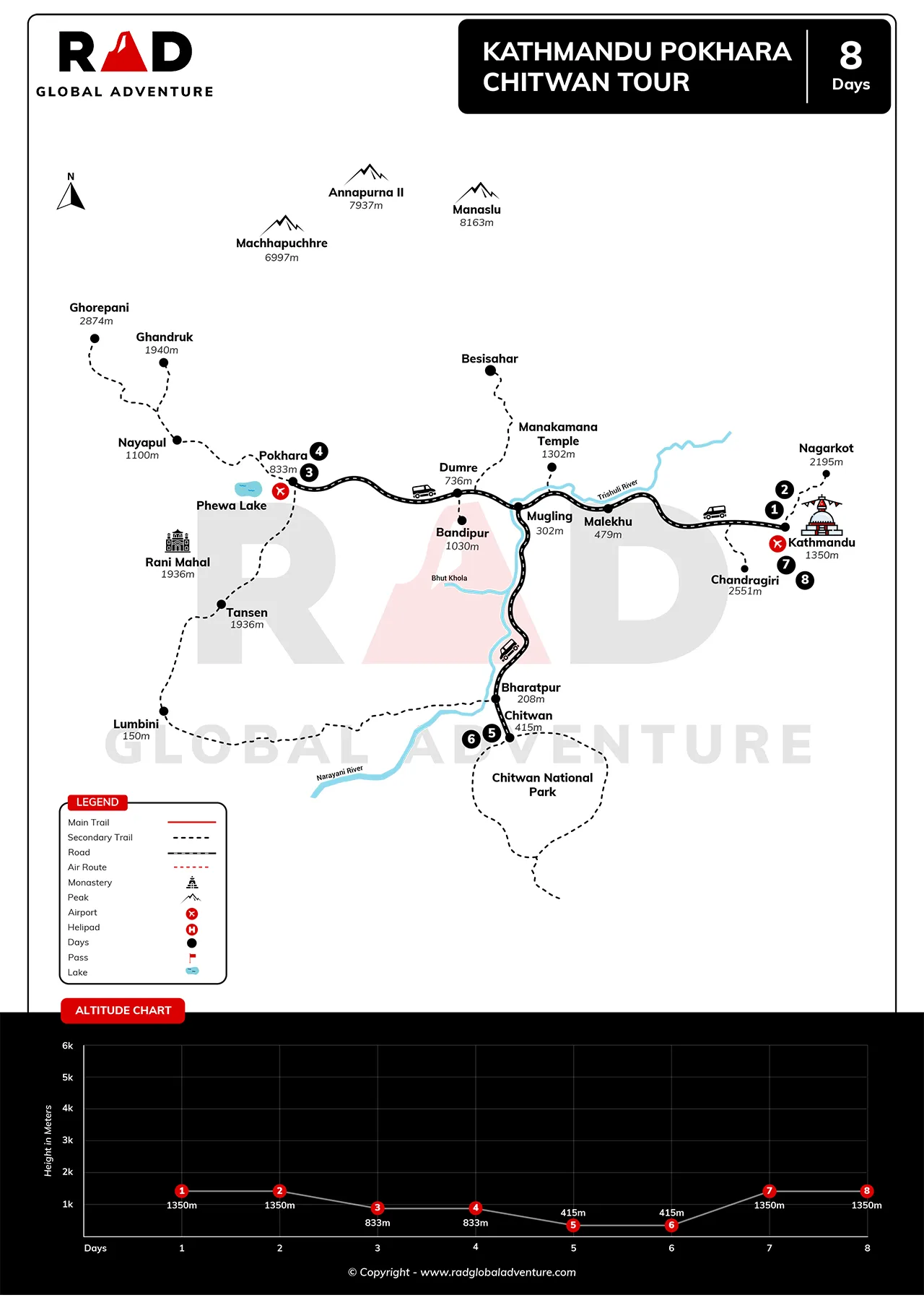
Route Map & Altitude Chart

Attractions and Highlights of Kathmandu Pokhara Chitwan Tour – 8‑Day Adventure

Discover Kathmandu’s Heritage

The historic heartland of Kathmandu is a living museum of Hindu and Buddhist culture, which are closely entwined. In Swayambhunath, golden steeples appear out of a whitewashed dome, and red-robed monks go round the stupa chanting mantras. The site at the hilltop provides a panoramic view of the Kathmandu Valley and the Himalaya.

In Pashupatinath Temple, religious cremations are undertaken on the banks of the Bagmati River, which are presided over by sadhus with dreadlocked hair. Close by is the giant Boudhanath Stupa that is circumscribed by prayer wheels and monasteries. It is a centre of Tibetan Buddhism in Nepal as it occupies a white dome and a gilded spire with a pair of eyes of the Buddha.

The Kathmandu Durbar Square comprises palaces, temples, and courtyards that are hundreds of years old. All of these sites are stories of the architectural and spiritual culture of Nepal, thus making the city an irreplaceable fusion of Nepalese culture.

Scenic Drive or Flights

Travelling to different places that include Kathmandu, Pokhara, and Chitwan gives one a vision of the diverse Nepali landscapes. On the way to Pokhara, the 200 km drive follows the Trishuli River, terraced fields, and rustic villages along the way.

Instant 25-minute transfer with aerial views of the Himalaya landscape is a benefit for people who go by flight. The Pokhara-Chitwan highway is a steep downhill journey of 90km, through the cooler hill terrain to jungle, river, sub-tropical forests, and farms.

On the way back to Kathmandu, you re-expedite your way towards the heartland zone. Road travel takes more time, although you will get to see what is happening on the highway and also have a chance to make a stop in local restaurants to have a tea. Riding down by road or flying overhead, the variable landscape is part of the trip.

Culture, Cuisine & Conservation

In this tour, travelers get acquainted with the rich culture of the Newar, Gurung, and Tharu people. In Kathmandu, you have a taste of Newari food, and you will see craftspeople creating metal statues and thangka paintings.

Pokhara is a city with rich Gurung hospitality with local music, and organically grown food. This is where you enjoy dinner of Phewa Lake fish and mouth-watering rice wine. Chitwan introduces you to Tharu villages that have mud dwellings painted with colorful murals and farmers telling tales of living with the jungle.

Conservation is a major element: Chitwan National Park serves as a home to the declining rhinos, tigers, and elephants, and the island Temple of Tal Barahi on Lake Phewa is a pilgrimage site and a place for tourists. Having an interesting local cuisine while indulging in the knowledge of wildlife conservation makes the trip more sustainable and keeps the trip rich to the tongue and the soul.

Wildlife Meets Wilderness: Get Wild in Chitwan

Chitwan National Park is home to 68 mammal species and over 540 bird species. The major attraction in this park is the greater one‑horned rhinoceros, which has unique armour-plated skin and a single horn.

Royal Bengal tigers also roam the sal forests, but it would certainly require you some luck and plenty of patience to sight one. Asian elephants herd across the grasslands and take a bath at the Rapti River, where the crocodiles are found basking.

Jeep tours, jungle walks, and canoe journeys make it possible to investigate various habitats. Nearby naturalists assist in the identification of birds, including colorful hornbills and darting kingfishers. Sighting of such biodiversity in their natural habitat forms an attraction of the Kathmandu Pokhara Chitwan Tour package.

Sunrise and Himalayan Views from Sarangkot

Perched on a ridge above Pokhara, Sarangkot is famous to get its sunrise view. In the early morning, you drive and then hike to an overlook at an elevation of approximately 1,600 m. The mountaintop peaks of Dhaulagiri, Annapurna I, Annapurna South, and Machhapuchhre (Fishtail) take on pink and gold tones as first light forms.

The 45-minute drive back is under terraced fields and sleepy villages coming awake to the day. The viewpoint at Sarangkot also has facilities to conduct paragliding, where adventure junkies can fly above the valley. You will not regret the money you spent, even though you are not an early riser, as the very sight of the sun and the view of the Himalayan range is priceless.

Sacred Sites & Spiritual Peace

The religious sites other than Kathmandu make the trips more interesting. A small island in Phewa Lake is the Tal Barahi Temple, a two-storey pagoda which can only be reached by boat. Worshippers get offerings of flowers and incense, and the quiet environment of the temple tempts an individual to stay calm.

The World Peace Pagoda on a hill to the south of Pokhara is the structure created by Japanese monks that aims to encourage world peace. This site has a scenic view of the lake and mountains that takes visitors to meditate.

The old Bishazari Tal (20,000 Lakes) wetlands of Chitwan are considered ecologically and culturally important by locals and support diverse wildlife. The temples of Kathmandu, Pokhara, and Chitwa give you a deep impression of the spiritual life and the chance to enjoy how the spiritual life can be connected to nature and community in Nepal.

Perfect for Families and First‑Time Visitors

The Kathmandu, Pokhara Chitwan tour package is perfect to fit in families and first-time travelers in Nepal. The pace of the itinerary is slow with moderate walking, driving, or comfortable stays. Activities such as boating, watching sunrise, and wildlife safari are attractive to both children and adults.

Tours in the city are interesting at their own pace, and the presence of interaction with the locals has an educational impact. There is no special training requirement since the altitudes are low and the grade is easy.

Safety is a priority: there will be professional guides, and safe lodges will be used during the excursion. Offering the best of both worlds, a bit of culture, nature, and even adventure, this tour is a mild introduction to Nepal and its wonders.

Trip Information of Kathmandu Pokhara Chitwan Tour – 8‑Day Adventure

Is this trip beginner‑friendly?

Yes. The Kathmandu Pokhara Chitwan Tour is tailored to entry-level trekking, thus it does not require any prior trekking skills or experience. There is limited walking as we spend most of the time driving to short city tours, a sunrise viewpoint, and a jungle stroll.

Also, there is minimal likelihood of altitude sickness as altitudes are below 1,600m. The itinerary will suit families with children, older travelers, and people with moderate fitness. Each day is matched to the group, with the guides deciding how fast or slow to go. To include extra adventure, people can include extra walks or flights without changing the basic itinerary.

Private Trip vs Group Joining

It is possible to organize this tour as an individual tour or in a group. These are ideal for couples, families, or friends who want to really tailor the pace of the trip, hotel options, and be able to alter the itinerary. You have freedom of selection in the dates of travel and can request special services like deluxe rooms or additional activities to the itinerary.

Group travel offers you a common resource in transport, a guide, and lodging. Typical group size is six to twelve. In a group, you will have fixed departure dates as well as a predetermined itinerary, but it will save you money and the opportunity to make new friends. Private or group, no matter the style, RAD Global Adventure offers professional guides, comfortable transportation, and priority to safety.

Trip Extension

You can extend your holiday in Pokhara by adding paragliding, zip-lining, or a two-day hike to Australian Camp or Ghandruk. You can also visit Lumbini, the birthplace of the Buddha, after Chitwan, and visit other monasteries and the Mayadevi Temple.

The Kathmandu Pokhara Chitwan package can be combined with a short hike of the Ghorepani Poon Hill trek; this takes four additional days and is a challenging to moderate-level of trekking. An alternative can be a visit to Bandipur, an enchanting Newar town between Pokhara and Kathmandu. You can pre- or post your extension as an add-on before or after the core itinerary; your travel advisor will recommend the choices based on your interests and timeframe.

Solo Trek

Solo travelers will find it easy and safe on this tour. RAD Global Adventure synchronizes airport transfers, a place to stay, guided tours, and you will never get lost. Independent travelers can book a group of a few people to retain the experience and cut down on expenditure, or opt to do their itinerary privately.

The itinerary is balanced so that a visitor can have time to reflect on what he or she has learned with their guide, as well as includes company cultural reports. Let people know about your day-to-day schedule, particularly when about in Kathmandu or Pokhara on your own, and take what your guide says up and about in the jungle of Chitwan will instruct you to do.

Photography & Drone Rules

Photography is one of the attractions, though never take photos of people without asking their permission, especially of monks or locals. Tripods are useful in temples and are used at sunrise.

Drones require a permit issued by the Nepal Civil Aviation Authority and the local municipality and are illegal in proximity to heritage sites and national parks. Remember to respect no photo zones and never bother animals in the process of photography.

Cultural Festivals on the Trail

There is always an alignment of your travel with the festivals in Nepal: Dashain and Tihar in autumn, the colorful Holi spring festivals, or Tharu Maghe Sankranti in January. Visitors are also welcome to watch, and sometimes participate. Dress conservatively, take off shoes in a temple or house, and adhere to guide etiquette standards to make your cultural encounters meaningful.

Tips for First‑Time Nepal Visitors

Bring a passport that is not expired (at least 6 months) and have your extra photos in case you want to apply to get a visa. Cash in terms of rupees is needed; there are not so many ATMs.

The recommended items to bring include pack layers, walking shoes, and bottled water. Make polite bargains in the market, and it is best to tip guides/drivers (USD 5-10 per day). Learn some easy Nepali phrases and learn to put a patient on Nepal’s slower pace.

Typical Daily Routine on the Tour

The day starts between 6-7 AM with breakfast, and the sightseeing or driving commences by 8 AM. The lunch is around midday, with the afternoon spent on exploring or reaching destinations.

Evenings are a dinner, briefings, or cultural performances. In Chitwan, early mornings are the best time to do wildlife. Long drives are tiring, so sleep early at night. Guides ensure there are sufficient rest stops and that the pace suits the group.

Mental Preparation & Trekking Mindset

This is not a strenuous tour, but there are long drives, delays, and a requirement for patience. Be open-minded to new practices and foods, learn to get out of bed early in the morning, and be tolerant of changes to plans due to weather or festivals. During the downtime, use books or music. Digitally disconnect, feel the temple atmosphere, the quiet of Phewa, and the sounds of the Chitwan jungle, and take a deeper trip.

Frequently Asked Questions

The package generally includes accommodation, breakfasts, airport transfers, guided city tours, park entrance fees, transportation between destinations, and jungle activities. Flights, some meals, and optional activities are extra.

Kathmandu to Pokhara is about a seven to eight‑hour drive. Pokhara to Chitwan is roughly four to five hours, and Chitwan back to Kathmandu takes around six to seven hours.

Yes. Kathmandu, Pokhara, and Bharatpur (Chitwan) can be reached by air. Flights last 25-30 minutes and are weather-dependent.

Absolutely, according to restaurants and lodges along the route, vegetarian, vegan, and gluten-free meals are offered along the route. Inform your tour operator well in advance of any dietary restrictions.

You will have comfortable hotel accommodation in Kathmandu and Pokhara, and safari lodges or simpler jungle resorts in Chitwan.

Families frequently make a reservation on this tour. Children are occupied with things such as boating, jeep safaris, and cultural shows. Make sure that they are accompanied during safaris and obey the guide.

Kathmandu and Pokhara are the only places that accept credit cards to make bigger purchases. Bring Nepali rupees in cash to tip, small stores, and in certain areas of Chitwan where ATMs are not available.

You may see one‑horned rhinos, elephants, types of deer, monkeys, crocodiles, and Bengal tigers. The park is also the home of more than 540 bird species.

Dress modestly with clothes that do not expose shoulders and knees. Before entering the temple, remove shoes and hats. Avoid leather products in Hindu shrines;s, this is impure.

The tip is not obligatory, but it is customary. It is a form to demonstrate appreciation of good service.

The currency is the Nepal rupee (NPR). The foreign currency can be exchanged at Kathmandu, Pokhara banks, and authorised money changers.

There are numerous ATMs in Kathmandu and Pokhara, but the number is relatively low in Chitwan.

The highest point of the peak is 1,600 m at Sarangkot.

Wi-Fi is common in Kathmandu and Pokhara restaurants and cafes. In Chitwan, broadband access and Wi-Fi are restricted in communal areas.

Yes. You may extend the tour with additional nights and adventure activities, or a side trip such as Lumbini or Ghandruk.

Pack comfortable walking shoes, lightweight clothing, a warm layer, a rain jacket, a hat, sunglasses, sunscreen, insect repellent, a reusable water bottle, a travel plug adapter, and any personal medications.

The tour is available year-round, but it is best to travel in spring and autumn.

Yes, park guidelines state that only an approved naturalist or guide can take one around during jungle activities to be safe and to conserve wildlife.

Routine vaccinations are recommended, so consult a travel clinic about hepatitis A, typhoid, and rabies vaccines. Malaria risk in Chitwan is low, but insect repellent and mosquito nets are advised.

Bookings should be made well in advance. However, during the off-season, it is possible to make a shorter notice booking.

Trip Reviews

expert-image
Need Help? Ask to Travel Expert
Get a Trip Quote Customize This Trip Make an Inquiry
  • Best Deal
  • Flexible Schedule
  • Instant Booking
  • No Hidden Costs
trip-advisor
5.0
25 reviews