expert-image
Talk to a Travel Expert +977 9818264758

Booking open for Nepal Trek 2025 & 2026

View Details
Kanchenjunga View Banner

Kanchenjunga Base Camp Trek

Based on 25 reviews
duration
Duration

24 Days

difficulty
Trip Difficulty

Difficult

max-altitude
Max. Altitude

5,143m

destination
Destination

Nepal

group-size
Group Size

2-16 People

meals
Meals

Breakfast, Lunch & Dinner

accommodation
Accommodation

Hotel, Teahouse

expert-image
Need Help? Ask to Travel Expert
Price starts

US$ 2600

23 Nights 24 Days
5% OFF

We offer group discounts

  • 1 - 1 person
    US$ 2900
  • 2 - 5 people
    US$ 2600
  • 6 - 9 people
    US$ 2450
  • 10 + people 9999
    US$ 2350

US$ 2900

Make an Inquiry
  • Best Deal
  • Flexible Schedule
  • Instant Booking
  • No Hidden Costs
trip-advisor
5.0
25 reviews

Overview of Kanchenjunga Base Camp Trek

The Kanchenjunga Base Camp Trek is one of Nepal’s most rewarding journeys into the heart of the Himalayas. Kanchenjunga is the third highest mountain (8,586 meters) and reaching its base camp is one of the most remote journeys in eastern Nepal. Unlike more popular trekking regions such as Everest and Annapurna, Kanchenjunga remains wild and untouched. Even compared to Upper Mustang, it is longer, higher, and more remote.

Our adventure begins with a scenic flight to eastern Nepal followed by a drive through rolling tea gardens to Taplejung. Leaving this point, the trail goes down into the Kanchenjunga Conservation Area where you will spend close to three weeks on ancient trails.

The trail winds through the Limbu and the Rai villages, across bridges in the Tamor River and the Ghunsa River on suspension bridges, and ascends gradually from subtropical jungles to alpine fields with rhododendrons and junipers. Each step opens you to a paradise of natural beauty and culture rarely found on mainstream trekking routes.

The trek gives you a reward of two amazing lookouts. The north base camp at Pang Pema (5,143 m) provides a panoramic view of the north face of Kanchenjunga, whereas the south base camp near Ramche, with the Oktang viewpoint (4,730 m) overlooking the Yalung Glacier, provides a different perspective. On the way you cross Buddhist monasteries, yak herders in high-altitude pastures, and if you are very lucky, you may glimpse a red panda, though sightings are extremely rare.

This is an intense adventure. The trek is approximately 24 days long and involves about 200 km of rough high-altitude terrain, several nights above 4,000 meters. It also is a restricted area and therefore trekkers must walk in pairs and be accompanied by a licensed guide. Special permits are also required. The cost ranges between USD 2,000–3,500 depending on group size, hotels in Kathmandu, private vs. shared jeep, and the number of acclimatization days. Packages generally include domestic flights, meals, guides, porters, and permits. The lower end covers basic teahouse accommodation, shared jeep transport, and essential inclusions.

The higher end includes better hotels in Kathmandu, private jeep transfers, additional acclimatization days, and more comfortable arrangements. The teahouses along the way are more modest and the pathway is much less flattened. It is quite remote, but this remoteness also makes it a very genuine Himalayan adventure.

At Pang Pema, you will realize why the trek is regarded as one of the greatest in Nepal as prayer flags straggle in the midst of gigantic ice walls. The pay-off does not only consist of scenic mountains, but also a sense of achievement and connection with landscapes and cultures that remain untouched by time.

Good To Know

The Kanchenjunga Base Camp Trek is one of the most physically demanding journeys in Nepal. The course features steep uphill and downhill climbs, an elevation gain of many high passes (above 4,000 meters) and several days above the tree line. Trekkers need prior multi-day hiking experience, require good cardiovascular endurance and determination.

Despite the fact that the itinerary contains acclimatization days, acute mountain sickness may occur. It is necessary to expect 5 to 8 hours of walking per day while carrying a daypack and living in teahouses. The Kanchenjunga is longer, higher, and more remote than Upper Mustang. Be very careful when making the arrangements. The safety and easiness will be increased by the fact that hiring a porter and a licensed guide is cheaper and more convenient.

Conditions in the Kanchenjunga area are very volatile in terms of weather due to its shifting through a number of weather zones. Spring (March–May) is warm with clear skies and it is the season of rhododendron blossoms. In autumn (September–November) brings crisp air, stable conditions, and excellent visibility of Kanchenjunga and Jannu.

Leeches, slippery trails, and monsoon rains (June to August) can be expected; in winter (December to February), deep snow is likely on high passes, such as Selele La (4,290 m). Note that high passes above 4,000 m may become impassable due to heavy snow in winter. Select your departure based on comfort with cold or wet weather. Bring along warm clothes, rain jacket and sun protectors. Mountains can best be viewed in the early mornings and evenings and particularly the north face of Kanchenjunga.

During the Kanchenjunga Base Camp Trek, teahouses serve simple yet hearty meals. The staple is rice, lentil soup and vegetables (dal bhat) often eaten twice a day. Noodles, potatoes, pancakes and eggs also form the menus. The higher the altitude the more the prices, meals typically cost USD 5–8 per meal at higher altitudes.

Pack energy bars, nuts and electrolytes as a supplemental source of energy. Clean water is essential—use purification tablets, filters, or buy boiled water. Avoid tap water and unwashed fruits. Tea, coffee, and the herbal infusions are commonly found and villagers may offer tongba (millet beer) if you visit their homes. Keep alcohol to the minimum because alcohol dehydrates you at high altitude.

Altitude is a major challenge on the Kanchenjunga Base Camp Trek. Acute Mountain Sickness (AMS) is the condition in which your body has trouble adjusting to decreased oxygen. The typical symptoms are a headache, nausea, fatigue as well as loss of appetite. Minimize risk by not climbing fast, taking plenty of water, having a well-nourished body, avoid alcohol and sleeping tablets.

The trek can have acclimatization days at Ghunsa and Khambachen. Never forget to mention to your guide in case any symptoms appear if it gets worse, descend immediately. Take acetazolamide (Diamox), consult your doctor before use. With proper pacing, most trekkers acclimatize well if they stay aware of their body and surroundings to experience the spectacular views of both base camps alertly.

Preparation is essential for the Kanchenjunga Base Camp Trek. Start training at least two months before departure. Work on your leg and core strength as well as your cardiovascular system (running, cycling, swimming). Take a hike uphill with a backpack in imitation of trek conditions. Include joint protecting, flexibility and balance exercises.

Some mental preparation is also essential- basic teahouses, few showers and long trekking days. Pack moisture-wicking layers, a down jacket, trekking poles, headlamp, sleeping bag liner, thick and strong boots. A solar charger helps ensure that your gadgets stay powered. The trek will be easier with proper training and equipment you can overcome the trek’s challenges.

Valid Nepal visa is available at Tribhuvan International Airport or at Nepali embassies, and is an essential requirement of all trekkers. The Kanchenjunga Base Camp Trek requires special permits because the area is restricted. You must trek with at least one other person and a government-licensed guide.

Restricted Area Permit (RAP): USD 20 per person per week (for the first 4 weeks; after 4 weeks, USD 25 per person per week); Kanchenjunga Conservation Area Permit: NPR 2,000 (USD 15–20). All the paperwork is normally handled by our guide in Kathmandu. Carry photocopies of your passport and passport-sized photographs.

Maintaining health and safety is vital on the Kanchenjunga Base Camp Trek. Carry a personal first-aid kit with bandages, blister care, pain relievers, and other prescription medications. Use only boiled water and freshly-cooked food. Himalayan sun is intense to deal with; hence apply sunscreen, use sunglasses, and a wide-brimmed hat. Wash your hands or sanitize frequently.

Trails may be rough and steep, and narrow; be extremely careful and do as your guide tells you. Emergency helicopter evacuation is available but very costly. Be mindful when taking photographs and when meeting people and be thoughtful of local culture by removing shoes before entering a home or monastery.

Your travel starts with a domestic flight to Bhadrapur, and jeep drive to Taplejung, through Birtamod. The return follows the same route, a two-way air ticket averages around USD 300–360, depending on season and airline. The standard price of a shared jeep between Birtamod to Taplejung is USD 40 to USD 45 and the cost relevant to the Birtamod to Taplejung by a private jeep is USD 250–300.

The roads are often muddy and bumpy during the monsoon season. Beyond Taplejung, there are no airports or roads, preserving the wild character of the Kanchenjunga Base Camp Trek. Your route of travel will then be entirely on trek (except that mules will be occasionally used to carry supplies).

With Kanchenjunga region, there are quite a number of variations on trekking trips to choose. A number of trekkers do a full circuit with the two base camps (north and south) and the Selele La (4,290 m). Others choose to take a shorter path to the north base camp at Pang Pema and back the same route.

A side trip can be added in Taplejung in the form of the Pathibhara Temple; this is a pilgrimage site of sacred hills. Other treks are shorter such as the trek of the Upper Mustang or the nearby Makalu Base Camp. However, the Kanchenjunga Base Camp Trek remains the most remote and rewarding choice for solitude and wilderness.

Alongside your package cost, expect some personal expenses during the Kanchenjunga Base Camp Trek. Teahouses also charge extra for boiled water, bottled beverages, hot water and charging of devices. Expect to spend money on snacks, treats, and occasional comforts along the trail. Tourist souvenirs and other additional costs like prayer flags, teas, or handmade crafts can also contribute to the costs.

In Kathmandu, the increment in hotel up-grading would be between USD 20-50/night. Consumables such as alcoholic beverages in the trail cost USD 5-8. There are ATMs only in Kathmandu and Birtamod, so don’t forget to take enough money with you when you make purchases on your way.

Kanchenjunga trail goes through the community that speaks Limbu and Rai dialects with Nepali being the common language. The trekking guides normally speak English and translate where there is a need. Know few words of Nepali like: Namaste (hello), Dhanyabad (thank you), and Sanchai? (How are you?). Respectful gestures, smiling, and polite body language help.

When ordering food, it is much better to point at the food items in the menu when there is a language barrier. Not only does communication help you on your journey but it also adds richer culture to the adventure you are undertaking whether in the villages of Kanchenjunga or trekking along trek routes such as the Upper Mustang.

Electricity during the Kanchenjunga Base Camp Trek comes mainly from solar panels or small hydropower units in villages. Teahouses charge USD 2–5 to charge a phone, camera etc. Carry power banks and some extra batteries to be ready. A little solar charger may as well come in handy in bright weather. At Ghunsa and Cheram there are communal sources to which visitors should always enquire before using them.

Wi-Fi can sometimes be found at a fee but it is slow and generally unreliable. Experience a digital detox and enjoy mountain life without screens. Connectivity during the Kanchenjunga Base Camp Trek is limited. Nepal Telecom SIM cards offer the most comprehensive coverage to eastern Nepal however the signal is lost relatively quickly beyond Taplejung. Coverage is lost quickly after Taplejung; Ghunsa/Cheram may have paid Wi-Fi but very slow.

Wireless Internet access may be available at some teahouses in Ghunsa and Cheram at a small charge and it will be irregular and very slow and unreliable. Avoid video conferences and the use of substantial data. When travelling, safety is a concern so a satellite communicator or Garmin InReach is recommended. Notify family and friends of long periods of non connectivity. Download maps prior to the trip.

Detail Itinerary

You arrive in Kathmandu, the capital of Nepal. You will meet an employee of RAD Global Adventure at Tribhuvan International Airport and transports you to the hotel. You can relax or enjoy walks in Thamel after your long journey or go to local temples.

During the evening you get to see the guide and other trekkers during a short discussion about the trek. This is an opportunity to raise equipment questions, permits and how to prepare. You will stay the night in a good hotel.

accommodation-small

Accommodation: Hotel

meal-small

Meal: Dinner

altitude-small

Max Altitude: 1,400m/4,593ft. (Kathmandu)

If our standard itinerary doesn't fully meet your needs, we are happy to tailor it to your specific preferences and requirements.

Includes and Excludes

What’s Included?

Transportation

  • International airport transfers
  • Flights Kathmandu – Bhadrapur – Kathmandu
  • Private jeep transfers Taplejung & Hapu Khola – Birtamod – Bhadrapur

Food and Accommodation

  • Full meals: breakfast, lunch & dinner on your choice.
  • Supplementary snacks: energy bar and cookies
  • Seasonal fresh fruits deserts every day
  • Unlimited chlorine treated safe drinking water
  • Hotel in Kathmandu and with breakfast and bed plan

Guide and Support Staff

  • An experienced english-speaking trekking guide
  • Porter service for luggage (one porter for every two trekkers)

Permit and Expenses

  • Restricted Area Permit (Kanchenjunga region)
  • Kanchenjunga Conservation Area Permit (KCAP)
  • Trekkers’ Information Management System (TIMS) card
  • All local and government taxes
  • Guide and porter salaries, insurance, equipment, transport, food and lodging

Medical and Gear

  • Oxi-meter: To check , heart rating and oxygen saturation
  • A comprehensive first aid kit
  • Emergency rescue in case of severe illness or injury (costs covered by your insurance)
  • Trekking equipment: down filled sleeping bag, walking poles and duffel bag
  • Free luggage storage in Kathmandu

Others

  • Farewell dinner in Kathmandu
  • Certificate of appreciation
  • Trekking route map and company t-shirt

What is not Included?

International Flights and Visa

  • International flights and visa

Food and Accommodations

  • Meals in Kathmandu (except farewell dinner)
  • Any hotel stays in Kathmandu before or after the trek

Travel and Medical Insurance

  • Comprehensive travel and medical insurance
  • Emergency rescue evacuation

Other Expenses

  • Personal expenses
  • Tips and gratuities
  • Personal trekking equipment
  • Unexpected expenses due to weather, flight cancellations, strikes, or natural causes

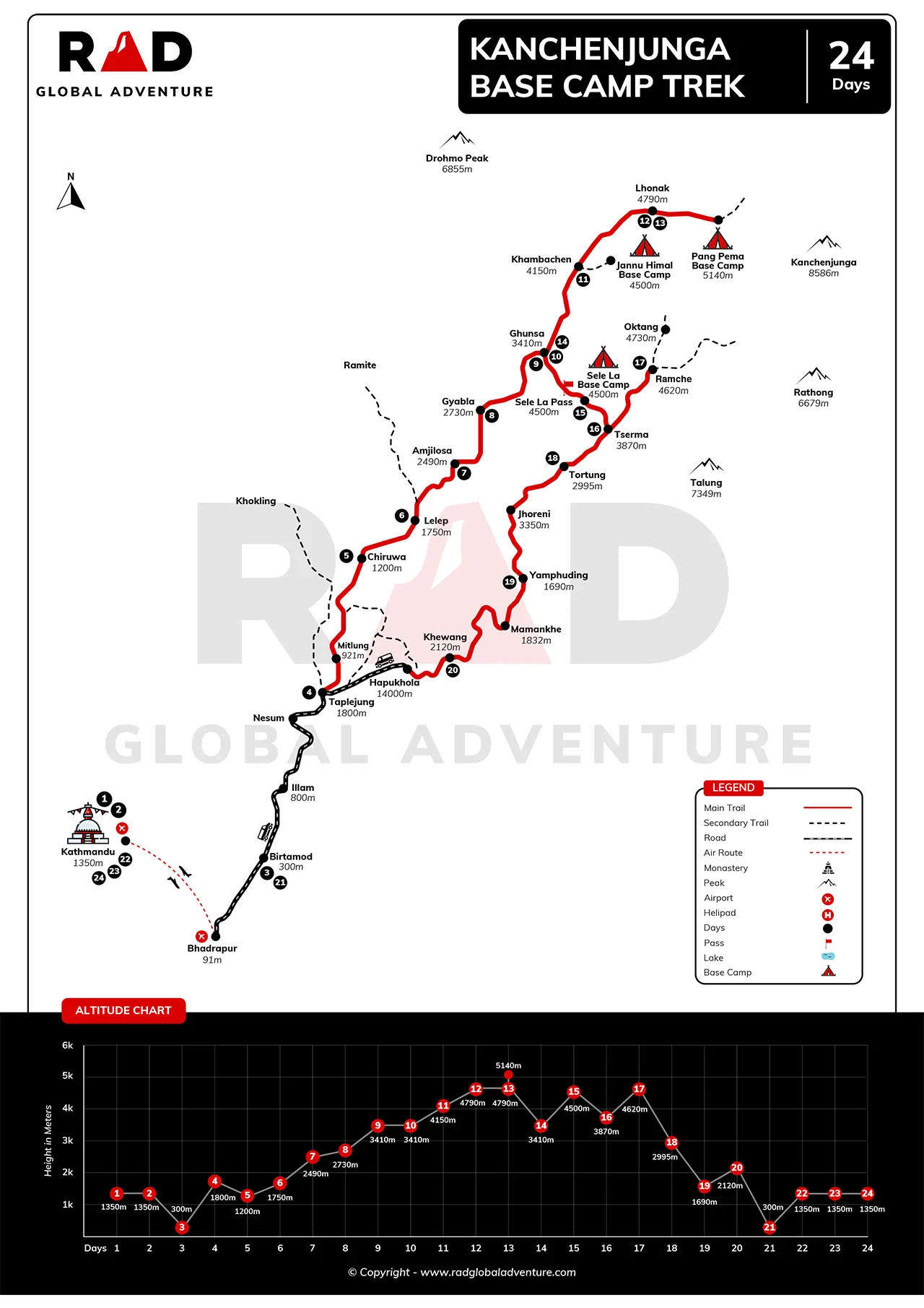
Route Map & Altitude Chart

Trip Information of Kanchenjunga Base Camp Trek

Is it beginner-friendly?

Complete beginners should not attempt this trek. It implies walking three weeks, having a daypack and surviving in the high altitude. There are sharp uphill changes of direction and downhill, landslides and simple tea-shops that require stamina. You can add to the experience, in case you are an advanced hiker, or you have already hiked through other long trails such as the Upper Mustang Trek. beginners who train hard and employ a guide and a porter occasionally manage to succeed, yet they have to be ready to face body and psyche challenges. The most effective method to test is initially trying shorter hikes to see how you can endure during an altitude- Langtang, Annapurna Base Camp or Everest View Trek. The Kanchenjunga trek can turn out to be the trip of a lifetime with dedication and correct planning and with a helping hand.

Private trip vs Group Joining

RAD Global Adventure provides individual and group departure. Traveling as a group reduces costs because guide and porter fees, transportation, and permits are shared. It brings companionship as well as an extra sense of security. But with group itineraries, it is fixed; we can not pick it up or take a detour. A personal journey is more expensive, yet more flexible-you can take more time to take pictures, change your walking plan and even provide a side trip like Pathibhara Temple or an extension of your journey to upper mustang. Families or friends travelling together are well covered by private groups. In any case, the company also provides a knowledgeable guide and porter, as well as assists with the logistics, including permits, flights and accommodation. Clarify your expectations when booking so that it is a smooth experience.

Trip Extension

Once the Kanchenjunga trek is finished, travelers often crave more adventures in the Himalayas. You may add on to your itinerary the holy Hindu temple of Pathibhara close to Taplejung and have panoramic views of Kanchenjunga and other mountains. It can also be combined with the Upper Mustang Trek, a trek into the former Kingdom of Lo with its walled city of Lo Manthang and Tibetan-style desert sceneries. Mustang trek involves various permits and meets approximately 10-14 days. Or visit cultural sites in Kathmandu Valley, take a safari in Chitwan National Park or take a flight to Pokhara, relax on its lakeside. When booking, speak to your agency about extensions, which can figure out logistics and obtain the requisite permits.

Solo trek

It is restricted to go trekking in the Kanchenjunga area alone since it is a restricted area. RAP requires 2 trekkers + guide as the minimum requirements. This regulation increases security in isolated communities. Not having a partner, you may take part in a group made by RAD Global Adventure or ask the company to match you with some other travelers. The guide takes care of navigation, translation and permits, and porters transport the heavy equipment. Individual travelers tend to enjoy the companionship which develops during lengthy expeditions. In case you want to go on a trek all by yourself, you can think of areas that are not restricted such as the Everest region or Langtang.

Photography & Drone Rules

The Kanchenjunga expedition offers unlimited subjects in photography- one can take a picture of smiling kids and panoramic views of the Himalayas. Never take pictures without asking the permission of people namely monks or old villagers. Show respect to cultural sites by not taking pictures when they have religious ceremonies without invitations. In Nepal, use of drones is subject to strict regulations; Flying drones in border areas near Tibet is strictly prohibited without special clearance and need to liaise with local agencies and your trekking agency. Drones are not allowed in military bases and along borders. In most villages, locals can feel that drones are disturbing; talk with your guide so that they do not offend the locals. Drones in conservation areas require CAAN & Ministry of Home Affairs approval. Batteries are slow to charge in cold altitude so warm them. It is best in early morning or late afternoon when the sun produces long shadows on glaciers.

Cultural Festivals on the Trail

The eastern Nepal cultural calendar is abundant. Limbu villages can also have Chasok Tangnam (Udhalek Nau), a November-December harvest ceremony, during which elders bless rice beer and give thanks to ancestors. Rai people hold Sakela (Toshi Tonga) dances where they dance with drums and wearing colourful costumes. At elevated altitudes, Tibetan Buddhist monasteries in Ghunsa and Phole mark the Losar (Tibetan New Year) with masked dances, prayers and feasts. The dates of Losar shift each year, usually between January and March. Prayer flags and coloured tika on the foreheads will be found during Dashain and Tihar (September-October), these festivals also align with the main trekking season.

Tips for First-Time Nepal Visitors

Research the Nepalese traditions and save some simple phrases of Nepali before you arrive. Dress modestly, especially in villages and temples. Give or accept things with both hands and be respectful. Secure your passport, permits and cash. Do not drink untreated water, and always eat freshly cooked food. In a bargaining situation on the markets, be friendly; haggling is also a part of the culture but it must be in a respectable manner. Pack adaptors (type C/D/M) and cash in small denominations. Allow time in travelling schedules-Delays occur because of weather and road situations. The tip is the norm; you should pay guides, porters and drivers. Finally, treat mountains like holy places; do not litter, pick wildflowers or disturb animals. These principles can be used whether you walk the Kanchenjunga, the Upper Mustang Trek or other parts of Nepal.

Typical Daily Routine on the Trek

Days are early- you are usually up at dawn when your guide wakes you up with a cup of tea. Pack daypack, sleeping bag, over breakfast. By 7-7.30 a.m. the team is headed out and walks 4-6 hours before lunch. Terrain varies from gentle paths to steep ascents, so pace yourself. Lunch is taken at a tea house at midday. Another 2-3 hours of walking reach your destination of the day by mid-afternoon. Have off time and rest, visit the village, write or do laundry. Meal time is at around 6 p.m. with briefing on the following day. A majority of the trekkers go to sleep at about 8 p.m. The same rhythm is followed on the Upper Mustang Trek, though the scenery is different.

Frequently Asked Questions

The journey lasts about 24 days to arrive and leave, including acclimatization and travel days.

Pang Pema has a north base camp at approximately 5,143 m; Oktang viewpoint near Ramche reaches 4,730 m.

Yes, it helps. Previous multi-day treks help you prepare for altitude and long days and elevation. It is better to begin with a shorter trek such as the Annapurna Base Camp or Langtang Valley Trek

Teahouses are simple where they have a common room and simple beds. Bring a sleeping bag, you may count on cold nights. Hotels in Kathmandu are comfortable.

Teahouses deliver small amounts of power with solar panels or micro-hydro. Charging costs US $2-5 per hour. Bring extra batteries and a power bank.

One might expect packages to include guide and porter fees, permits, in-country flights, transport, lodging and breakfast, lunch and dinner.

Yes. Dal bhat is vegetarian and lodges can make vegetarian meals. Vegan options are limited—bring snacks.

No. ATM is only found in Kathmandu and in Birtamod. Bring enough Nepalese rupees for personal expenses and tips.

Yes. Medical treatment and helicopter evacuation insurance up to 6,000 m is required.

Consult your doctor. The hepatitis A/B, typhoid and tetanus vaccines are usually prescribed. Bring a first-aid kit and personal medicines.

There are no official restrictions, but trekkers are expected to be physically fit. People who are below 18 are supposed to walk with a guardian and see a doctor.

Make a reservation at least two months in advance so as to have permits, flights and experienced guides. Autumn and spring departures fill quickly.

Typically, yes, however, outlets can be busy or non-existent. Schedule days when you will not charge and then switch on airplane mode to save battery.

Slowly ascend, keep hydrated, eat well and get rest on acclimatisation days. Diamox may be taken with doctor advice.

Yes, licensed guides speak English and sometimes other languages as well. Porters can speak only a small amount of English, but they are familiar with trekking routes.

Yes. A lot of agencies provide combined itineraries. Plan additional permits and at least 10 more days.

Hiking boots, warm layers, rain gear, trekking poles, sleeping bag, water purification, headlamp and personal medicine are listed in detail.

Drones are subject to license and government allowances. Do not disturb local privacy, work with your guide to get permissions.

Guides have communication equipment. In severe situations, trekkers are evacuated by helicopters to Kathmandu with injured trekkers. Make sure rescue is insured.

These are both difficult; Kanchenjunga is longer, more remote, and less developed than Everest Base Camp. A limited number of facilities and increased distances make it more challenging to many trekkers.

Trip Reviews

expert-image
Need Help? Ask to Travel Expert
Price starts

US$ 2600

23 Nights 24 Days
5% OFF

We offer group discounts

  • 1 - 1 person
    US$ 2900
  • 2 - 5 people
    US$ 2600
  • 6 - 9 people
    US$ 2450
  • 10 + people 9999
    US$ 2350

US$ 2900

Make an Inquiry
  • Best Deal
  • Flexible Schedule
  • Instant Booking
  • No Hidden Costs
trip-advisor
5.0
25 reviews