expert-image
Talk to a Travel Expert +977 9818264758

Booking open for Nepal Trek 2025 & 2026

View Details
Paro Taktsang

Jomolhari Trek Bhutan

Based on 25 reviews
duration
Duration

11 Days

difficulty
Trip Difficulty

Moderate

max-altitude
Max. Altitude

4,930m

destination
Destination

Bhutan

group-size
Group Size

2-16 People

start-end
Start / End

Kathmandu / Kathmandu

meals
Meals

Breakfast, Lunch & Dinner

accommodation
Accommodation

Hotel, Tented Camp

expert-image
Need Help? Ask to Travel Expert
Get a Trip Quote Customize This Trip Make an Inquiry
  • Best Deal
  • Flexible Schedule
  • Instant Booking
  • No Hidden Costs
trip-advisor
5.0
25 reviews

Overview of Jomolhari Trek Bhutan

The Jomolhari trek in Bhutan is a famous 11 day adventure combining high Himalayan trekking with rich Bhutanese culture. It begins at the Paro Valley and through some of the most clean forests, traditional villages and the base of the mountain Jomolhari. You explore the popular attractions, such as the cliffside Tiger’s Nest Monastery, and spend the night in the starry skies near snow capped mountains.

The path is between Paro and Thimphu, remote parts of Bhutan often not visited by travelers.You should expect to walk on different types of ground, including rice terraces and pine forests in the lower valleys, alpine meadows and glacier valleys in the higher mountains. The track is inside the Jigme Dorji National Park that is a wildlife shelter. If you’re lucky, you might spot Himalayan blue sheep or a variety of high altitude birds during your Jomolhari trek.

Two high mountain passes are also crossed along the route, Nyele La (4,830 m) and Yeli La (4,930 m), and get to enjoy a panoramic view of such sacred peaks as Jomolhari (7,326 m) and Jichu Drake.This Bhutan Jomolhari trek is fully guided and supported by a local crew (as solo trekking in Bhutan is not permitted). That will include an informed guide, a cook, pack animals and camping personnel to look after the logistics. Each evening you come to a ready campsite with tents and a hot meal ready.

Trekkers need to be in good shape and moderately strong, with approximately 5 to 7 hours of walking per day at high altitude. To allow your body to acclimatize to the thinner air, a rest and acclimatization day is included. Besides the natural beauty, the trek provides a cultural experience. You will pass remote Bhutanese villages where life has not varied much in centuries and you will visit ancient fortresses (dzongs) and monasteries on your way.

By the time you finish in Bhutan’s capital, Thimphu, you will have experienced the Jomolhari trek as both a physical challenge and a deep dive into Bhutan’s unique Himalayan heritage. The trip is a great option among trekkers who want an off the beaten path experience within the Land of the Thunder Dragon. Prepare to see some of the most memorable mountain ranges and the warm hospitality of Bhutan with this exciting adventure

Good To Know

The Jomolhari trek is considered a moderate to challenging Himalayan trek. No technical climbing experience is required, although you must be in good condition and have some prior hiking experience. It is a trekking route with lengthy days of walking (5-8 hours) through hilly areas with sharp rises to the top of high passes. It is nearly 5,000 m high hence making it more challenging due to the thin air.

With preparation, beginner trekkers can accomplish the trek, although it is not an easy walk. Active training before the trip and some experience at altitude (or multi-day trekking experience) will help you comfortably tackle the Bhutan Jomolhari trek.

The Himalaya weather is unpredictable, though Bhutan has specific trekking seasons. The best time to do the Jomolhari trek is in spring (April–June) and autumn (September–November) when skies are generally clear and temperatures moderate.

The weather in these months is a cool day to go hiking and nights are cold but bearable. Daytime highs of 10–20 °C are expected at lower levels, and temperatures are colder at high camps, and nights may drop to below zero at Jangothang Base Camp. Summer monsoon (July-August) is rainy and leaves muddy tracks which is not suitable for trekking. The winter brings very cold temperatures and snow or ice may make passes impassable at times.

On the Bhutan Jomolhari trek, all meals are provided and prepared by a dedicated camp cook. You will have a combination of Bhutanese and Western cuisine, which will keep you well nourished and refreshed. Breakfast may contain porridge or eggs and toast and dinner may be rice or noodles with seasonal vegetables and (such as chicken or lentils) spiced with local mild flavors.

Lunch is typically a hot picnic lunch on the trail or a scenic stop. Safe drinking water is available as our crew boils or filters stream water for you each day. Avoid drinking untreated stream water. Camp is also likely to have tea, coffee and snacks.

Altitude sickness is a concern on the Jomolhari trek because you will be sleeping above 3,500 m and climbing over 4,900 m at the passes. The itinerary is also planned with acclimatization in place there is a rest day at Jangothang (4,050 m) to allow your body to become easy. Nonetheless, one should take his/her time, keep hydrated, and observe your body.

The most common mild side effects are headache, fatigue, or shortness of breath. Your guide will take care of the health of everyone and carry a basic first aid kit. In case a person shows severe Acute Mountain Sickness (AMS) symptoms, the quickest solution is to reduce the altitude and, in case of necessity, to organize evacuation.

Preparing for the Jomolhari trek will make your journey much more enjoyable. Begin training at least 8-12 weeks prior to your travel. You should emphasize cardio exercises, such as jogging, cycling, or swimming to train stamina, and you should engage in exercises that strengthen your leg muscles (hiking up the mountain, stair climbs, or squats with weights) so that your muscles are prepared to the climbs.

When you can, do a bit of practice walks with a daypack to break in your boots, and to make them more enduring. The day before you arrive in Bhutan or some light hikes (such as the Tiger Nest acclimatization hike) will make your body acclimatize. Good fitness will let you fully enjoy each day of the Bhutan Jomolhari trek.

Any foreigner (except Indian nationals) should have a Bhutanese visa and trekking permits which are obtained prior to their travel with the help of a licensed tour operator. You can apply for your visa online and book services directly; however, for trekking routes and protected areas you must be accompanied by a licensed Bhutanese guide, and most visitors use an official tour operator. The typical Bhutan visa process takes a scan of your passport and a single visa fee (usually around USD $40), and is applied for in advance by your licensed tour operator and stamped on arrival in Paro with a Visa fee US$40.

Moreover, Bhutan imposes a Sustainable Development Fee (SDF) on tourists in the country on a daily basis. SDF is US$100 per person per night for foreign nationals and INR 1200 per night for Indian nationals. We will also obtain permits to Jigme Dorji National Park and trekking areas which is typically form part of the trip price and are handled behind the scenes. All you need to do is make sure that you have a passport that is at least six months active after the trip and leave the paperwork to RAD Global Adventure.

Bhutan is a safe place to visit and the trek is arranged keeping your well-being in mind. A trained guide accompanies you throughout the Jomolhari trek, ensuring you follow safe trail practices and acclimatize properly. The trekking crew will have a first aid kit, they are familiar with such frequent problems as simple injuries or inappropriations caused by the altitude. To keep healthy, it is necessary to have good hygiene on the trail so, drink boiled or filtered water and wash or sanitize hands frequently.

Wildlife sightings are rare and usually safe if you respect the animals by keeping your distance and not feeding them. Your guide can organize evacuation in case of emergency. In Bhutan, some of the routes have helipad spots, or you can be taken to the closest road by horseback(subject to weather, terrain, and availability; not always immediate.).

Generally, with the guidance of your guide and reasonable treks, you can have a safe adventure in Bhutan. Helicopter support and evacuations are weather- and terrain-dependent and not always immediate.

Paro International Airport (PBH) is Bhutan’s sole international airport. The trip will entail RAD Global Adventure taking care of all the local transportation. A personalized vehicle picks you up at the airport. You will have brief journeys to sightseeing (such as to trailheads or between Thimphu and Paro). The trek itself involves the use of pack animals (horses or yaks) to convey equipment between camps, and does not involve vehicles after you are on the trail.

A vehicle will also be arranged to meet you at the end of the trek (at Dodena, to the north of Thimphu) and bring you back to civilization. All road transfers, such as the 30-minute drive to the trek start point or the 2-3 hour drive between the trail end and Thimphu/Paro, are included and in comfortable private cars. The roads in Bhutan are scenic, however, winding and hence transportation is not only convenient, but also enjoyable.

The classic Jomolhari trek described here is the longer route from Paro to Thimphu (around 7 trekking days plus acclimatization). There is another path called the Jomolhari Loop that has a shorter alternative. The Jomolhari Loop is generally a 5-day hiking journey that begins and finishes in Paro to the Jangothang Base Camp and then returns via another trail (which may go through the Bhonte La pass) without stopping at Lingshi.

It is an excellent option in the case you have limited time and want to explore Jomolhari Base Camp. At the other end, in case you need something even more adventurous, you can continue past Lingshi to the Laya-Gasa trek or even to the Snowman Trek of Bhutan (one of the toughest 3-week treks in the world) which passes through the Jomolhari trail. These will lead you on further into the wilderness of Bhutan beyond the standard Jomolhari itinerary.

The Jomolhari trek package is generally all-inclusive, covering your meals, accommodation (hotel and camping), guide, permits, and transfers. There are however some additional expenses that should be planned. You may use the money in Paro and Thimphu to buy snacks, alcoholic beverages or even have dinner that is not part of the program (such as exploring on your own during the evenings).

Tips to your guide, cook, and trek crew are usual at the end of the trek, so you should budget a bit of cash to tip, to demonstrate your appreciation (again, the amount is up to you, most travelers tip about 5-10% of the trip cost shared among the staff). Another personal cost is the souvenirs: there is some gorgeous handicraft in Bhutan, and you might also like purchasing, as souvenirs, things such as prayer flags, textiles or handmade paper. And, also, when you intend to carry a camera drone (note: this requires special permission in Bhutan) or other equipment, which will require fees, it is up to you.

A bit of USD is also a good idea and then change to Bhutanese Ngultrum (Nu) or even Indian rupees (widely accepted in Bhutan) to make small purchases and tips. As ATM reliability with foreign cards is not always consistent, carry as many dollars as you will spend on yourself during the trip.

The national language of Bhutan is Dzongkha, although most of the guides and other people in the tourism sector speak English. During your Bhutan Jomolhari trek, you will have an English-speaking guide, so communication won’t be a problem. Most people on the road can speak a small amount of basic English but they mostly use Dzongkha, or local dialects. You can learn two easy Dzongkha greetings (such as Kuzuzangpo la which means hello) and make people happy when you greet them.

Communication In the cities you will be communicating normally, but when on the trek you will be largely off grid (see the section on Mobile Network and Internet). There is usually a plan of how to communicate in an emergency scenario in the mountains, or guides usually have a satellite phone. Language barriers are minimal for tourists as the Bhutanese people are very welcoming and a warm smile is always enough to connect even without words.

As soon as you get out of Paro and enter the mountains, mobile connections and the Internet become extremely weak. Local SIM cards (B-Mobile or TashiCell) are available in Paro and Thimphu and provide 3G/4G connection in town. However, on the Jomolhari trek, do not expect consistent connectivity, most of the route is remote.

There may be some phone signal at some of the high points or around villages at the beginning of the trail, but otherwise, it is a digital detox. Camping places such as Jangothang or Lingshi do not have Wi-Fi or cell coverage. To charge your devices, you will need to carry a power bank or extra batteries.

There is no reliable electricity on the trek; bring power banks or spare batteries. Our support crew may have solar panels, but there are no public charging points. Support crew may carry solar chargers for their use, the trek has no charging points whatsoever, the support team usually brings in solar chargers or battery lamps to charge their own devices. Save your phone battery by turning it off or going into airplane mode and utilize the phone primarily as a camera.

Detail Itinerary

We will reach the Paro International Airport where our guide will be very happy to introduce us to Bhutan, the Land of the Thunder Dragon. Our short drive to the hotel follows beautiful country and houses. After a restful stay, we will take a trip to the beautiful sites of Paro.

Next we will explore Rinpung Dzong, a fantastic fortress with monks and local offices, and then we will visit Kichu Lhakhang, the oldest temple in Bhutan that was built in the 7th century. The early evenings, we will be able to take a walk through the silent streets of Paro, observe the wooden houses, and have the first dinner together. We will spend a night in a friendly hotel in Paro.

accommodation-small

Accommodation: Hotel

meal-small

Meal: Lunch, Dinner

altitude-small

Max Altitude: 2,350m/7,710ft. (Paro)

If our standard itinerary doesn't fully meet your needs, we are happy to tailor it to your specific preferences and requirements.

Includes and Excludes

What’s Included?

Transportation

  • International airport transfers in Bhutan
  • All private ground transportation during the tour and trek
  • Support vehicle and pack animals (yaks/horses) for luggage during the trek

Food and Accommodation

  • Hotels in Paro and Thimphu (twin sharing) and tented camps during trek
  • Full board meals (breakfast, lunch, dinner) during the trek
  • Unlimited safe boiled or filtered drinking water
  • Farewell dinner in Kathmandu


Guide and Support Staff

  • Experienced English-speaking Bhutanese trekking guide
  • Porter or pack animal service for luggage transport

Permit and Expenses

  • Bhutan visa arrangement and travel permit feesAnnapurna Conservation Area Permit (ACAP)
  • Royalty and sustainable development fees (SDF)
  • Trekking permit for Jomolhari route
  • All local and government taxes
  • All staff wages, meals, transportation, and insurance included

Medical and Gear

  • Basic medical first aid kit carried by the guide
  • Camping equipment: sleeping tent, dining tent, toilet tent, and sleeping mattress
  • Emergency rescue coordination (cost covered by your insurance)

Others

  • First aid medical kit
  • Company service charges
  • Trip completion certificate

What is not Included?

International Flights and Visa

  • International flights and visa

Food and Accommodations

  • Meals or hotel stays before arrival or after departure
  • Extra snacks, bottled drinks, or alcohol

Travel and Medical Insurance

  • Comprehensive travel and medical insurance
  • Emergency rescue evacuation

Other Expenses

  • Personal expenses
  • Tips and gratuities
  • Unexpected expenses due to weather, flight cancellations, strikes, or natural causes

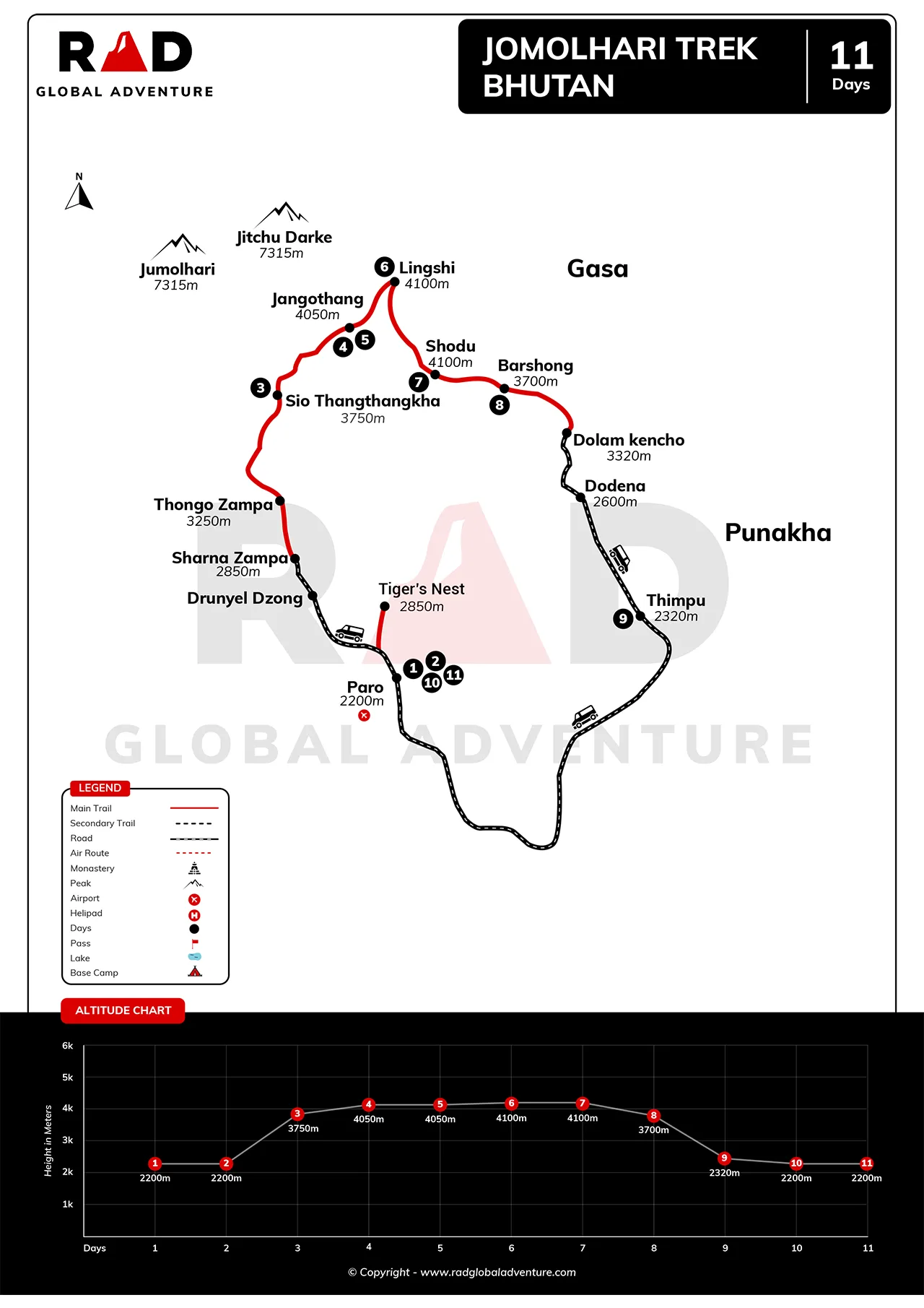
Route Map & Altitude Chart

Attractions and Highlights of Jomolhari Trek Bhutan

Visit the Famous Tiger’s Nest Monastery

We will also make hikes to Tiger Nest Monastery (Paro Taktsang) which is located at the top of a cliff overlooking Paro Valley. The path passes through pine forest with prayer flags and a serene outlook coffee shop along the way. We shall move slowly, savor the serenity, and pay a visit to the shrines, where there are the monks who pray and pilgrims light butter lamps.

Your guide will tell you about the story of Guru Rinpoche, who, according to legend, meditated here. On the other side of the canyon, we will also be able to enjoy the postcard worthy sceneries of the white walls and the golden roofs constructed into the rock. This increase gradually accustoms us to increased days of trekking and provides us with a significant cultural beginning. We will go back to Paro inspired and acclimatized.

Trekking in Traditional Bhutan Villages

We will cross small villages such as Sharna Zampa, Soi, Takethang, and Dangochang, where people live their everyday lives slowly. We will find stone and wooden houses carved into circles of windows, fluttering prayer flags, and barley or buckwheat fields. People welcome tourists with Kuzuzangpo la, and we might find gho clad men and kira clad women working on farms or weaving.

We will walk in a good order, we will keep the trail tidy, and take a good smile or a cup of butter tea if offered. These scenes allow us to relate to the Bhutanese culture in a simple manner. Sharing the way with villagers and yak herders, we will learn that these mountains are not only beautiful, they are home.

Breathtaking Mountain Views (Jomolhari, Jichu Drake, Tshering Gang)

With the trek, we will have beautiful mountain sceneries. We will see The Mount Jomolhari (7,326 m) when we reach Thangthangkha and then above it at Jangothang. At sunrise and sunset, the light will paint the snowy faces gold and pink. At its side we shall have the steep summit of Jichu Drake, and, higher up than that, the ridges of Tshering Gang.

The angles and light will shift with every turn of the day and provide us with new ideas to shoot pictures and have a silent private moment. We will make frequent breaks to see the scene, inhale deeply, and enjoy the stillness. These views will be part of our best memories in Bhutan.

Crossings of High Passes (Nyele La and Yeli La)

The trek will have two high passes, which will be the most challenging and the most proud moments. We will initially ascend gradually to Nyele La (4,830 m), the place where we will walk between moving prayer flags and gaze back at Jomolhari and Jichu Drake.

The following day, we will climb Yeli La (4,930 m) the point of the path. We will also take time, drink water and go slowly to get used to the thin air. We will celebrate with every passing cross, take pictures, and be thankful that we made it across safely. Those long ways down to camp will be satisfying. These crossings will show us how patience and teamwork can take us to beautiful places.

Diverse Landscapes: Forests to Glacial Valleys

The diversity of the scenery we will pass in several days will be immense. Farther down we shall follow streams and cross blue pine, oak, and rhododendron woods. At elevation, trees will yield to open fields, shrubs, and grazing yaks. Along the passes, there will be alpine lakes, rocky debris, and small areas of snow or ice.

Once across we will pass into more fertile valleys which have streams and waterfalls, and then back to forest near Barshong. It is a subtle alternation between forest and tundra and vice versa that makes every day fresh and exciting. Seasonal flowers, the changing bird-call, and novel perspectives will present themselves to us round every turn.

Spot Rare Himalayan Birds and Wild Life

We will have our eyes open to wildlife within the Jigme Dorji National Park. We can find colorful birds in the forests such as Himalayan monal or blood pheasant. As the hill gets steeper, we will look out after yellow-billed choughs and hopefully, golden eagles or lammergeiers flying off. We might see yak herds and possibly blue sheep on rocky slopes.

Although chances to see such animals as red panda or snow leopard are extremely low, the possibility that they inhabit this land makes it all the more exciting. We will watch without disturbing, never give food to animals, and never get too close. These are tiny, mindful experiences with nature that will be bringing our hike to life.

Visit Ancient Monasteries and Barshong Dzong Ruins

We will incorporate culture into our mountain days. We will start with Kichu Lhakhang and Rinpung Dzong in Paro to introduce the atmosphere. On the road, we shall observe Lingshi Dzong on its ridge which reminds us of the history and religion of Bhutan.

Towards the finish, we will pass through the moss covered ruins of Barshong Dzong and experience the silent grace of a place gradually returning to nature. Our guide will tell you easy stories and myths of the locals, and we will know why these valleys are sacred. We will operate with respect, leave with only photos and footprints. These trips will provide an even greater attachment to Bhutan than the scenery.

Travel Information

Is this a beginner-friendly trip?

Yes, with preparation. The Jomolhari trek is moderate, so we recommend that first-timers train for several weeks with regular hikes or cardio and practice walking on hills with a daypack. You will pass passes close to 5,000 m and that is rough due to the thinner air and cold yet the path is on laid tracks and requires no technical climbing.

The logistics are done by a licensed guide and a support crew, and this means that you are free to progress at an even pace, hydrate and concentrate on acclimatization. In case you have not done much trekking before, we would recommend an additional acclimatization day and adopt a positive, slow and steady attitude. A lot of motivated Trekkers do this trek and walk away with their own sense of accomplishment.

Group Joining vs Private Trip

The both are good options and the one you choose will depend on your preference of traveling. You can customize your own adventure by picking your own dates, determining your own actions, and asking minor changes like an extra photo day or a day off. Your guide pays all his attention to your group, which is appropriate to families or friends who want to have a personal experience.

Group departure gives you a readymade team, cost sharing, and a camp experience filled with stories and encouragement. Groups tend to be small, and the experience remains personal. All treks in Bhutan are guided and pre planned, so either model is comfortable and secure. Choose what you want, and we will align the plan with your style.

Trip Extension

You may easily continue your adventure. In Bhutan we can include some mild cultural days in Punakha, Phobjikha or bumthang in terms of temples, valley treks and farmhouse dinners. You can always do additional hiking; one of the options is to add the Druk Path 5-day trip to Jomolhari which follows a rest day.

We will take care of the logistics, permits, and pacing in such a way that it does not feel like the extension happened. Note that additional nights in Bhutan will increase visa and daily charges, but most visitors consider this added richness and diversity to be well justified when they have already travelled so many miles.

Photography & Drone Rules

There are thousands of photo opportunities, such as cliffside monasteries, yak pastures, and high passes. You must ask permission before taking pictures of individuals, not to take photographs when people are praying, and bear in mind that in most temples and shrine room’s photography is prohibited.

The use of drones in Bhutan is highly regulated, and visitors would require prior government permission, which is hardly ever issued in cases of leisure travel, so unless you want to be fined or have your equipment taken away, you better keep your drones at home. Rather, bring extra batteries, a power pack, and a polarizing lens when those high-altitude bright days hit. We will inform you about local etiquette every day to record respectful, memorable photos without any trouble.

Cultural Festivals on the Trail

Big festivals occur in towns, rather than on the long path, so we recommend planning your trip around a Tshechu in Paro (spring) or Thimphu (autumn) before or after the trek. You will see masked dances, listen to the ceremonial music, and mix with locals in their best clothes, which also creates the rich context of your mountain adventure.

It might happen that you will find small village ritual along the path, archery competition over the weekend, or monastery activities in the case of the schedule coinciding, but these are not guaranteed. Inquire whether a festival is important, and we will arrange your dates so that you can trek Jomolhari and still have an opportunity to enjoy the living Bhutanese culture.

Tips for First-Time Bhutan Visitors

Travel lightly and kindly. Wear simple clothing at holy places, walk clockwise around chortens, and embrace hospitality with a smile. Keep cash in hand to buy small items because cards and ATMs are not always available. Stay healthy by hydrating, dressing for the unpredictable, wearing sun protection, and talking with your doctor about altitude medication (where necessary).

Look forward to poor connectivity on the hiking trail and take the digital detox. Tell us what you like in spices; we can change meals. To ensure Bhutan is kept clean, pack in waste, and keep on the trail. English is common and therefore it is good to interact with your guide and hosts they enjoy narrating their stories and values.

Frequently Asked Questions

No. Bhutan does not allow independent trekking. Any visitor should bring a licensed guide on a journey through an approved tour operator who will arrange your permits to make your journey easy and safe.

The peak will be Yeli La Pass which is approximately 4,930 m, and the next point will be Nyele La which is approximately 4,830 m. Both provide spectacular mountain scenery.

You will tend to walk 5-7 hours daily depending on the terrain. There are days that are shorter and then the longest day (crossing Yeli La) could take approximately 8-9 hours.

Altitudes do not have similar temperatures. Day time is usually pleasant (10–15 °C), and night at upper camps may drop as low as below freezing (–5 °C to –10 °C). It is necessary to wear warm dresses.

The main duffel bag will be carried by friendly pack animals like horses or yaks. All that you need is a small day pack containing essential items such as water, snacks, and a camera.

Please bring heavy hiking shoes, layered clothing, a down jacket, gloves, a warm hat, sun protection, trekking poles, a sleeping bag (comfort –10 °C), and any prescribed personal medications. We will give a complete packing list in advance.

You will have access to clean toilets tent at every camp site. You will get a bowl of warm water with which you wash yourself in the morning and evening. Hotels offer full bathroom facilities during and after the trek.

Your guide is first aid trained and will look after you well. When necessary, we may slow the pace, rest, or organize evacuation. We always value your health and safety.

None of the specific vaccines is necessary. It is however a good idea to keep abreast of the standard shots and communicate with your physician before travelling about altitude medication (like Diamox).

We have small groups and typically 4-8 individuals, which gives our organization a personalized, friendly, and only a low environmental impact.

Trip Reviews

expert-image
Need Help? Ask to Travel Expert
Get a Trip Quote Customize This Trip Make an Inquiry
  • Best Deal
  • Flexible Schedule
  • Instant Booking
  • No Hidden Costs
trip-advisor
5.0
25 reviews