expert-image
Talk to a Travel Expert +977 9818264758

Booking open for Nepal Trek 2025 & 2026

View Details
Gokyo Lake Trek

Gokyo Lake Trek

Based on 25 reviews
duration
Duration

12 Days

difficulty
Trip Difficulty

Moderate

max-altitude
Max. Altitude

5,357m

destination
Destination

Nepal

group-size
Group Size

2-16 pax

meals
Meals

Breakfast, Lunch & Dinner

accommodation
Accommodation

Hotel, Tea House

transportation
Transportation

Bus , Flight

expert-image
Need Help? Ask to Travel Expert
Get a Trip Quote Customize This Trip Make an Inquiry
  • Best Deal
  • Flexible Schedule
  • Instant Booking
  • No Hidden Costs
trip-advisor
5.0
25 reviews

Overview of Gokyo Lake Trek

If you’re looking for a trek that feels real, not just scenic, but raw and quiet and full of moments that stick. The Gokyo Lake Trek gives you just that. It’s not the busiest route, but it’s the one with long views, frozen lakes, and trails that don’t feel crowded. You will get to walk beside the Ngozumpa Glacier, the longest in Nepal. It’s 36 kilometers of ice and rock, snaking through the high Himalayas. The path to Gokyo follows its edge. Prayer flags flap in the wind, marking the way across rocky moraines.

You’ll see the sixth lake mostly frozen, even in spring. The lower ones reflect Cho Oyu like mirrors when the morning is still. You will wake up early to climb Gokyo Ri. At 5,357 meters, the summit hits trekkers hard. But when you reach the top, you see Everest’s summit staring back. Lhotse, Makalu, and Nuptse are also a part of the scene. On clear days, you can even spot peaks spilling into Tibet. We recommend taking your photos as fast as the wind rolls in by late morning.

Below 3,500 meters, rhododendron forests line the trail. In March and April, they bloom red and white. You’ll also get to pass yak herders near Machhermo. They live in stone huts, high above the tree line, during the grazing season. Some walk all the way down to Namche to trade cheese and wool. Namche is the last real stop. It’s got bakeries, coffee shops, and tiny stores selling snacks and gloves. We will spend our acclimatization day there, exploring the nearby viewpoints and attractions.

There will be no luxury tents, no modern services. Just real trail, real altitude, and space to move at your own pace. You cover 90–100 kilometers in 12 days, and after you complete the Gokyo Lake Trek, you will get back home with stories, not just photos.

Good To Know

You walk 6 to 8 hours a day for 12 days to complete the Gokyo Lake Trek. The total trek is about 90 – 100 kilometers and climbs to 5,357 meters above sea level on Gokyo Ri. The trail is rocky with endless stone steps, and the moraine paths near Gokyo are uneven and tiring. You cross wooden bridges and icy streams with no ropes or climbing gear needed. But you need solid stamina, and previous trekking experience definitely helps. We keep a steady pace throughout, while the rest days in Namche and Gokyo help you adapt.

We have to stick to spring (March to May) and autumn (October to November) for the best weather conditions. These months have the most stable weather. You’ll get clear skies and steady trails. Daytime temps in Namche sit between 5°C and 15°C. Above 4,000 meters, nights drop below -5°C, but we will have sleeping bags to keep us warm. October is the driest month of the year, offering the best trails and scenes.

Morning flights from Lukla usually run on time during the main trekking seasons but weather conditions can delay it at times and even have us land at Manthali instead of Kathmandu. Monsoon (June to September) brings rain, leeches, and landslides. Winter (December to February) has snow, frozen paths, and frequent flight delays.

We eat meals in the teahouse dining rooms throughout the Gokyo Lake Trek. Dal bhat, noodles, pasta, burgers, sandwiches, and soups are standard. Boiled water and tea are readily available at most of the lower region villages. We sleep in shared rooms with comfortable foam mattresses and warm blankets. Charging ports might cost you extra, along with Wi-Fi connectivity. Toilets are very basic, and hot showers cost 200–400 NPR. The higher we ascend, the fewer the amenities.

We plan a slow ascent to lower risk, and you even spend a full day in Namche to adjust. You should watch for headache, nausea, and dizziness, while the Gokyo Lake Trek guides check oxygen levels daily with pulse oximeters. They carry dexamethasone and emergency oxygen, just in case. HAPE and HACE are rare but serious above 4,000 meters. If symptoms get worse, we descend fast to the nearest health post. Medical clinics in Namche and Machhermo can help. Helicopter evacuation is available if needed.

We train for 10 to 12 weeks before departure and walk 15 to 20 kilometers weekly with a loaded backpack. Stair climbing is recommended, as it builds leg strength. We also recommend practicing with trekking poles and doing cardio sessions that improve lung capacity. You must test the gear before arrival. The walking pace is set at 3 to 4 km/h or less on uphill terrain for the entire Gokyo Lake Trek. Prior experience above 3,000 meters is recommended, but not mandatory.

You can get your Nepali tourist visa at Kathmandu Airport. You have to pay $30 for 15 days on arrival. You are required to submit two passport-sized photos, a proof of return ticket, proof of accommodation, a visa application, and your passport. You can even fill out the form online before arrival, which saves you time at the airport. The Gokyo Lake Trek package does not cover your visa fees.
We need two permits. The first is Sagarmatha National Park, which costs 3,000 NPR, while the Khumbu Pasang Lhamu Rural Municipality costs 2,000 NPR. We show both at Monjo and other check posts along the way. We also have to carry passport copies. Permits are obtainable in Kathmandu or Namche, and the Gokyo Lake Trek package covers the fees.

Overall, the trails we will go through are very safe. The only major risk en route is altitude sickness. Major crimes, organized crimes, tourist scams, etc., are just not a thing in the Himalayas; they have never been a part of the tourism industry there, and probably never will. Crime and discrimination against trekkers are unheard of. However, you need to take good care of your health as sanitation can be challenging in the remote highlands, where even the basic necessities are hard to come by.

We fly from Kathmandu to Lukla at the start of the Gokyo Lake Trek. The flight takes 30 minutes. We use domestic airlines like Tara Air. We return the same way. Trail transport is on foot, while the porters carry the heavy luggage; you just have to carry your personal gear. Ground vehicles do not access Lukla since there are no drivable roads leading to Lukla. Along with the flights to and from Lukla, the trek package will also cover the airport drop-off and pick-up fees.

Mobile networks are only reliable up to a certain point in the trek; up in the Gokyo village, you will not get a single bar of network. In addition to that, you are unlikely to find a WiFi connection at every tea house, especially after we reach considerable elevation. So, be prepared to spend some days without internet or any other connectivity.

On average, trekkers spend $20 to $30 per day on extras. This includes bottled water, hot showers, battery charging, and tips. Wi-Fi costs around $5 per hour in higher villages. We advise carrying cash in Nepali rupees since digital payments are not possible. ATMs in Namche charge high fees, so cashing out in Kathmandu is the best option.

The primary language we use to communicate on this Gokyo Lake Trek is English. We use NCELL or NTC SIM cards for the mobile network, preferably NTC. Coverage works in Namche, Machhermo, and some most low-region villages, and NTC has a better reach of up to 4,000 meters. Mobile network signal drops between villages, but satellite phones come to the rescue in times of emergencies.

Wi-Fi is paid in teahouses, but you can get the Everest Link Card instead. This card will cost you around USD 30 for the standard package; you can also buy their premium packages if you need more internet time. Charging your devices in the tea houses and eateries en route will cost you by the hour. The general rate is USD 1 or 2 per charging hour.

Detail Itinerary

You land at Tribhuvan International Airport, reaching the capital of Nepal. It’s in the southern part of Kathmandu. You clear immigration and customs, which usually takes 40 to 60 minutes. Our team meets you in the arrival hall with a signboard. You hop into a pre-arranged vehicle for the hotel. The drive takes 20 to 40 minutes, depending on traffic.

You check into a standard hotel in Thamel, or an upgraded one that you prefer. For the time being, you can rest and shake off the flight stress. Your guide gives a quick intro to the Gokyo Lake Trek. You can go over the itinerary, risks, and what to expect. You should confirm your permits and documents and pack your duffel bag for the trek. We recommend charging your phone, headlamp, and power bank.

You have to attend a pre-trek meeting before calling it a night. We will confirm your Lukla flight for Day 2, while you have to weigh your bag; airlines allow 15 kg max. You can just leave the extra luggage at our office.

accommodation-small

Accommodation: Hotel

altitude-small

Max Altitude: 1,400m/4,593ft. (Kathmandu)

If our standard itinerary doesn't fully meet your needs, we are happy to tailor it to your specific preferences and requirements.

Includes and Excludes

What’s Included?

Transportation

  • International airport transfers
  • Flights Kathmandu – Lukla – Kathmandu

Food and Accommodation

  • Full meals: breakfast, lunch & dinner on your choice.
  • Supplementary snacks: energy bar and cookies
  • Seasonal fresh fruits deserts every day
  • Unlimited chlorine treated safe drinking water
  • Accommodation: Lodge (twin room)

Guide and Support Staff

  • An experienced english-speaking trekking guide
  • Porter service for luggage (one porter for every two trekkers)

Permit and Expenses

  • Sagarmatha National Park entry permit
  • Trekkers’ Information Management System (TIMS) card
  • All local and government taxes
  • Guide and porter salaries, insurance, equipment, transport, food and lodging

Medical and Gear

  • Oxi-meter: to check , heart rating and oxygen saturation
  • A comprehensive first aid kit
  • Emergency rescue in case of severe illness or injury (costs covered by your insurance)
  • Trekking equipment: down filled sleeping bag, walking poles and duffel bag
  • Free luggage storage in Kathmandu

Others

  • Farewell dinner in Kathmandu
  • Certificate of appreciation
  • Trekking route map and company t-shirt

What is not Included?

International Flights and Visa

  • International flights and visa

Food and Accommodations

  • Meals in Kathmandu (except farewell dinner)
  • Any hotel stays in Kathmandu before or after the trek

Travel and Medical Insurance

  • Comprehensive travel and medical insurance
  • Emergency rescue evacuation

Other Expenses

  • Personal expenses
  • Tips and gratuities
  • Personal trekking equipment
  • Unexpected expenses due to weather, flight cancellations, strikes, or natural causes

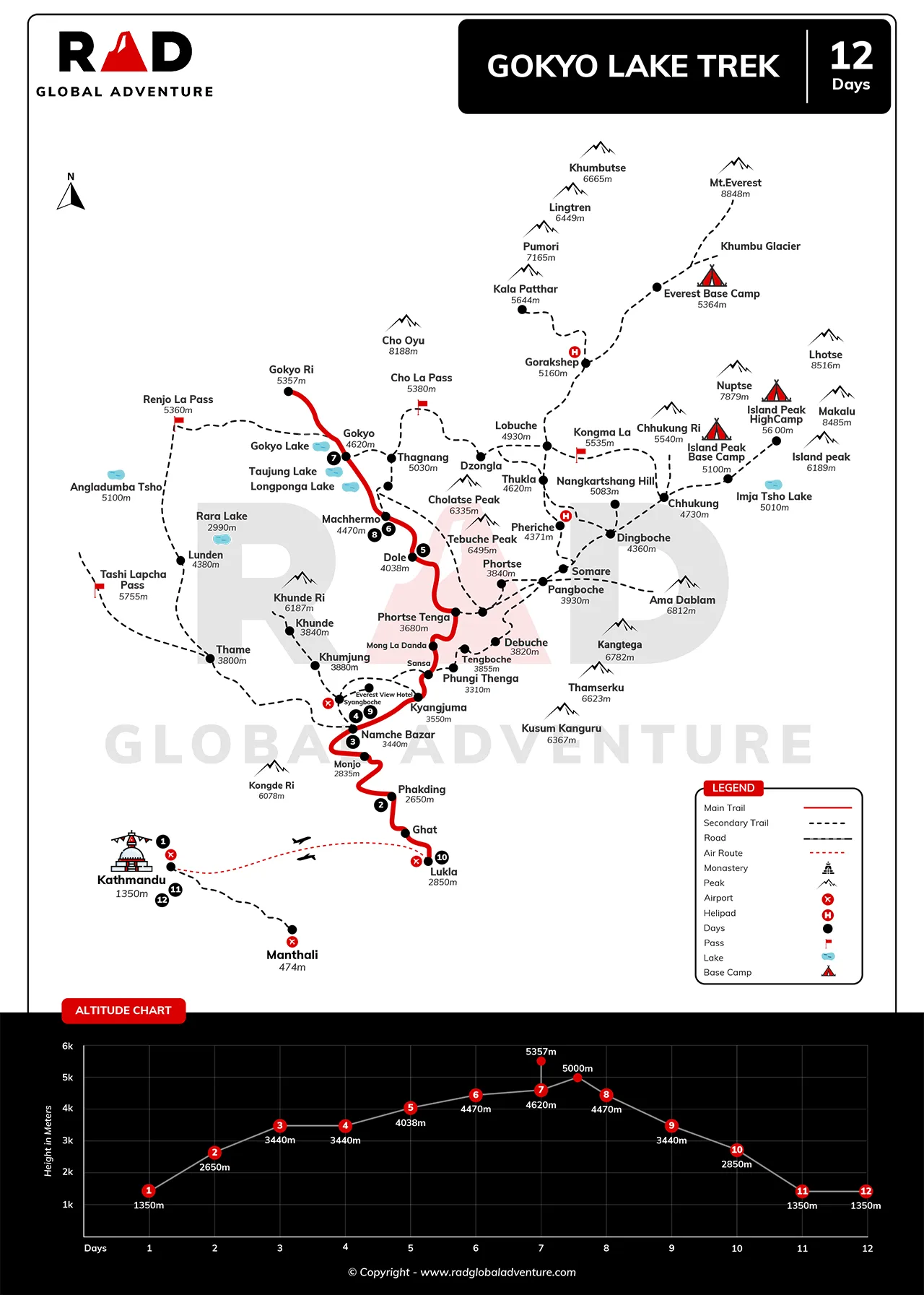
Route Map & Altitude Chart

Attractions and Highlights of Gokyo Lake Trek

We stand on Gokyo Ri at sunrise and see Everest’s full south-western face across the valley

We climb 5,357 meters for a direct view of Everest’s south-western side. Lhotse, Makalu, and Cho Oyu surround us as the light hits the peaks early. We have to take photos fast since the wind picks up by 9 a.m. The trail back down is steep, and we complete the hike in 3 to 4 hours round-trip.

We walk alongside the Ngozumpa Glacier, Nepal’s longest at 36 kilometers, with views of its terminal moraine

The glacier starts near Cho Oyu and flows down to 4,600 meters. We walk on its lateral edge while the rock debris covers the ice. We see crevasses from a safe distance. The terminal moraine marks the glacier’s farthest reach, truly a magnificent distance.

We cross the lateral moraine between Machhermo and Gokyo

The path is narrow and exposed, with prayer flags lining the route. We walk on rocky ground above 4,700 meters. The view opens to the entire lake system. These narrow ridges with prayer flags and scenic treats for days are one of the best scenes you will see on the Gokyo Lake Trek.

We get a view of all six Gokyo Lakes, with the third and fourth lakes offering the clearest reflections of Cho Oyu

The lakes sit between 4,700 and 5,000 meters. The lower lakes thaw by late morning, and the ice edges melt fast in the sun. We see Cho Oyu mirrored on still days. The water is turquoise from glacial silt.

We visit Machhermo, home to the Himalayan Rescue Association’s seasonal clinic and a working monastery

The clinic runs from March to May and September to November. It treats altitude sickness cases, and the monastery hosts local Sherpa monks. We might even hear prayers in the morning. The village sits at 4,470 meters and has basic teahouses.

We avoid the Everest Base Camp trail congestion and walk quieter paths after Namche

The EBC trail sees 300+ trekkers daily in peak season. Our Gokyo Lake Trek route sees fewer than 100. We walk without crowds and rest at our own pace. We see herds of Yaks, feel the cold wind blow, and hear the birds chattering all along.

Trip Information of Gokyo Lake Trek

Is this trip beginner-friendly?

We consider this trek moderate to challenging. Beginners can join if they train for 12 to 14 weeks. We recommend beginners to train 6–8 hours weekly. Elevation reaches a high point of 5,357 meters at Gokyo Ri, and we spend two nights above 4,000 meters. Prior trekking experience helps, but it is not mandatory. We gain altitude slowly, and acclimatization days are built into the Gokyo Lake Trek itinerary. First-time trekkers can complete the journey with proper fitness and pacing.

Private trip vs Group Joining

Trekkers can choose a private trek for a flexible itinerary with custom stops and personalized trekking pace. Group treks cost less but follow fixed day-to-day schedules. Private trips offer you the option to choose the starting date of the Gokyo Lake Trek, while group departures run weekly in peak season.

Trip Extension

We can extend the Gokyo Lake Trek to include Renjo La Pass or link to Everest Base Camp. Renjo La reaches 5,340 meters, and it requires just one extra day. We arrange permits and guides in advance. Some travelers also add a Pokhara or Chitwan tour; all your extensions must be confirmed before departure.

Solo trek in the Gokyo region

We allow solo trekkers on this route. We require travel insurance and a guide for safety. Solo trekkers join group departures or pay a single supplement. We provide daily accommodation, food, local taxes, and more. Communication is limited above Namche, but our guides will take you to your destination and back without any need for technology.

Photography & Drone Rules

The local government permits photography along the trail; however, drones require a special permit from CAAN in Kathmandu. The local committee does not allow drone use near Lukla or Namche. We should respect local privacy and ask permission before photographing people or homes.

Cultural Festivals on the Trail

We can experience Mani Rimdu in October or November. It runs for 19 days at Tengboche and Chiwong Monasteries. Locals perform masked dances, and the festival marks Guru Rinpoche’s birth. We see prayer flags, butter lamps, and crowds, while some teahouses close during peak days. You can plan the Gokyo Lake Trek around festival dates if you want a cultural immersion.

Tips for First-Time Nepal Visitors

We must carry cash in Nepali rupees. ATMs work in Kathmandu and Namche, but the service charge can be high in Namche. You must avoid consuming tap water directly. We recommend packing layers for cold nights and always respecting local customs. You must remove your shoes before entering homes and walk on the left side of the trail. We greet locals with “Namaste.”

Typical Daily Routine on the Trek

We wake at 6 a.m., tea arrives in our room, and we pack our bags by 7 a.m. Breakfast is at around 7:30 a.m., sometimes earlier. We start walking at 8 a.m. and hike for 4 to 5 hours till the early evening hours. We stop for lunch at noon and reach the lodge by 3 or 4 p.m. We rest, drink fluids, and eat dinner before heading to bed.

Mental Preparation & Trekking Mindset

You should prepare for discomfort as the trails are rocky, the lodges are basic, and cold temperatures will always accompany us. Cold Himalayan wind and trek fatigue are very common. You must accept slow progress on steep days and learn to stay patient with weather delays.

Frequently Asked Questions

Yes, you may spot tiny figures on the Southwest Face or North Col in daylight.

Yes, near Machhermo and Dole, herders live in stone huts above 4,200 meters.

No, airline staff do not check insurance before boarding.

Only if your policy allows solo high-altitude trekking; many require a guide’s presence.

Yes, coverage must explicitly include trekking up to 6,000 meters for validity.

Solo trekking is not possible in the Everest region; you must have a licensed guide with you.

You must carry printed copies; digital versions are not accepted at checkpoints on the Gokyo Lake Trek itinerary.

Yes, hot water runs out early in peak season. But they will prepare more as demands pour in.

Yes, we request a packed lunch the night before. Most teahouses accommodate.

A few lodges in Gokyo rent oxygen. The cost varies as we go deeper into the region.

Yes, most teahouses have a shared dining room with a stove for warmth.

No, mattresses are thin foam. You can bring a sleeping pad for comfort.

All agencies should provide satellite phones. RAD Global’s guides carry them throughout the Gokyo Lake Trek.

Our certified guides are trained to spot HAPE and HACE symptoms early.

Yes, you can hire an extra guide. Additional cost applies.

Yes, RAD Global ensures porters get the same meals and lodging.

Trip Reviews

expert-image
Need Help? Ask to Travel Expert
Get a Trip Quote Customize This Trip Make an Inquiry
  • Best Deal
  • Flexible Schedule
  • Instant Booking
  • No Hidden Costs
trip-advisor
5.0
25 reviews