expert-image
Talk to a Travel Expert +977 9818264758

Bookings Now Open for Nepal Treks, Tours & Climbing – 2026 & 2027

View Details
Ghandruk

Ghorepani Poon Hill Trek – 7 Days

Based on 25 reviews
duration
Duration

07 Days

difficulty
Trip Difficulty

Moderate

max-altitude
Max. Altitude

3,210m

destination
Destination

Nepal

group-size
Group Size

2-16 pax

start-end
Start / End

Kathmandu / Kathmandu

meals
Meals

B L D

accommodation
Accommodation

Hotel, Tea House

transportation
Transportation

Bus , Flight

expert-image
Need Help? Ask to Travel Expert
Get a Trip Quote Customize This Trip Make an Inquiry
  • Best Deal
  • Flexible Schedule
  • Instant Booking
  • No Hidden Costs
trip-advisor
5.0
25 reviews

Overview of Ghorepani Poon Hill Trek – 7 Days

The Ghorepani Poon Hill trek is a 7-day route in the Annapurna region. It offers beautiful scenery and suits both adventure seekers and beginners. In the course of the week, trekkers pass through rich forests and terraced lands with lovely Gurung settlements. The Annapurna Ghorepani Poon Hill trek culminates at Poon Hill (3,210 m), where dawn reveals the Annapurna massif. You will enjoy 360° views of the Annapurna range, Machhapuchhre, Hiunchuli, and Mount Dhaulagiri.

At the beginning of the trek, we can take an option of a scenic drive or small flight to Pokhara. The journey will depart by road to Nayapul and then start the trek. Every night, we will sleep in comfortable teahouses and the traditional Nepali food will be served in various forms of dal bhat and momos. The hike goes through forests of birdsong and waterfall. In spring, woods are covered by rhododendron and oak forests in colors, and banks of wildflowers adorn the slopes.

The journey is also culturally enriching. We will visit traditional villages where Gurung and Magar communities welcome us to share their culture and stories and they we will invite us to share a cup of tea. Kids wave whenever the trekkers pass by and you will even get to see local women carrying on with their weaving sessions or cultivating the soil. The combination of nature and culture offers incredible uniqueness to the Ghorepani Poon Hill trek itinerary. The itinerary devised is what is referred to as balancing adventure with comfort and is very popular with international travelers.

The trek is moderate in difficulty, with elevations exceeding 3,000 meters. There is no technical climbing required and the acclimatization will be gradual. Individuals, who are healthy and in basic hiking shape, can complete the days of uphill and downhill walking. It is an ascending trail that is moderate and does not lead to too much physical exertion because people start early in the morning. We will feel a sense of accomplishment and we discover stunning views with every step you take. After the end of the trek, a beginner is left with a sense of accomplishment of being able to see such incredible Himalayan views.

Good To Know

Ghorepani Poon Hill Trek is moderate trekking with some difficulty. We ascend gradually, but the route includes steep stone steps at Ulleri and ridge trails but pace is steady and manageable. No technical climbing skills are required for the Ghorepani Poon Hill Trek. With general fitness and stamina, we can manage to do the trek. The trek goes along lovely villages and forests, so we can have a break whenever we feel like. Walking at a steady pace and resting as needed helps you feel great at the end of each day.

The Ghorepani Poon Hill Trek can be best experienced during the months of spring (March to May) or autumn (September to November). In autumn, the skies are crystal clear and there are breathtaking views of the Himalayas, whereas spring favours you with warm days and blossoming rhododendrons. Monsoon season (June-August) is not favorable because of heavy rains and slippery trails and leeches. December-February is a cold winter and it may snow at higher altitudes. The sunrise seen at Poon Hill is most spectacular in clear autumn mornings. Always carry a light windbreaker or rain jacket. Mountain weather changes quickly in every season.

Tea houses on the Ghorepani Poon Hill Trek offer simple but good Nepali food. The most commonly available dish is dal bhat (rice with lentils and seasonal vegetables) which is often available with free refills. We will also get noodles, soups, curries and vegetables. Snacks can be bought at tea houses, where there are biscuits, instant noodles, fruit, and energy bars.

Black tea, masala tea and coffee are served throughout the day. Lodges offer boiled or filtered drinking water as well as bottled water, or we can use a personal filter. Local treats such as rice bread or roasted corn add variety to breakfast. Alcoholic beverages are available in larger villages, beer or local raksi, best enjoyed in moderation.

Poon Hill is located at 3,210 meters so the chances of altitude sickness are not high, but possible. We may feel mild headache, nausea, or shortness of breath. Prevent this by climbing gradually, drinking plenty of water, and eating energy-rich foods. Inform our guide if you feel unwell. Some trekkers carry Diamox (acetazolamide) to ease symptoms. Most people feel more comfortable after the first night.

Proper training makes the Ghorepani Poonhill trek easier. Build endurance through activities like hiking, stair climbing, or jogging. We should be at the medium-level of fitness to take the trek as you would comfortably walk up to 5-6 hours in hilly areas. Since trekking can cause blisters, break in your trekking shoes beforehand. Pack light to make walking easier. Stay in a constant rhythm and rest when feeling necessary. Make the right preparations and find the trek to be manageable and rewarding.

Foreign tourists are given a visa upon arrival at Kathmandu airport or the border crossings. Entry in the country: A 30-days tourist visa from Nepal is about USD 50 (NPR 5,000) in cash. The Ghorepani Poon Hill Trek  requires two permits: the Annapurna Conservation Area Permit (ACAP) and the TIMS card.

The ACAP costs NPR 3,000 (about USD 25) and the TIMS card around USD 10. They are readily available in Kathmandu or Pokhara and your passport and passport photo are required. The majority of trekking agencies or guides make such permissions on your behalf.

For a safe trek, prepare with proper vaccinations (routine ones, plus typhoid). Always drink water that is boiled or filtered and eat well cooked food at lodges, otherwise you may have a stomach problem. Wash your hands before you eat, the sun at altitude is strong, so apply sunscreen,sunglasses and a warm hat.

Carry a personal first aid kit, altitude tablets or inhaler. Take care of the altitude and weather advice that your guide communicates. Hold the handrail when crossing narrow bridges or steep stairs.and refrain from trekking when there is heavy rainfall or storm to be safe.

Before starting Ghorepani Poon Hill Trek , we go to Pokhara. The majority of the visitors prefer a scenic 25–30 minute flight from Kathmandu to Pokhara, though a tourist bus takes 6-8 hours more and also costs less. At Pokhara, you will cover 1.5 hours to 2 hours travelling by jeep or bus to the starting point of the trek at Nayapul. The task to be followed is on foot only because no vehicles are involved.

You then trek down to Nayapul and then back on road to Pokhara. Then fly back to Kathmandu or drive (6-8 hours). During monsoon, additional time should be taken into consideration as the roads will be slow since the roads are not in good condition during this season.

The coverage of mobile phone in Ghorepani Poon Hill Trek is quite good in main settlements including Ghorepani and Ghandruk. Both Ncell and Nepal Telecom network are functional but they drop in the forested valleys. There should be full coverage in Kathmandu and Pokhara, however, not all of the trek will be covered reliably. Other teahouses charge a small fee to provide Wi-Fi, though it is normally slow. It is recommended to purchase a local SIM card in Kathmandu and download offline maps prior to the start as it will otherwise be difficult to get a constant connection. Guides can advise where to find better signal and charging points along the route.

You may adjust Ghorepani Poon Hill Trek according to your time and interests. However, to reduce a day start in Ghandruk or Sanosware. To lengthen the trip, proceed on to Annapurna Base Camp after Ghorepani and this will add 5-6 days. The alternative is a trek to Mardi Himal viewpoint. Others will take the route of Ghandruk down to Nayapul excluding Tadapani. And you can leave the trek and combine it with a Chitwan jungle safari or cultural tour in Lumbini.

Prices Packages mostly include meals, lodging, guide and porter services in the Ghorepani Poon Hill Trek . You should budget extra for personal expenses. Hot showers and power are NPR 100-200 each and Wi-Fi is often charged additionally. Snacks, tea, coffee and alcohol beverages are an additional cost.

Souvenirs and the optional gear rentals (such as sleeping bag or walking poles) also add to your budget. Tipping is expected with a US Dollar 5-10 a day being recommended to guides and porters. The ATMs are only in Kathmandu and Pokhara so bring enough Nepalese Rupees in cash to cover the trek.

Nepali is the official language and there are also Gurung and Magar dialects that are prevalent in the area. English is also common in tourist areas and many guides and lodge owners speak well. Some simple Nepali words can also be learnt to use as respect and to connect well with the inhabitants such as Namaste (hello/hi), dhanyabad (thank you). It is easy to speak English in Pokhara and other bigger cities but in smaller villages you can use more body language and smiling.

The electric power in Ghorepani Poon Hill Trek  is basically by solar or minilocal generators. Teahouses also offer the use of charging locations to charge the telephones and cameras often around NPR 100-200 per device. Pack a power bank to have as reserve, as there is limited supply and power cuts happen regularly.

In Nepal, the voltage is 220V closely spaced round pin plugs, so bring an international adaptor. Wi-Fi is available in Kathmandu and Pokhara and some lodges on the trail use it at a fee, though the connection tends to be both erratic and slow. In order to conserve energy, make sure that you charge your devices to full capacity when you still have power at the start of the trek and use them minimally on the path.

Detail Itinerary

We leave Kathmandu in the early morning and we will drive to the west towards Pokhara. The trek goes along terraced fields, rugged valleys, and villages on the hills and can take up to 8 hours. We will have lunch on the way and appreciate the swings of the landscape.

As we get closer to Himalayan Annapurna foothills, we can see some snowcapped mountains in the distance. In the afternoon we will get back to Pokhara, a calm lakeside town at 900 m. We will do boating on Phewa Lake, visit Davis Falls or the World Peace Stupa. The evening is free to relax by the lake or explore the lakeside bazaar.

activity-small

Activity: 7-8 hours drive

distance-small

Distance: approx. 200km by road

accommodation-small

Accommodation: Hotel

meal-small

Meal: BLD

altitude-small

Max Altitude: 900m/2,953ft. (Pokhara )

If our standard itinerary doesn't fully meet your needs, we are happy to tailor it to your specific preferences and requirements.

Includes and Excludes

What’s Included?

Transportation

  • International airport transfers
  • Kathmandu – Pokhara – Kathmandu by tourist bus
  • Pokhara – Nayapul – Pokhara by private jeep
  • Pokhara – Kathmandu by domestic flight

Food and Accommodation

  • Full meals: breakfast, lunch & dinner on your choice.
  • Supplementary snacks: energy bar and cookies
  • Seasonal fresh fruits deserts every day
  • Unlimited chlorine treated safe drinking water
  • Hotel in Kathmandu and Pokhara with breakfast and bed plan

Guide and Support Staff

  • An experienced english-speaking trekking guide
  • Porter service for luggage (one porter for every two trekkers)

Permit and Expenses

  • Annapurna Conservation Area Permit (ACAP)
  • Trekkers’ Information Management System (TIMS) card
  • All local and government taxes
  • Guide and porter salaries, insurance, equipment, transport, food and lodging

Medical and Gear

  • Oxi-meter: To check , heart rating and oxygen saturation
  • A comprehensive first aid kit
  • Emergency rescue in case of severe illness or injury (costs covered by your insurance)
  • Trekking equipment: down filled sleeping bag, walking poles and duffel bag
  • Free luggage storage in Kathmandu

Others

  • Farewell dinner in Kathmandu
  • Certificate of appreciation
  • Trekking route map and company t-shirt

What is not Included?

International Flights and Visa

  • International flights and visa

Food and Accommodations

  • Meals in Kathmandu (except farewell dinner)
  • Any hotel stays in Kathmandu or Pokhara before or after the trek

Travel and Medical Insurance

  • Comprehensive travel and medical insurance
  • Emergency rescue evacuation

Other Expenses

  • Personal expenses
  • Tips and gratuities
  • Personal trekking equipment
  • Unexpected expenses due to weather, flight cancellations, strikes, or natural causes

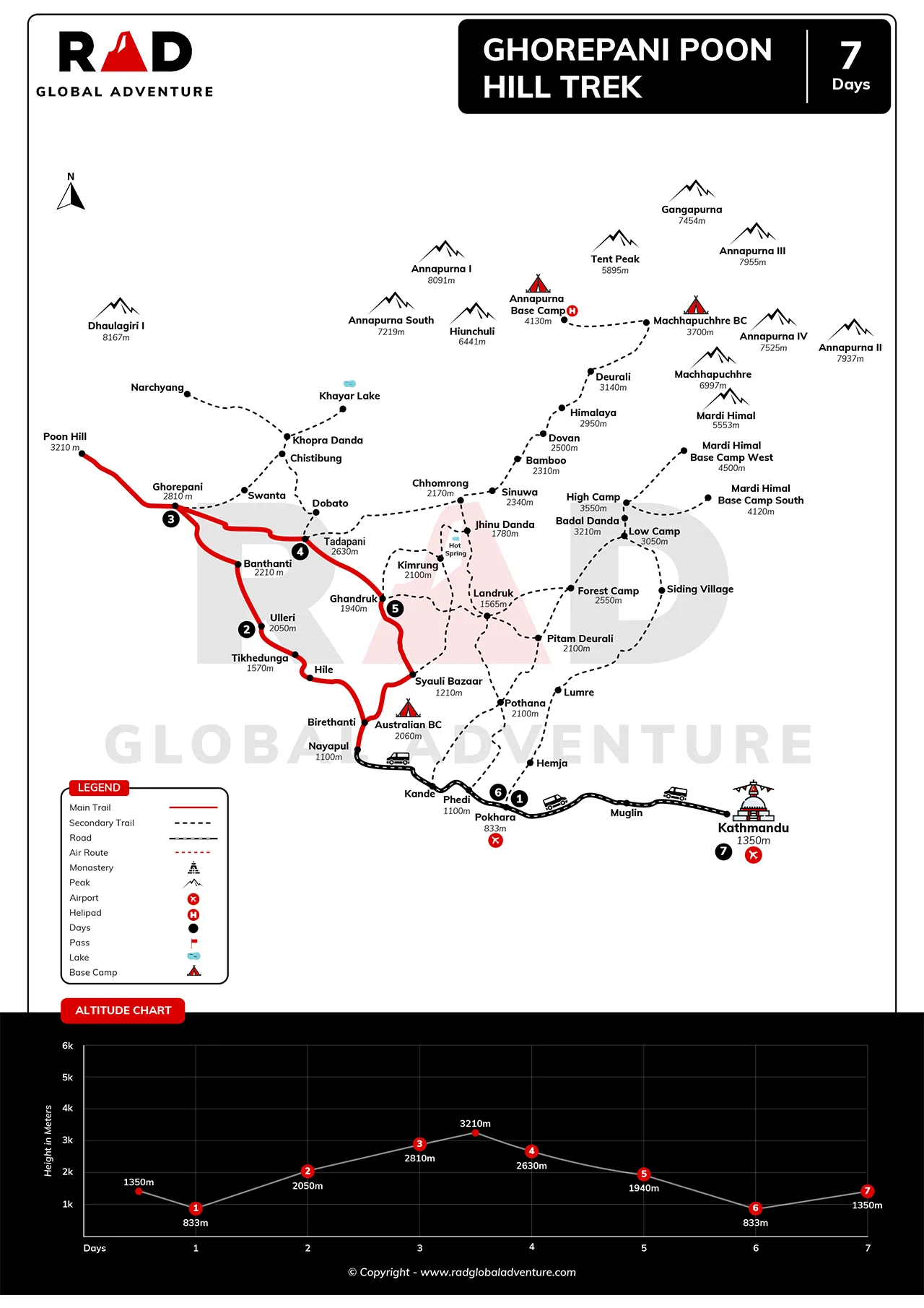
Route Map & Altitude Chart

Attractions and Highlights of Ghorepani Poon Hill Trek – 7 Days

Scenic Drive to Pokhara

The road trip between Kathmandu and Pokhara presents you to the Nepal landscapes. There are terraced hills, sparkling rivers, and lush valleys the road goes around. On a clear day, you could see the Himalayan mountains which include machhapuchhre ( Fishtail), Annapurna, and Dhaulagiri among others, above the ridges. During the journey you come across with waterfalls, village markets and rural Nepal, and It is your first introduction to Nepali village life. In Pokhara, one enjoys the serenity of Lake Phewa and the snow capped horizon in preparation of this trek and a skyline under a setting sun hid by snowy peaks.

Climb the Famous 3,000 Stone Steps of Ulleri

The second day of the trek is again rewarding as you climb up the renowned stone stairs of Ulleri- over 3,000 steps cut across steep terraced hills and into the forests. It is a tough hike but we were offered relief points with chai and refreshments and tea shops here and there.

With each switchback there is a cooler breeze and views of the mountains. Just by the time you reach the Ulleri village at 2,070 m, you will be filled with accomplishment and will be ready to face whatever awaits you in the following days. This is the steepest climb of the trek.

Magical sunrise View from Poon hill (3,210 m)

The peak of the Ghorepani Poonhill hike is to wake up very early in the morning and climb Poon Hill. We start out early and arrive at the viewpoint before the sun comes above the horizon. The first ray hits the mountains and Annapurna South, Dhaulagiri, and Machhapuchhre are pink and gold. The walls dip into valleys below, and are often muffled in mist, and the morning silence adds to the charm. The stunning scenery is a rewarding aspect of trekking at the wee hours of the morning and trekkers cannot forget the memory in their lifetime.

Amazing Mountain Views Along the Trail

During the trek, you are accompanied by mountain views. Ghorepani and Poon Hill trek give you the view of Annapurna I (8,091 m), Annapurna South (7,219 m), Machhapuchhre, Hiunchuli and Nilgiri, to the west, is the majestic Dhaulagiri (8,167m). Every ridge opens up a new wide panorama, and every sunrise and sunset tint the Himalayas in incandescent colours. The mingling of the evergreen forests with snow covered mountains form scenery that photography enthusiasts and nature lovers dream about.

Experience local culture and flavour Himalayan foods

The Ghorepani Poon Hill Trek  is rich in cultural immersion in addition to scenery in rural teahouses, the hosts will be very welcoming and will feed you well. You will taste dal bhat, momo, thukpa, butter tea or cardamom spiced milk tea. In Ghandruk, you can taste local jam of apricots or yak cheese. Seeing farmers, children, and elders going about daily life adds to the cultural charm of Nepal. A trek turns into a cultural one with the sharing of food and moments together with locals.

Explore Ghandruk a Traditional Gurung Village

Among the highlight of the trek is the town Ghandruk, a large village of stone built houses having slate roof. Here, you can know about the Gurung culture, visit the local museum, and have an authentic hospitality that is based on tradition. Machhapuchhre and Annapurna south loom over the village. During the evenings you might hear folk songs, or you might see dances at teahouses. There is a cultural experience and a view of the mountains when visiting Ghandruk.

Insights into a walk through Rhododendron and Oak forests

Big portions of the trail are through enchanted forests. In spring, the rhododendrons flower in the red, pink and white as well as creating a natural garden over the hillsides. Pine and wildflowers trail through the air as oaks and maples border over the trail. The song of the birds can be heard everywhere in the forest-monals, bulbuls and sunbirds fill your walk with music. The temperate waterfalls and streams surface besides you as you take up the trek in the forest which is calming and cooling.

Trip Information of Ghorepani Poon Hill Trek – 7 Days

Is This Trek a beginner friendly?

Yes. Despite being a short trek, the 7 days Ghorepani Poon Hill Trek  is great even to beginners. It does not have any technical climbing, summit elevation is 3 210 m, and there are lodges at the end of the day. Each day is spent walking 5-7 hours in marked trails. The route can be accomplished successfully in moderate fitness and preparation even by first time trekkers and families.

Private vs Group trek

You can do the Ghorepani Poon Hill Trek in a group or by yourself. Group treks are cheaper, while private treks are more flexible in terms of schedule and pace. The similarities between the two choices are the same panoramas. Select a private trek in case you want to be independent or a group trek in case you love to share the experiences and reduce the costs. Either way, the Ghorepani Poon Hill Trek  offers unforgettable views.

Trip Extension

Several on-option activities are available in Pokhara: boating on Phewa Lake, paragliding, or going to Sarangkot. You can do a combination trek with a Chitwan safari and/or a Lumbini cultural tour or add on to the trek to Annapurna, Base Camp (an additional 5–6 days) or Mardi Himal (additional 4-5 days). It is also possible to organize side tours like a Tilicho Lake or Annapurna Panorama through the agencies.

Solo Trekking

There is an option of going solo trekking, but some people prefer being accompanied by a guide or porter to be on a safe ground. Teahouses offer food and accommodation and even the route is well-marked. Solo trekkers meet other trekkers on the trail. Solo female trekkers may feel safer in the company of a guide. Have enough cash with you, because there are no ATMs except in Pokhara and Kathmandu. Solo trekking is satisfying but a guide makes it easier in terms of logistics.

Photography and Drone Rules

Photography is allowed during the trek, only ensure that you ask them before taking their pictures. Drones must be registered and have permits with Nepal Civil Aviation Authority, and the Annapurna Conservation authorities. Illegal flights can be associated with fines. Your handheld camera records incredible shots at Poon Hill, Ulleri and Ghandruk even without a drone.

Festivals in the Trail

Depending on the season you might come across colorful festivals of Dashain, Tihar or Gurung Losar. Villages exchange gifts, sing and dance and the trekkers have usually been invited to participate. The addition of these customs gives your Ghorepani Poon Hill Trek  more depth in culture.

Tips to First Time Visitors in Nepal

Layer clothing depending on the temperature, keep cash handy in rupees and keep hydrated with boiled or filtered water. Respect local traditions- take off shoes when entering house, dress decently, learn some greetings like; Namaste and Dhanyabad. Smile a lot and learn to accept Nepali hospitality- it adds to your experience.

What a typical Day in the Trek looks like?

Breakfast is at 7 AM and days start early. By 8 AM, the hiking starts and lunch is taken at noon. You reach the lodge within 3-4 PM, and have time to rest, take shower or enjoy social interactions before the dinner at 6 PM. Evenings are calm, with gazing up at the sky or talking by the fire arch, to wind up before bedtime that is at 9 PM.

Mental preparation and Pre trekking mindset

The trek needs not only physical condition but also mental. It is simple, and when you take it slow and positive, every ascent would reward you. The reward would be sunrise at Poon Hill so focus on each step, breathe steadily and remember the reward. Keep it versatile and be thankful- that would make the journey fulfilling.

Frequently Asked Questions

Autumn (Sept-Nov) and spring (Mar-May) are the preferable seasons. Weather: The climate is rather cold and dry and there are blooming rhododendrons in spring. Monsoon (Jun-Aug) is wet and is slippery and winters are very cold at nights.

The trek is moderate There are marked paths so you hike 5-7 hours a day. It does not involve any technical climbing; There are steep stair sections, but basic fitness (regular walking or stair climbing) is enough. First-time trekkers usually manage it well.

Teahouses provide blankets, but nights can be freezing. Carry a warm sleeping bag or liner for extra comfort and hygiene.

We stay  in local mountain lodges (also known as teahouses) where we eat and sleep twin shared accommodation with shared bathrooms. Rooms more often than not have plain beds with blankets. The facilities are modest yet are well maintained. You will get a warm hospitality and home-cooked meals.

There are no ATMs on the trail. Carry as much Nepalese Rupee as you can in Kathmandu or Pokhara. It is practical to carry extra cash for hot showers, snacks, and tips. In cities you can pay by credit card but not on the trek.

You will require a tourist visa to Nepal and two permits which are Annapurna Conservation Area Permit (ACAP) and a TIMS card. It is possible to arrange these in Kathmandu or Pokhara prior to the trek. Always carry your passport and a passport size photo should you need to get any permit.

In Nepal, tipping is acceptable. In case you like the service, it is a common way to tip guides and porters about 5-10 dollars a day per person. Tips reward good service, and help local people, so only tip when the service is good.

Cell phone coverage (Ncell/NT) is offered in the larger villages, but will lose connection in valleys. Only a small number of the lodges have Wi-Fi (as an additional charge). Download maps and messages in advance. Buy a local SIM in Kathmandu or Pokhara, so you can make your internet calls.

You must buy a travel insurance to ensure that it includes high altitude trekking (up to 4,000 m) and helicopter evacuation and medical care. Without insurance, rescue or medical costs in the Himalayas can be extremely high.

Children (probably 10 or more) may do it in case they are fit and accustomed to hiking. The path is relatively easy and the accommodations offer safe conditions, but do make sure that the children will be able to walk several hours, and gain elevation.

Yes, the Annapurna region is safe for trekking. Trails are well developed and you have guides and groups. Avoid walking alone at night, be mindful of traffic in towns, and follow your guide’s advice.

Hiking boots, that are waterproof and sturdy, with excellent ankle support, work best. Break them in advance of the trek. The trail may be rough, wet or muddy. Flip-flops or anything that cannot be gripped on footwear is not good to use.

Potable water is available to purchase in the form of pure or boiled water (or bottled water) at lodges at a small cost (100-200 NPR per bottle). River water is not safe to drink. Always buy or boil water before drinking.

Most trekking packages have all the meals (breakfast lunch dinner) included along the trail. The food consists of basic Nepali foodstuff You might wish to bring some snacks or energy bars along on hikes, but standard meals are available.

It is a typical week itinerary: The drive Kathmandu/Pokhara, hike Nayapul/Ulleri/Ghorepani, climb Poon Hill and walk over to Tadapani, Trek to Ghandruk, walk down to Nayapul and back to Pokhara and finally the flight back to Kathmandu.

You are expected to have a good base in short distances (have been able to hike 5-7 hours day with a day pack). Stair-climbing and training hikes are useful. It is not necessary to be an athlete, though being in good shape will make the trek much more enjoyable and reduces fatigue.

Trip Reviews

expert-image
Need Help? Ask to Travel Expert
Get a Trip Quote Customize This Trip Make an Inquiry
  • Best Deal
  • Flexible Schedule
  • Instant Booking
  • No Hidden Costs
trip-advisor
5.0
25 reviews