expert-image
Talk to a Travel Expert +977 9818264758

Booking open for Nepal Trek 2025 & 2026

View Details
Lobuche to Dzongla

Everest Three High Pass Trek

Based on 25 reviews
duration
Duration

20 Days

difficulty
Trip Difficulty

Challenging

max-altitude
Max. Altitude

5,465m

destination
Destination

Nepal

group-size
Group Size

2-16 People

start-end
Start / End

Kathmandu / Kathmandu

meals
Meals

Breakfast, Lunch & Dinner

accommodation
Accommodation

Hotel, Teahouse

transportation
Transportation

Tourist Bus, Flight

expert-image
Need Help? Ask to Travel Expert
Get a Trip Quote Customize This Trip Make an Inquiry
  • Best Deal
  • Flexible Schedule
  • Instant Booking
  • No Hidden Costs
trip-advisor
5.0
25 reviews

Overview of Everest Three High Pass Trek

The Everest Three High Pass Trek (Everest 3 Passes Trek) is a top 20 days long Everest region trek by RAD Global Adventure in Nepal. This exciting journey crosses three high mountain passes – Kongma La (5,535 meters), Cho La (5,420 meters) and Renjo La (5,360 meters) and has a climb up to Everest Base Camp (5,364 meters).

You will also trekk across beautiful Sherpa villages, ancient monasteries and beautiful alpine lakes on the way. The sight of the Everest, Lhotse, Makalu, Ama Dablam and other high mountains accompany the trek during every single day between colorful Namche Bazaar and high camps, above the 5,000 m mark.

You begin with a short flight to Lukla and a hike with rhododendrons and other forests to Namche Bazaar the lively capital of Sherpas. In the weeks that follow we shall wander along narrow lanes through deep valleys, and across glowing glaciers. All the passes you cross offer panoramic views of the Himalaya. Among the highlights of this trek are views over crystal clear Gokyo Lakes, standing at the base of the highest mountain in the world and watching a sunrise at the summit of Kala Patthar (5,545 m).

You will go through Sagarmatha National Park, which is a UNESCO World Heritage site with its own wildlife. During this trip, you will be able to meet the Sherpa families in mountain villages of Namche, Tengboche or Khumjung and the rich culture they have. There is a beautiful sky at night at the Himalaya with numerous stars.

Every mountain-top and valley look-out appears to be a goal in this expedition of the roof of the world. Only those seeking a true Himalayan adventure should attempt this trek, with expert Three High Pass guides who ensure your journey is safe and rewarding. Spend the night in cozy tea houses every night, savor Nepali dal bhat and hot soups and rest up to the next day adventure.

By the last few days, you will reach Everest Base Camp and climb Kala Patthar for sunrise, two of the trek’s most rewarding highlights. The Everest Three High Pass Trek is truly a once in a lifetime trek that will leave you with memories for life. Each view reminds you that this is the final Everest Three High Pass Trek journey.

Good To Know

The Everest Three High Pass Trek is strenuous. You will be hiking long days (up to 8 – 9 hours) on rugged, rocky trails with steep, slippery parts. The summits (Kongma La, Cho La, Renjo La) are above 5,300 m, so you need good physical fitness and mental strength. This hike is for experienced hikers or extremely fit beginners. Practice with long uphill hikes and stairs. Trekking poles to reduce the stress on your knees Daily treks involve an altitude gain of 500-1000m, so it is important to have strong legs and cardio fitness.

Weather in Everest area is unpredictable. The ideal seasons to try the trek are autumn (mid September to November) and spring (March to May). Clear skies, stable weather and moderate daytime temperatures characterize these seasons. In autumn, forests become colourful; in spring rhododendrons bloom.

During monsoon (June-August), the trails get muddy, so there is a lot of rain, clouds, and poor visibility. Winter (December- February) is very cold with frequent snowstorms often blocking the high passes. During autumn and spring you will experience crispy sunny days – ideal for trekking.

Meals are served at teahouses and lodges. Dhal bhat (rice, lentils and vegetables), usually served with curry, is the traditional Nepali meal for lunch and dinner. Breakfast typically consists of porridge, eggs or bread and hot Nepali tea or coffee. Carry snacks such as nuts, chocolate, and protein bars (for break time).

Drink lots of boiled or filtered water to stay hydrated, don’t drink untreated tap water, we offer water filtration solutions on the trek. Hot drinks such as ginger tea or lemon tea are available at lodges everywhere. Local teas and soups help you to stay warm. Also, it is important to stay hydrated and well-nourished.

Altitude sickness (AMS) is caused by ascending above 4000m. We take a careful acclimatisation plan, including rest days in Namche Bazaar and Dingboche. Drink fluids, eat carbohydrates and be slow. Some trekkers take medicine like Diamox (acetazolamide) to facilitate acclimatization – consult your doctor first. Our guides have oxygen and first aid units. If the symptoms get serious (Headache, nausea, dizziness, and fatigue) group members will have to descend. Give attention to your body, and follow the instructions of the guide.

Good fitness is essential. Begin training 8-12 weeks before using cardio exercise (hiking, jogging, cycling) and leg strength exercises (squats, lunges, stair climbing). Walk with a backpack (10 – 15kg) to simulate conditions. Be able to trek uphill for 5-6 hours per day Emphasis on stamina and general fitness.

Mental preparation is also important: prepare for basic facilities as well as long and demanding days. Adequate rest, a positive attitude and confidence in your training will help you overcome the tough moments. We have an extensive list of equipment to assist you in preparation.

Most travelers get a Nepal tourist visa on arrival at the airport or land borders of Nepal (15 days = US$30, 30 days = US$50, and 90 days = US$125). Carry passport size photographs and money (USD) for visa fee. For the trek special permits are needed: Sagarmatha National Park entry (~US$30) and Trekkers’ Information Management System (TIMS) card (US$10).

RAD Global Adventure will make these permits and will accompany you to the office at the start of the trek. Make sure your passport is valid for at least 6 months. Photocopies of your passport and permits should be kept close by for security reasons.

This journey is relatively safe if you take proper precautions. Get routine vaccinations (tetanus, hepatitis A, typhoid) before travelling. In Kathmandu and during the trek, maintain proper hygiene: wash your hands frequently, use hand sanitizers, and drink boiled or filtered water. Maintain the hygiene of food and drinks in Kathmandu like in any other major city. Guides bring first aid kits, oxygen and communication equipment (radio or satellite phone).

Mountain weather changes rapidly; follow the instructions of the guide regarding clothing and rest stops. You need to wear sunscreen and sunglasses which block UV because the sun is strong on the mountains. Stay on designated trails, watch out for rock falls and respect wildlife. You should always follow the guide’s recommendations. Safety on the Everest Three High Pass Trek is a group effort.

We will pick you up at Kathmandu and arrange the transportation to Lukla. In peak seasons, most groups drive for 4-5 hours to Ramechhap airport and then fly for 30 minutes to Lukla (2,860 meters), the usual starting point for the Everest Three-High-Pass trek. If the flights are cancelled, a longer road route to Lukla is available.

After the trek we will fly back to Kathmandu, mountain flights can be delayed due to the weather so we allow buffer days. RAD Global Adventure takes care of all ground & air transport. Other transfers can be easily done by comfortable tourist buses or private cars within Kathmandu.

The classic Everest Three-pass trek way can be done either clockwise or anticlockwise. Our standard route goes from Gokyo Lakes and returns via Thame though some trekkers prefer the opposite. Both routes have the same three passes and Everest BC. You can make the trek easy by avoiding the high passes and taking a direct trek to Everest Base Camp.

Another is to add additional peaks such as Island Peak after this trek. We talk about route options before we go. Any variations to the route and duration will be well planned to ensure permits and logistics are up to date.

Plan for some extra expenses during the trek. During the trek you can purchase snacks, tea or hot lemon drinks between meals (US$2 – 5). Bottled water is about US$3-4 per liter. Charging a camera, or phone is approximately US$1 – 2 per charge in teahouses. A hot shower costs around US$3–6 per use, depending on the altitude and lodge.

After trek you need cash for extra nights in Kathmandu for your meals, souvenirs and tips. Carry about US$200 – 300 in small bills. ATMs are available in Kathmandu and Namche Bazaar, but may run out of cash, so carry enough cash.

The official language is Nepali; Sherpa, a dialect of Tibetan, is spoken in the Khumbu villages. Basic communication is simple as guides, lodge staff and most locals in trekking areas speak English. A few phrases like Namaste (Hello) and Dhanyabad (Thank you) will help you connect politely. Signs and most restaurants are in English in Kathmandu and Namche. Polite gestures are also quite effective.

Telecom coverage is only found in larger villages. It is possible to have NTC or NCell service in Namche Bazaar or other major villages; at high camps and Everest Base Camp, no signal is available. Many teahouses now offer Wi – Fi for a fee, especially in Namche, Dingboche, Pheriche and Gorak Shep, but speeds are slow.

Lodges supply basic electricity (either solar or generator) for charging devices, the fee is around US$1 to 2 per charge. We suggest bringing a good power bank and extra batteries. If you have a small solar charger, it can help. Adapters for Nepal power sockets may be helpful (2 pin sockets, 220V). In practice, have a digital detox because this trek is all about the views.

Detail Itinerary

Our staff will greet you at Tribhuvan International Airport and drop you to your hotel in Kathmandu. After you check in you can spend some time to rest and recover from your flight. If you want, you can take a short walk around Thamel, a colorful neighborhood, full of shops, cafes and prayer flags.

This first evening offers you an opportunity to sample the taste of Nepali food or simply to relax before the trek. The moderate altitude of Kathmandu is a good place to start the acclimatization. Tonight, you sleep comfortably while our guides work on logistics for the coming days. This day is the start of your memorable Everest Three High Pass Trek.

activity-small

Activity: 30 mins drive

accommodation-small

Accommodation: Hotel

altitude-small

Max Altitude: 1,350m/4,429ft. (Kathmandu)

If our standard itinerary doesn't fully meet your needs, we are happy to tailor it to your specific preferences and requirements.

Includes and Excludes

What’s Included?

Transportation

  • International and domestic airport transfers
  • Drive Kathmandu – Ramechhap – Kathmandu (round trip)
  • Flights Ramechhap / Kathmandu – Lukla – Ramechhap / Kathmandu
  • All private ground transport for sightseeing in Kathmandu Valley

Food and Accommodation

  • Full meals: breakfast, lunch & dinner on your choice.
  • Seasonal fresh fruits deserts every day
  • Unlimited chlorine treated safe drinking water
  • Accommodation: Lodge / Teahouse (twin sharing) during trek
  • Hotel accommodation in Kathmandu after trek
  • Farewell dinner in Kathmandu

Guide and Support Staff

  • An experienced English-speaking trekking guide
  • Porter service for luggage (one porter for every two trekkers)

Permit and Expenses

  • Sagarmatha National Park entry permit
  • Khumbu Pasang Lhamu Rural Municipality permit
  • Trekkers’ Information Management System (TIMS) card
  • All local and government taxes
  • Guide and porter salaries, insurance, equipment, transport, food and lodging

Medical and Gear

  • Oxi-meter: to check , heart rating and oxygen saturation
  • A comprehensive first aid kit
  • Emergency rescue in case of severe illness or injury (costs covered by your insurance)
  • Trekking equipment: down filled sleeping bag, walking poles and duffel bag
  • Free luggage storage in Kathmandu

Others

  • Certificate of appreciation
  • Trekking route map and company t-shirt

What is not Included?

International Flights and Visa

  • International flights and visa

Food and Accommodations

  • Meals in Kathmandu (except farewell dinner)
  • Any hotel stays in Kathmandu before or after the trek

Travel and Medical Insurance

  • Comprehensive travel and medical insurance
  • Emergency rescue evacuation

Other Expenses

  • Personal expenses
  • Tips and gratuities
  • Personal trekking equipment
  • Unexpected expenses due to weather, flight cancellations, strikes, or natural causes

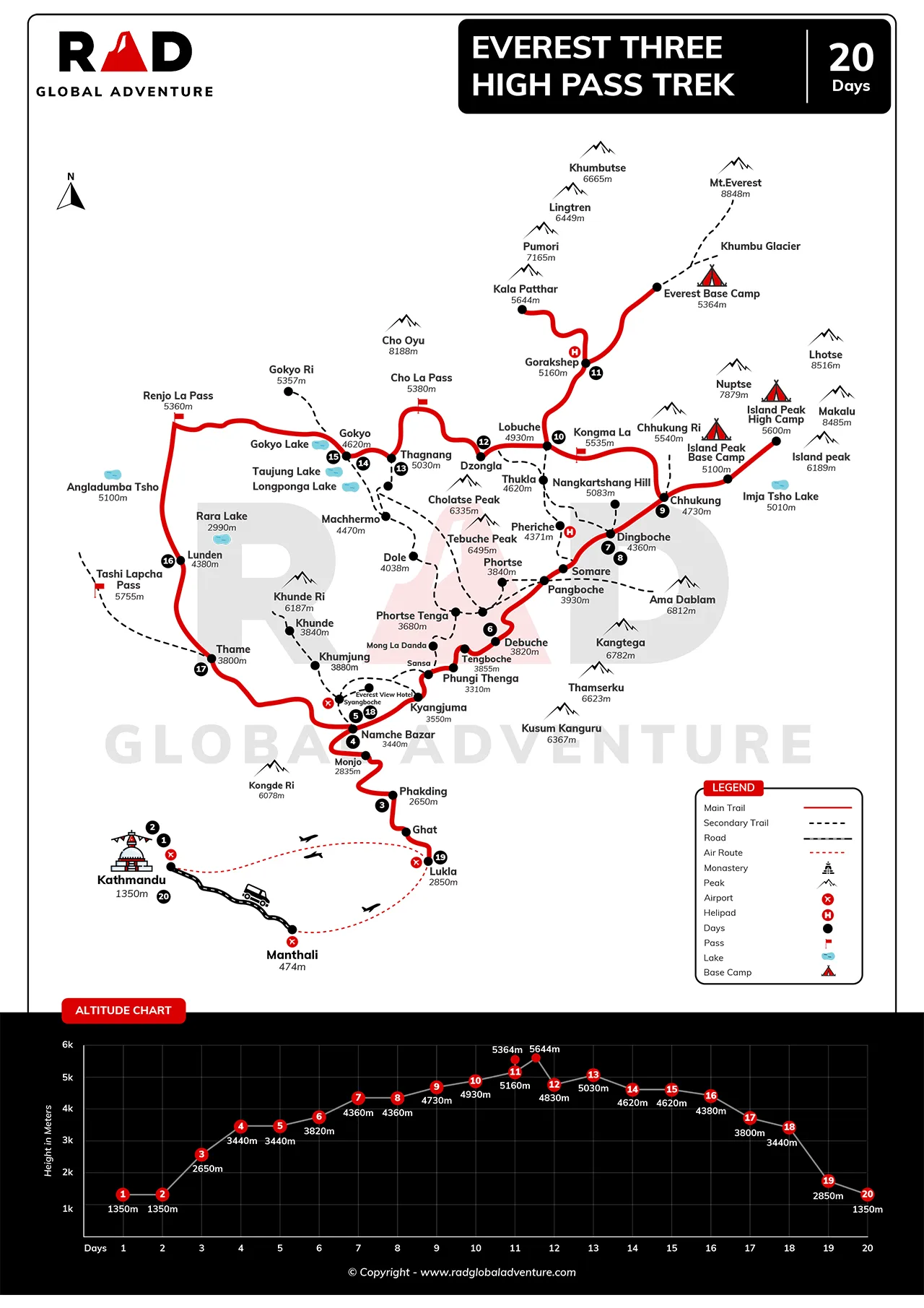
Route Map & Altitude Chart

Attractions and Highlights of Everest Three High Pass Trek

Crossing Kongma La Pass, Cho La Pass and Renjo La Pass

Crossing Kongma La, Cho La and Renjo La are the three big highlights of the trek. Each pass climb is physically demanding (above 5,300m) but the payoff is incredible. At the top of each pass you have 360 degrees view of Everest and the surrounding 8,000 meter peaks and you share the feeling of achievement with fellow trekkers.

Colorful prayer flags set on every summit add to the delightful atmosphere. These crossings are the highlight moments of Everest Three High Pass Trek which only a few travelers experience. Each summit is marked by fluttering of prayer flags and provides a shared sense of achievement among the fellow trekkers.

Standing at the Everest Base Camp (5,364m)

Standing at the Everest Base Camp is the final highlight. Here you are at the base of Mount Everest, surrounded by colorful expedition tents. You can look up at the slopes of Everest and Nuptse, knowing you have hiked all the way from Lukla.

The air is thin and the scenery unreal, infinite icefalls, high peaks, prayer flags fluttering in the wind. Despite the hard work to get this far, standing at Base Camp brings a sense of overwhelming satisfaction and perspective. Reaching Everest Base Camp is like touching the heart of Everest – a core memory of the Everest three high pass treks.

Sunrise Views from Kala Patthar (5,545m)

Kala Patthar Sunrise trek is a memorable journey. A steep pre-dawn ascent rewards you with a golden panorama: Everest, Lhotse, Nuptse and surrounding giants are bathed in morning light. On clear mornings the colors of the sunrise glow on Everest’s peak and across the glacial valleys. Breathing the cold morning air and gazing out over Nepal and Tibet from up here, is a very moving experience.

It really does feel like you are on top of the world. Experiencing that view in dawn is one of the best moments of Everest Three High Pass Trek. Climbing up to Kala Patthar, you will have a wide view of the Himalayas in the rising sun.

Visiting Gokyo Lakes and Climb Gokyo Ri

The Gokyo Lakes are a series of six turquoise high altitude lakes with snow-capped mountains in the background. The village Gokyo is located next to the Ngozumpa Glacier, which is the longest glacier in Nepal. Trekking in this place is like walking into a fairytale: emerald waters reflect the sky, and reflections of mountains move on the lake surfaces.

The lakes are considered sacred by locals. Climbing Gokyo Ri (5,357m) provides an outstanding viewpoint – you can see Everest, Cho Oyu, Lhotse, Makalu and all five Gokyo Lakes below. During this sunrise hike, the Everest Three High Pass Trek feels completely worth the effort. These lakes are really peaceful highlights.

Experiencing Sherpa Culture in Namche Bazaar and Khumjung

Namche Bazaar and Khumjung region are highlights of the cultural. Namche is a colourful Sherpa trading centre with markets, cafes and the traditional wooden architecture. Here you meet friendly locals, and taste Sherpa hospitality in 3440m altitude. Visit a nearby medieval monastery (which houses the legendary Yeti scalp) and a modern Sherpa hospital founded by Sir Edmund Hillary in nearby Khunde.

These villages are great examples of Sherpas’ strength and spirit – you will hear English spoken widely, learn the history of Everest climbers, and perhaps catch a festival in session. Namche’s bustling bazaar and Khumjung’s quiet gompa are living lessons in Himalayan life. The golden light of sunrise or sunset on Tengboche Monastery and Sherpa villages, the red brick buildings are enhanced by the light against the snowy peaks

Visiting Everest Viewing Tengboche Monastery

Tengboche Monastery (3,860 m) is the spiritual centre of the Khumbu. This ancient gompa is located on a ridge with Everest, Nuptse and Ama Dablam towering behind it. Monks spin prayer wheels and chant as the monastery’s golden facade glows at dusk or dawn. Tengboche is an emotional place to go to: you feel at peace among prayer wheels and statues, with prayer flags flapping in the cold wind.

The chants of the monks in the background of the mountain are unforgettable. The monastery is one of the most scenic and sacred places to see. Founded in 1916, it has been destroyed and rebuilt multiple times, but remains the spiritual heart of Khumbu with incredible views of Everest.

Trekking in the Valleys, Glaciers and Alpine Scenery

The Everest Three High Pass Trek takes you through wildly different landscapes. You follow river valleys (Dudh Kosi, Imja Khola), cross rocky glacier moraines and hike above the treeline through alpine meadows. The vast Khumbu and Ngozumbas glaciers cover the horizon. Every day the landscape changes, from green forests to expansive glacier valleys and windy plains.

Look out for wildlife such as Himalayan tahr, musk deer and snowcocks and see how plants become fewer the higher we go.” Each step takes you to yet another view: huge icefalls, sharp peaks and prayer-flagged ridges. Trekking to the remote valleys and high passes reveals the pure beauty of the Himalaya.

Trip Information of Everest Three High Pass Trek

Beginner-friendly?

The Everest Three High Pass Trek is not designed for absolute beginners. You are expected to be fit and have some experience at hiking with a pack (several hours a day). A normal trekker should be able to trek for 5-6 hours a day with altitude gain. If you are new to hiking, do training hikes and stay active. We move at a slow, steady pace to suit the group.

With proper training and support, many motivated novices have achieved great success. All in all, most trekkers can successfully complete the Everest Three High Pass Trek with our guidance and lots of determination and a positive mindset.

Private Trip vs Joining Group

This trek can be booked as a private tour (only your party) or as a group tour. Private trips offer total freedom (you can set your own time, choose your hotel) and are best suited to families or friends. Group departures are a good option for solo travelers to join and share expenses. Our team sizes are usually between 4 and 12 people.

Group trips have pre-defined dates of departure; private trips can be arranged at any time of the year. Group travel is more affordable on a per-person basis; private travel offers more privacy and a personal pace. Both formats contain the same expert advice. Whether the group or private, you will enjoy the same Everest Three High Pass Trek itinerary with professional support.

Trip Extension

You can easily extend your trip in Nepal. Tours to Pokhara, Lumbini or Chitwan can be added easily before or after Kathmandu. You can also include a trekking expedition to Ama Dablam Base Camp or another Himalayan Himal peak on the side of the expedition if you have time.

If you are a mountain lover, you can climb Island Peak or Lobuche Peak (extra permits are required), or take additional days trekking to Everest View Hotel (optional) or further explore Khumbu villages. These extensions enhance the overall Everest Three High Pass Trek adventure. We will organize any additional accommodation, transport and permits required, just tell us your interests.

Solo Travel

Solo trekkers are welcome. You can join a group departure or book the trek on a private basis (still with guide/porter support). Solo travelers are frequently placed in groups for porters and lodging. Apart from requesting a single in the hotel in Kathmandu, there is no mandatory single room supplement for a private trek.

In lodges, rooms are typically twin or triple-sharing; single rooms in Kathmandu can be booked at an extra charge. Solo trekking is safe here with our guides; there are many solo travelers who join every season and share the joy of friendship.

Photography & Drone Rules

Photography is a major attraction of the trek. Most Buddhist shrines and landscapes can be photographed for free. The use of drones in Nepal is highly regulated: a special permit must be issued by the government (very expensive and time-consuming). Unlicensed drones are illegal and can be seized. We strongly do not recommend bringing a drone.

Instead, bring a good camera or phone: the scenery (mountains, prayer flags, villages) is stunning. Use a tripod or selfie stick for stability. Ask permission to shoot people if you are taking pictures. Take ground-level photos – the views on the Everest Three High Pass Treks are amazing without a drone.

Cultural Festivals along the Trail

Tibetan Buddhist festivals are sometimes encountered along the path. For instance, Mani Rimdu festival in Tengboche is celebrated in Oct-Nov. Losar (Sherpa New Year) around Feb/March is a colorful festival celebrated with dance in villages. Smaller puja ceremonies are taken place at monasteries often. You might come across a festival parade on the trail which is a special experience to watch.

In Thamel/Kathmandu there also occur Hindu festivals like Dashain or Tihar in autumn. We will bring it to your notice in case of any major festival falling on your dates. Be respectful of local customs: dress modestly at gompas, respect silence or participate in prayer. These festivals will give a cultural flavor to your Everest Three High Pass Trek journey.

Tips for Visiting Nepal for the First Time

First-time visitors must mentally prepare themselves for the contrasts of Nepal. Dress in layers (mountain weather is unpredictable from day to day) and wear good sun protection. The Nepalese official currency is Nepali Rupee or NPR. ATMs are available in Namche and Kathmandu but are hard to find off these areas. Take enough cash for teas, tips and small shops.

Learn few phrases in Nepali language (“Namaste”, “Dhanyabad” etc); people appreciate the effort. Only boiled or purified water should be consumed. Do not walk alone in the cities at night. We recommend coming to Kathmandu 2-3 days in advance to rest and enjoy the main sights in the city.

Travelling with RAD Global Adventure guarantees that you have assistance along the way. Nepal is a must-visit destination and the first-time visitor can savor their trip with an open mind and respect for the culture. On the Everest three high pass trek, acclimatization is crucial.

General Daily Schedule on the Trip

A typical trek day begins early in the morning. You should get up around 6-7am and have a hot breakfast. We begin trekking by 8–9 am. trek for 3-4 hours to lunch at a tea house, then another 2-3 hours to camp by mid-afternoon. Afternoons are for resting: drying clothes, recharging devices and drinking hot tea.

Dinner is served at 6-7 pm (usually dal bhat). Brief guides’ talks or briefings take place in the evening. Lights-out is early (about 8-9 PM) so you’re well-rested in case of cold mornings. The routine of early start, lunch in the middle of day and rest in the afternoon is made to help you acclimatize and make steady progress on the Everest three high passes trek.

Mental Training and Trekking Attitude

High altitude trekking will test you both mentally and physically. Training by gaining confidence on shorter hikes is a good idea. On bad days, push yourself to see the positive – small achievements and stunning panorama. Altitude can exhaust you mentally, so approach problems in small steps. Learn to live simply (basic toilets, no hot showers) without complaining about it, as living simply is part of the experience.

Listen to your guide – they know how to pace and support you. Be prepared to be uncomfortable and flexible (the weather may not always be within our control). Trekking in Nepal is about challenge and reward, and for your Everest three high pass trek, you’ll need a strong, resilient mindset to make your journey rewarding. Remember, every step you take is closer to lifetime memories.

Frequently Asked Questions

Please bring layered clothing, a warm jacket, sturdy boots, gloves, crampons (for icy passes), a –10°C sleeping bag, trekking poles, a headlamp, sunscreen, and personal medicines.

Days are mild (10–15°C), but nights can be very cold (–5 to –15°C). Warm clothing is important, especially at high passes.

No special vaccines are required, but we recommend standard travel shots such as hepatitis A, typhoid, and tetanus.

ATMs are available in Kathmandu and Namche. Please carry around US$200–300 in cash for snacks, tips, and extras.

Yes, a –10°C rated sleeping bag is essential. You may also rent one, but we recommend bringing your own for comfort.

Yes, teahouses have basic toilets. Please bring toilet paper and hand sanitizer for your convenience.

Weather delays do occur. We will rebook your flight for the next clear day, or a helicopter can be arranged if needed.

Groups are usually 4–12 trekkers. Private treks can also be arranged if you prefer.

The trek is very challenging, so it is not recommended for young children. Fit older teenagers may join with care.

Tipping is customary and usually pooled among the support team. A standard guideline is US$10–15 per day for guides and US$5–10 per day for porters, shared across the group.

We recommend bringing US dollars or euros to exchange for Nepalese rupees. Carrying small bills is helpful.

Guides carry first-aid kits and oxygen. In case of a serious issue, helicopter evacuation to Kathmandu is possible with insurance.

Yes, Nepal is generally very safe. Our guides take care of your well-being, and the main risks are weather and altitude, not crime.

Trip Reviews

expert-image
Need Help? Ask to Travel Expert
Get a Trip Quote Customize This Trip Make an Inquiry
  • Best Deal
  • Flexible Schedule
  • Instant Booking
  • No Hidden Costs
trip-advisor
5.0
25 reviews