expert-image
Talk to a Travel Expert +977 9818264758

Booking open for Nepal Trek 2025 & 2026

View Details
Everest Base Camp Trek with Helicopter Return

Everest Base Camp Trek with Helicopter Return

Based on 25 reviews
duration
Duration

14 Days

difficulty
Trip Difficulty

Moderate

max-altitude
Max. Altitude

5,555m

destination
Destination

Nepal

group-size
Group Size

2-10 People

meals
Meals

Breakfast, Lunch & Dinner

accommodation
Accommodation

Hotel, Lodge

expert-image
Need Help? Ask to Travel Expert
Get a Trip Quote Customize This Trip Make an Inquiry
  • Best Deal
  • Flexible Schedule
  • Instant Booking
  • No Hidden Costs
trip-advisor
5.0
25 reviews

Overview of Everest Base Camp Trek with Helicopter Return

The helicopter return in the Everest base camp trek is the ultimate Himalayan adventure tour that would allow adventurers to explore the most renowned base camp in the world and fly back in style. This adventure is a combination of the adventure of walking through the Khumbu Valley and a helicopter flight along snow-covered mountains.

You will follow the traditional route over Sherpa villages, suspension bridges, high-altitude viewpoints, and finally arrive at the Everest Base Camp. Going back, you do not have to walk the same way back up the mountain if you take a helicopter return option.

The Everest helicopter return trek is created to suit travelers who have limited time and don’t want to walk back to Lukla. Once in Kathmandu, you fly to Lukla and walk gradually upwards, acclimatizing at Namche Bazaar and Dingboche.

Ascending from Dingboche, you will cross Tengboche Monastery, Nangkartsang Peak, and reach the base camp of 5,364 m. Then the following morning, you will walk to see the sunrise from Kala Patthar, and fly back to Lukla or Kathmandu.

The camera angle of the bird’s-eye view shows concealed valleys and makes you feel like you have just conquered the terrain. This combination of trekking and flying is a challenge as well as comfortable.

Along the way, you will get to know the Sherpa culture and hospitality. You will visit Namche Bazaar, meet the yak herders, turn prayer wheels in mani walls, and be blessed by the monks.

Additionally, the trails offer you the opportunity to experience teahouse hospitality. The helicopter ride will provide a luxurious feel, and you will have a chance to get to know Kathmandu better at the end of your Everest trek because of the short itinerary.

Good To Know

This Everest base camp trek with helicopter return is a moderately challenging trek. In 9-11 days, you will walk 10-15 km a day on a rocky trail. Trekkers require good cardiovascular fitness and strong legs so that their bodies can settle in on the acclimatization days.

Trekkers with previous trekking experience are helpful. There is no technical climbing needed, but you must be able to walk at altitude for a few hours. The helicopter trip eliminates the time-consuming walk back, so the trip can be undertaken even by the trekkers who have limited time.

The Everest helicopter return trek is best enjoyed in spring (March–May) and autumn (September–November). This time of the year has clear skies, mild days, and stable weather conditions for both flying and trekking.

In spring, rhododendrons are in blossom, and in autumn, there is a chill and mountain vistas. Heavy rain, slippery trails, and flight delays are characteristic of the monsoon season (June -August). Winter (December to February) is characterized by heavy snowfall at higher elevations. So, it is better to avoid winter and the monsoon.

Teahouses along the route serve traditional Nepali meals like dal bhat, momo dumplings, and Sherpa stew. However, in Namche, you will find some bakeries selling pastries and coffee.

Remember to keep energy bars, nuts, and a protein bar to boost your energy throughout the trip. Don’t drink tap water without boiling and filtering it. Additionally, avoid drinking alcohol and caffeinated beverages at altitude because they dehydrate your body and retard acclimatization.

The rapid increase in altitude is dangerous during the Everest base camp trek. Acute mountain sickness symptoms such as headaches, dizziness, loss of appetite, and nausea may occur during the trail. In order to reduce the risk, climb gradually, drink lots of water, and have frequent meals.

The plan will comprise days of acclimatization in Namche Bazaar and Dingboche, as well as ascending to higher heights. It is important to monitor the symptoms and get immediate medication. The evacuation option is also available in the helicopter choice in case of need, which increases safety.

Start training 3 months before your trek. Focus on cardiovascular training such as running, hiking, and cycling. Leg, core, and back strength can be developed by squats, lunges, and planks.

Train to carry a full pack on hiking to get an idea of what a trek would be like. Run on a rough surface and stairs to train the ankle and knee. Mental preparation is important as well. With adequate preparation, the journey becomes a pleasure, and your success rate goes higher.

Visitors to Nepal can obtain a tourist visa on arrival at Tribhuvan International Airport. In the Everest base camp trek with helicopter return, you will have two permits: the Sagarmatha National Park permit and the Khumbu Pasang Lhamu Rural Municipality permit. These documents are normally organized by your trekking company. TIMS cards are no longer needed.

Have passport-size photographs and photocopies of the passport on hand to complete paperwork. The checks of permits are performed on the entrance to the park in Monjo and at several points during the trail. Keep your permits in a waterproof pouch so they will not be ruined by rain or snow.

Health is a very important issue to maintain on this trip to Everest. Bring hand wash, hand sanitizer, and avoid uncooked foods. Always have your own first-aid kit of bandages, pain relievers, altitude sickness tablets, and rehydration salts.

Walking alone without a guide is not recommended. Report to your guide if you are not well. The weather may be unpredictable, so wear layers and sturdy boots. Helicopter evacuation can be provided in case; however, make sure you have insurance.

The expedition starts with a flight from Kathmandu to Lukla. If the Kathmandu traffic is high, then the flights can be diverted to Manthali Airport. You will walk from Lukla to Everest Base Camp and take a helicopter to Lukla and then to Kathmandu.

This air trip will offer an aerial sightseeing of the Khumbu Valley, as well as save trekking time. Flight delays are common because of weather, so add buffer days in your schedule. Airport transfers in Kathmandu are done by means of private vehicles.

Wi-Fi is available in Lukla, Phakding, Namche Bazaar, and Dingboche at some charge. Satellite internet is available in some teahouses in Lobuche and Gorak Shep, but it is slow and very costly.

Buy a local SIM card in Kathmandu in case you require mobile data. Networks will probably not be available past Namche. In order to keep phones and cameras charged, carry a power bank and solar charger. Inform your close ones about the connectivity problem during the trek.

If you have enough time, you can choose to extend your Everest trek by adding side trips. You can visit well-known routes such as Gokyo Lakes and the Three Passes Trek. You may also visit Island Peak or the Ama Dablam Base Camp.

The extensions demand further acclimatization and additional walking. To customize the itinerary with extended trips, talk to us about working with your itinerary. These paths have alternative views on the Himalayas and a more cultural exploration.

Although the trek package includes the food, accommodation, and helicopter transport back, budget for yourself. Hot showers and charging electronics, as well as Wi-Fi, require extra budget at teahouses.

Equipment rentals, soft drinks, tips, souvenirs, etc., require extra budget. Bring in cash in Nepalese rupees because there is no ATM past Namche. The budgeting will ensure that you do not feel the financial strain on the helicopter return trek to the Everest.

Sherpa is the primary language spoken in the Everest region, but Nepali and simple English are widely spoken. Learn the basic words such as Namaste (hello) and Dhanyabad (thank you). Guides provide the role of translators.

In monasteries, mind your manners by walking clockwise around stupas, rotating prayer wheels clockwise, and taking off your shoes to enter. Courteous communication not only makes your Everest base camp trip back with a helicopter, but also develops relationships with the locals.

Power in the Khumbu originates from solar energy and micro-hydro plants. Lodges charge a fee for charging your devices, and it is advisable to bring a power bank. The lower villages, like Namche, have relatively reliable electricity; however, the higher communities often experience electricity outages.

There is Wi-Fi in Namche and Dingboche, but not guaranteed in Lobuche and Gorak Shep; there is satellite internet, but it is expensive. Before beginning your Everest trek and returning by helicopter, download offline maps, music, and books. Take the opportunity to unplug and connect with the mountains instead.

Detail Itinerary

After arriving at Tribhuvan International Airport in Kathmandu, you will be welcomed by a representative of RAD Global Adventure and driven to your hotel. After check-in, spend the afternoon resting or wandering through lively Thamel.

During the evening, you will have a welcome dinner wherein your guide will present the itinerary for the Everest base camp trek with helicopter return. Introduce yourself to your fellow trekkers and plan gear, permits, and expectations.

accommodation-small

Accommodation: Hotel

altitude-small

Max Altitude: 1,400m/4,593ft. (Kathmandu)

If our standard itinerary doesn't fully meet your needs, we are happy to tailor it to your specific preferences and requirements.

Includes and Excludes

What’s Included?

Transportation

  • International airport transfers
  • Flights Kathmandu – Lukla – Kathmandu
  • Helicopter flight Gorak Shep/Kala Patthar – Lukla

Food and Accommodation

  • Full meals: breakfast, lunch & dinner on your choice.
  • Supplementary snacks: energy bar and cookies
  • Seasonal fresh fruits deserts every day
  • Unlimited chlorine treated safe drinking water
  • Accommodation: Lodge (twin room)

Guide and Support Staff

  • An experienced english-speaking trekking guide
  • Porter service for luggage (one porter for every two trekkers)

Permit and Expenses

  • Khumbu Pasang Lhamu Rural Municipality Permit
  • Sagarmatha National Park entry permit
  • Trekkers’ Information Management System (TIMS) card
  • All local and government taxes
  • Guide and porter salaries, insurance, equipment, transport, food and lodging

Medical and Gear

  • Oxi-meter: To check , heart rating and oxygen saturation
  • A comprehensive first aid kit
  • Emergency rescue in case of severe illness or injury (costs covered by your insurance)
  • Trekking equipment: down filled sleeping bag, walking poles and duffel bag
  • Free luggage storage in Kathmandu

Others

  • Farewell dinner in Kathmandu
  • Certificate of appreciation
  • Trekking route map and company t-shirt

What is not Included?

International Flights and Visa

  • International flights and visa

Food and Accommodations

  • Meals in Kathmandu (except farewell dinner)
  • Any hotel stays in Kathmandu before or after the trek

Travel and Medical Insurance

  • Comprehensive travel and medical insurance
  • Emergency rescue evacuation

Other Expenses

  • Personal expenses
  • Tips and gratuities
  • Personal trekking equipment
  • Unexpected expenses due to weather, flight cancellations, strikes, or natural causes

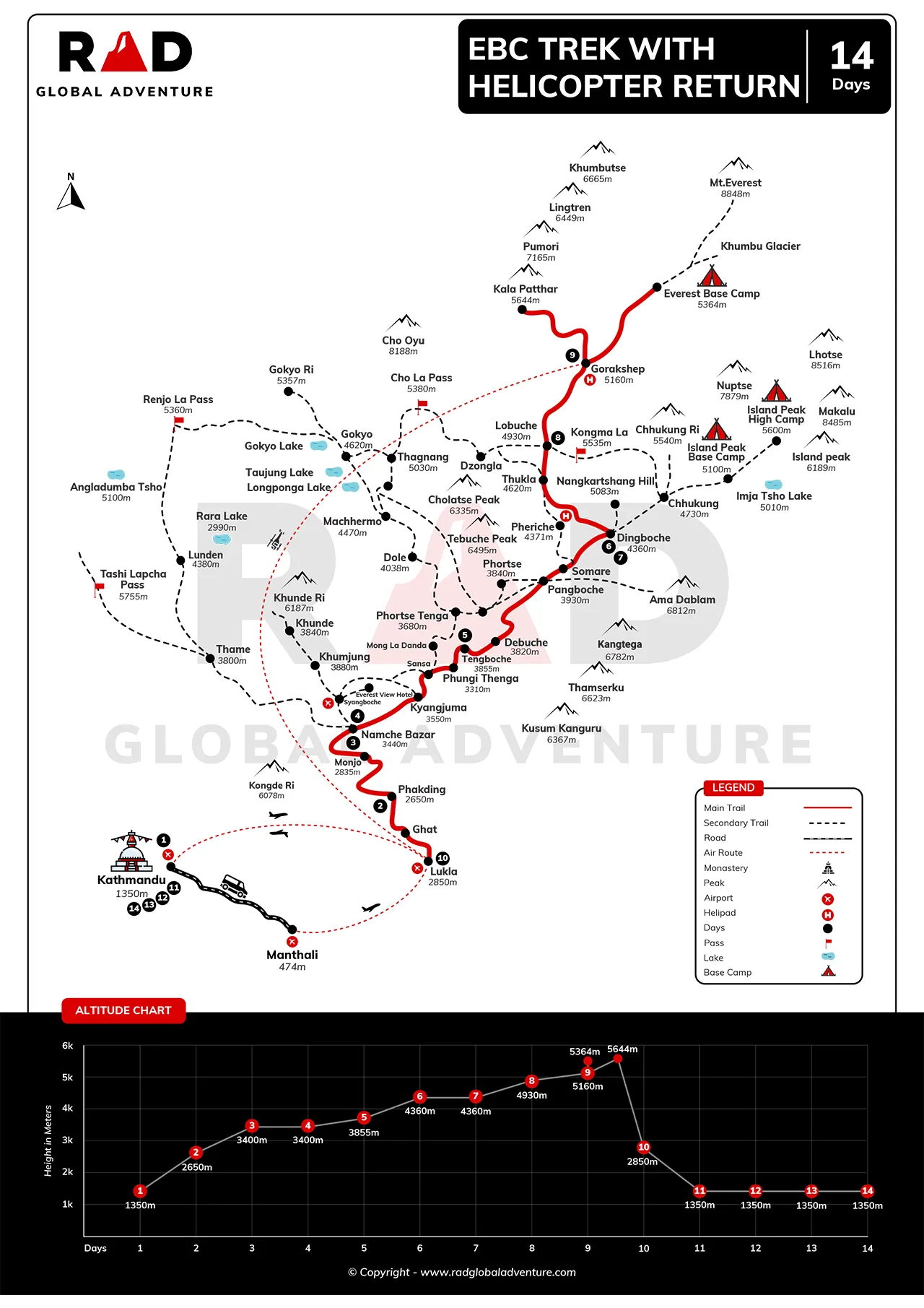
Route Map & Altitude Chart

Attractions and Highlights of Everest Base Camp Trek with Helicopter Return

Scenic Mountain Flight to Lukla

Flying to Lukla is an adventure. The small plane is maneuvered between mountains and lands on a short runway with a landing point at 2,840 m. The window is occupied with views of terraced hills, deep gorges, and snow-capped peaks.

This flight will save days of hiking and sets the tone for your Everest helicopter return journey. If flights depart from Manthali, you are given a ride around rural Nepal, then you take off on the plane. Whichever the case, the trip is thrilling and gives the most magnificent introduction to the Khumbu Valley.

Trek Through Sherpa Villages

During your trek, you will cross Sherpa villages such as Phakding, Namche Bazaar, Tengboche, Dingboche, and Lobuche. Terraced hillsides are covered with houses painted in bright colours. You can see local children running on the trails, and yaks graze on fields while walking.

Have a break in family-owned tea shops to take yak butter tea and Sherpa stew. Go to monasteries with prayer flags, and turn prayer wheels for good luck. The hospitality and strength of the Sherpa people will make your Everest trek and helicopter ride an enriching experience.

Explore Namche Bazaar – Gateway to Everest

Namche Bazaar is the trading and cultural center of the Khumbu region. It has the bakeries, shops, and lodges carved into the hillside. Acclimatization hikes to the Everest View Hotel or the Sherpa museum provide an understanding of the local history and the success of mountaineering.
On Saturdays, the villagers of the surrounding areas come to the market to trade goods. Your stay here will enable you to acclimatize to the altitude and have fun in the lively life of the Everest base camp trek with a helicopter return.

Acclimatisation Hikes with Panoramic Views

Acclimatisation is crucial for high‑altitude trekking. Viewpoint elevation, such as the Everest View Hotel, Nangkartsang Peak, and Kalapatthar, provides breathtaking scenery and helps your body adapt.

From these points, you can see Everest, Lhotse, Nuptse, Ama Dablam, and even Makalu on a clear day. Climbing high and sleeping low is one of the ways of lowering the chances of experiencing altitude sickness. These hikes offer you amazing photo opportunities as well when you are on your Everest helicopter flight back.

Visit Tengboche Monastery (3,860 m)

The Khumbu has a spiritual center at Tengboche Monastery. The monastery of 1916 is located on a ridge, with Ama Dablam as a background. You can go to a prayer hall where there are monks chanting and colorful murals with illustrations of Buddhism.

The Mani Rimdu festival during the fall is made up of masked dances and blessings. A visit here links you to the cultural and spiritual aspect of the Everest base camp trek, including a helicopter pick-up.

Stand at Everest Base Camp (5,364 m)

The highlight of the trip is reaching the Everest Base Camp. You are at 5,364 m, surrounded by rising mountains and the Khumbu Icefall. Feel the base camp rock, take photos in prayer flags, and sense the power of climbers who are about to go up. This moment marks the culmination of days of trekking and acclimatization. Helicopter return also allows you to witness the base camp without having to take the long walk back.

Hike Under the Shadow of Ama Dablam

Ama Dablam, a mountain frequently named as the Matterhorn of the Himalayas, occupies a lot of the skyline during the trek. Its steep edges and hanging glaciers make it constantly inspirational. The walk to Pangboche and Dingboche makes you nearer to its base. The peak is painted by the sunrise and sunset golden light. Trekking below the shadow of Ama Dablam will make your Everest trek and helicopter back photogenic.

Helicopter Return from Gorak Shep to Lukla

The trek is crowned by the helicopter ride. Upon arriving at Kala Patthar, you skip the long descending pathway and fly above Khumbu Valley, taking aerial views of rivers, villages, and glaciers.

The journey lasts 15-20 minutes and lands at Lukla, where you will finally relax before flying back to Kathmandu. The Everest helicopter return trek is a combination of trekking and flying, which makes it an adventure and at the same time comfortable.

Sagarmatha National Park Exploration

Sagarmatha National Park preserves the delicate ecosystem of the Everest region. During your trek, you may be lucky enough to see Himalayan tahr, musk deer, and pheasants in the forests of blue pine and rhododendron.

The high altitude landscape also includes moraines, glaciers, and alpine meadows. Your entrance fee contributes to the conservation of the area. The hiking experience through this UNESCO site reinforces the environmental significance of the Everest base camp trek with a helicopter return.

Sherpa Culture & Himalayan Hospitality

The Sherpa culture is flourishing in the Khumbu Valley. There are traditional houses, painted in colorful window frames, in front of prayer wheels and chortens. The monks and nuns maintain the ancient monasteries, while farmers are working on the potato fields and on yak herds.

You will experience amazing Sherpa hospitality, as the owners of teahouses welcome their guests with a hospitable smile and good food. Learning Sherpa practices makes your trip to Everest and the flight back by helicopter more complete.

Blend of Adventure & Comfort

This tour provides both fun and comfort. The hike to the Everest Base Camp puts your body and mind to the test, and the helicopter will offer comfort. Appealing teahouses, nutritious food, and guided support ensure you are in good condition. That combination of physical activity and luxury makes the return helicopter trek to Everest attractive to the traveler who does not wish to miss the convenience.

Trip Information of Everest Base Camp Trek with Helicopter Return

Is This Trip Beginner‑Friendly?

This walk is not perfect with absolute beginners. It entails heavy foot trudging of the high altitudes, although a helicopter comes back. Good physical fitness and prior trekking experience are necessary. If it is your first time trekking, begin with shorter hikes that are not too high. This is a satisfying but challenging adventure for trekkers who want a shorter adventure.

Private Trip vs Group Joining

This trek may be booked either on an individual basis or organized into a group. Personal travel is flexible in terms of schedule, speed, and company. The group treks are cheaper and create socialization. Both have guides and porters to help and assist. Go solo to make it your own adventure or join forces to have fun and share the expenses- either way, you are in safe hands.

Trip Extension

After completing the Everest Base Camp trek with a helicopter return, you can extend your Nepal trip. The most popular add-ons are the jungle safari in Chitwan, rest in Pokhara, or the rich culture of Kathmandu.

Other adventure possibilities are Gokyo Lakes or Annapurna Base Camp. You can also go to Lumbini, or fly scenically over Everest.  We can assist you with an extension to your trip that is both smooth and enriching.

Solo Travel

Individual travelers can also join group treks, which provide security, assistance, and expenses. You may ask to have your own rooms in cities, but trail lodges are frequently shared. The tourists are usually safe in the hands of the local guides and the respected communities. Hiking without a guide is not recommended because of the elevation, and it’s better to go with a group to relax.

Photography & Drone Rules

The hike provides a breathtaking photo opportunity. Additionally, it is important to seek permission before you photograph locals, particularly monks and children. In most places, the use of a drone requires permission and is prohibited. Also, carry battery warmers and dry bags for your stuff. Move aside when shooting to ensure that you do not block the trail. And most of all, do not forget to enjoy the scenery outside the camera lens.

Cultural Festivals on the Trail

Scheduling your trek in the local Sherpa festival gives depth to your trip. Masked dances, feasts, and colorful celebrations are provided at events such as Mani Rimdu, Dumji, and Lhosar. They are found in villages and monasteries on the way. Take the etiquette tips of your guide, wear simply, take off your shoes, and respect all people you meet. Being part of these traditions is even more memorable of your Everest adventure.

Tips for First‑Time Nepal Visitors

If it is your first trip to Nepal, arrive in Kathmandu early to acclimatize. You require cash (USD or Euros) for your visa. You should only drink purified water, not tap water. Avoid eating raw food. Dress in layers and download an offline map and apps. Learn some of the basics of Nepali – they will appreciate and remember it. Bargen, but don’t be rude about it. Nepal is a country where you need both flexibility and an open heart. Embrace the unexpected – this trek will push you and open your mind in a way you didn’t think was possible.

Typical Daily Routine on the Trek

Your days will begin early. Usually, tea is given to you at 6 am, followed by breakfast at 7:30 am. You may trek for 3-4 hours in the morning, have lunch, and then another 2-3 hours in the afternoon.

Your evenings will typically consist of dinner, a briefing of the following day, and lights out by 9:00. At base camp, we will leave before dawn to summit Kala Patthar and fly back by helicopter for an unforgettable experience.

Mental Preparation & Trekking Mindset

Mental toughness is a key component for success on this Everest helicopter return trek. There will be long travel days and simple accommodations, which can be challenging. Remain optimistic, flexible, and take one step at a time. Praise little achievements and encourage other trekkers. Imagine getting Basecamp, flying back, and being proud of the work. A robust attitude and open-mindedness make the suffering an adventure that will never be forgotten.

Frequently Asked Questions

It is time-saving, does not take so long, and provides a gorgeous view of the Himalayas.

The Everest base camp trek with helicopter return spans 14 days, including a helicopter arrival and buffer days.

Yes, prior experience of trekking for more than a day and good fitness are advisable.

The best weather is during spring (March-May) and in the fall (September -November) because these seasons offer amazing weather for trekking and sightseeing.

Its peak is Kala Patthar with an altitude of 5,555m.

It is possible, but prevention is possible with acclimatization and hydration.

You will be in teahouses along the trail and a 3-star hotel in Kathmandu.

Foods in the teahouses are dal bhat, noodles, soups, pancake, and simple snacks.

Solo trekking is no longer permitted in the Everest region. A licensed guide is mandatory.

Yes, you can charge your devices in lodges. Bring a power bank and an adapter for convenience.

Yes, wifi is available in Lukla, Phakding, Namche, and Dingboche for small fee. You will experience a poor connection above Lobuche.

Helicopters are indeed run by experienced licensed pilots and are weather-dependent.

Buffer days are added in the itinerary, and the alternative flights can be scheduled in case of necessity.

Warm clothes, sturdy boots, poles, a sleeping bag, and simple equipment are necessary.

Budget around 10% of trip cost or USD 100–150 per guide and USD 50–100 per porter (shared among trekkers).

Yes, the private trips can be fully tailored based on your interests.

There is no rigid restriction, but everyone must be healthy and physically fit.

We may hike during light rain or snow; however, safety is paramount. If the weather is dangerous, our guides will change their plans.

The last reliable place to get cash is in Namche Bazaar. Be sure to carry enough money in case you would like any extras, like Wi-Fi, snacks, or souvenirs.

If you fly back after you reach Kala Patthar, you will not have to acclimate again for a descent. You will be descending rapidly and are less likely to suffer altitude-related risks.

Trip Reviews

expert-image
Need Help? Ask to Travel Expert
Get a Trip Quote Customize This Trip Make an Inquiry
  • Best Deal
  • Flexible Schedule
  • Instant Booking
  • No Hidden Costs
trip-advisor
5.0
25 reviews