expert-image
Talk to a Travel Expert +977 9818264758

Booking open for Nepal Trek 2025 & 2026

View Details
Dhaulagiri

Dhaulagiri Circuit Trek

Based on 25 reviews
duration
Duration

20 Days

difficulty
Trip Difficulty

Challenging

max-altitude
Max. Altitude

5,100m

destination
Destination

Nepal

group-size
Group Size

2-16 People

start-end
Start / End

Kathmandu / Kathmandu

meals
Meals

Breakfast, Lunch & Dinner

accommodation
Accommodation

Lodge, Teahouse

expert-image
Need Help? Ask to Travel Expert
Get a Trip Quote Customize This Trip Make an Inquiry
  • Best Deal
  • Flexible Schedule
  • Instant Booking
  • No Hidden Costs
trip-advisor
5.0
25 reviews

Overview of Dhaulagiri Circuit Trek

The Dhaulagiri Circuit Trek is a 20-day High altitude adventure by RAD Global Adventure which encircles the Nepalese high altitude mountain range, Dhaulagiri. This is the tough Dhaulagiri circuit trek that takes daring adventurous tourists to some of the most natural mountain scenery, mountainous alpine trails and amazing views of some of the highest mountains on earth.

The trek is located in the western Nepal close to the Annapurna ranges, and it tracks the Myagdi Khola valley across the traditional Magar villages and terraced fields as it ascends to the high Himalaya. During the journey, the trekkers will be able to experience the beautiful rhododendron forests, flowing streams, and alpine meadows and moraine.

Every day spent on the trip presents a new experience, whether it is a mountain village with old houses or a snow field, reminding trekkers that it is in the very center of the Nepalese high Himalaya. The path around Dhaulagiri is made up of two high passes followed by steep descent: the French Pass at 5,360 m, and the Dhampus Pass at 5,240 m, and then the walk descends into the hidden valley, a holy glacial basin surrounded by great mountains.

The trekkers spend the night under the stars on moraines and grassy plateaus and get a taste of real wilderness trekking. The trail goes down to the fertile Kali Gandaki Valley, after the visit to the distant hidden Valley. After descending into the Kali Gandaki Valley (often described as one of the world’s deepest gorges), the beautiful village of Marpha provides a pleasant cultural break.

From Jomsom, take a short flight to Pokhara and then continue to Kathmandu, which rounds this famous Dhaulagiri circuit trek. RAD Global Adventure provides local knowledge, safety, and support throughout the Dhaulagiri circuit through the services of its knowledgeable guides. They offer properly organized logistics, such as tent camps and rests in cozy teahouses on the route.

The trek will conclusively bring you round the basics of the Dhaulagiri range and you will finish with a deep sense of achievement and a rare insight into Nepal’s hidden Himalaya. It is an incredible Dhaulagiri Circuit Trek which is a bucket list adventure for experienced trekkers and adventure travelers who seek to explore beyond the trail.

Good To Know

The Dhaulagiri Circuit Trek is strenuous and demanding, suited for experienced trekkers with excellent fitness. The trip includes trekking that takes 5-7 hours per day in uneven, usually steep and rocky paths. Anticipate numerous river crossings and snow and ice covered sections particularly around the high passes. In winter (December–February), deep snow often blocks the passes and can halt the itinerary.

The altitudes rise to a point of more than 5,000 meters and thus the trek is not suitable to first time   trekkers. The treks made each day are physically demanding and need good fitness and stamina since the high altitude and rough terrain needs serious preparation and determination.

The best time for the Dhaulagiri Circuit Trek is in spring (March to May) and autumn (late September to early December). During these seasons the skies are clear and mild and there are lower elevation daytime temps around 10–20 °C in spring and autumn, nights get cold, and at high camps temperatures often fall well below 0 °C. During spring the rhododendrons are in blossom and air is sweet, whereas during autumn weather is still and mountain visibility is excellent.

The monsoon (June- August) causes a lot of rain, land slips and leeches along trails and travelling is complicated and perilous. During winter (December-February), temperatures are extremely low and lots of snow exists at high altitudes, thus closing the passes. Always be ready for rapid weather changes in the high Himalaya.

Food in the Dhaulagiri Circuit Trek will mainly comprise of Nepali and Tibetan food. Trekkers will have a filling meal of dal bhat (lentils and rice), vegetable curry, noodle soups and Tibetan dumplings (momo). Eggs, porridge or pancakes are common breakfast meals. Consume a lot of boiled or purified water to keep hydrated. Hot milk, tea and coffee are easily obtained in teahouses on the trail.

There are also villages, where the local apple brandy or spirits are served in small portions. The trail food is minimal, and carry energy snacks (e.g., granola bars or dried fruits) to have some variety between meals.

Acute Mountain Sickness (AMS) may happen in anybody who is more than 3,000 meters. Rest and acclimatization days (Italian Base Camp and Dhaulagiri Base Camp) are included in the itinerary, but the symptoms may still appear. Hydrate well, climb gradually, and favour complex carbohydrates. Monitor symptoms like headache, nausea, lightheadedness, or shortness of breath.

Our guides carry pulse oximeters and a comprehensive first-aid kit, and can organize evacuation in case of emergency. There are trekkers who use Acetazolamide (Diamox) prophylactically. Tell your guide immediately if you feel unwell, descending to a lower altitude is the most effective response.

Before this trek, you need to prepare and be fit. Training: Strengthen your endurance through cardio training (Running, cycling or swimming) and train to hike with a loaded backpack months before departure. Train the legs to climb stairs or hike up hills to strengthen, train the core to balance. Intend to practice long day treks (5-7 hrs) with increase in altitude prior to the trek.

Good cardiovascular endurance and leg strength are crucial for the steep ascents and long days of the Dhaulagiri circuit trek. The better you are in shape and the better prepared, the more comfortable you will be in each half of the journey.

You can obtain a Nepal Tourist Visa on arrival (RAD Global Adventure assist with the process). Fees: USD 30/15 days, USD 50/30 days, USD 125/90 days. Bring passport photos and a payment method (cash/card). ACAP (Annapurna Conservation Area Permit) and a TIMS card are required. Fees are collected in Nepalese Rupees and change periodically, we will confirm the latest rates before departure.

Bring two passport photos and carry sufficient NPR (and backup USD/EUR) for fees in case card terminals are down. You should always bring your permit documents with you on the trek, police can examine it at the village checkpoints.

Safety is the number one concern. RAD Global Adventure offers highly trained guides, first-aid kits, and communication equipment. Prior to the trek, get your regular vaccines (e.g. tetanus, hepatitis A/B, typhoid). We will carry some essential medicines in case of pain/stomach problems and altitude sickness. Wear high-SPF sunscreen, sunglasses, a warm hat and layered clothing.

To prevent illness, drink safe water (boiled or filtered) and wash hands as often as possible. Take the directions of your guide on the high altitude. Hike at least in a pair and report any health problems to guides. If medically required and covered by your insurance, we coordinate helicopter evacuation.

The trek begins with a scenic but long drive from Kathmandu to Beni (850 m), which is the starting point of the Dhaulagiri circuit trek. The highway leads to mountains, the town of Pokhara and river valleys. RAD Global Adventure organizes comfortable tourist buses or private jeeps.

After the trek, there is a descent at the end of the trek through the Kali Gandaki Valley to Marpha or Jomsom. There, you can take transportation by either jeep/bus to Pokhara or have an optional 20-minute flight to Pokhara (Jomsom to Pokhara). Lastly, you get back to Kathmandu by a tourist bus or flight.

The conventional Dhaulagiri Circuit Trek route is a clockwise circuit. But modifications can be made. Other trekkers begin at Jomsom and complete the loop in the opposite direction, or continue the trek on by Tatopani hot springs and Ghorepani/Poon Hill to gain additional acclimatization.

As a second alternative, on the south side, Hidden Valley is only accessible on foot, there is no vehicular access. RAD Global Adventure has the ability to design your route depending on conditions and preferences. Any modifications can lead to additional permits or to acclimatization.

Prepare in advance personal expenses on top of the trek price. Tipping is customary. Typical pooled guidance: guide USD 10–15 per person/day; porter USD 7–10 per person/day. Hot shower cost (1-2 dollars), charging devices (1-2 dollars), and internet/Wi-Fi (1-3 dollars per hour) in lodges.

Bring small Nepali rupees to buy snacks, drinks, and souvenirs (Many Nepalese tea houses can only accept cash). They only have ATM in Beni, Jomsom or Pokhara and are not always operational. Include additional spending in Kathmandu or Pokhara, shopping, and adventure.

Nepali is the official language. In the villages along this walk, the residents of the villages are either Nepali or ethnic ( Magar, Gurung). Teahouse staff and guides normally speak excellent English. It is possible to converse with simple Nepali phrases (such as Namaste) and pleasant body language

Coverage of mobile phones is minimal on the Dhaulagiri Circuit Trek trail, therefore count on your guide and other trekkers to keep you company. There are several nights of camping or staying in remote teahouses, so you have to spend free time by yourself.

Cell phone coverage in Himalaya is poor. Signal coverage of Nepali networks (NTC or Ncell) is limited in lower villages (Beni, Dharapani, Muri, Marpha). The coverage is normally zero above 3,000 m (Dobang and above). In a few tea houses, you may have Wi-Fi at a nominal fee (most are between 1 and 3 dollars per hour) though it may be slow or ineffective.

In a widespread majority of teahouses (when generators or solar units are operating), electricity can be accessed (at a cost of $1 to $2 per device or a shared outlet). Be prepared and carry a charged power bank and additional camera batteries.

Detail Itinerary

You will arrive in Kathmandu, where our Dhaulagiri Circuit Trek officially begins. At Tribhuvan International Airport, a representative of RAD Global Adventure will receive you and transport to your hotel. After the check in we will spend time to either rest or visit the colorful markets of Thamel to find gear and souvenirs.

In the evening we will have a briefing on the trek, you will meet our guides and we will also have a welcome dinner which is going to be Nepali food. This is the day you get to relax and acclimatize to the 1,400 m altitude as well as prepare in the mind regarding the adventure that awaits us in the Himalayas.

activity-small

Activity: Airport pick-up

accommodation-small

Accommodation: Hotel

meal-small

Meal: Dinner

altitude-small

Max Altitude: 1,400m/4,593ft. (Kathmandu)

If our standard itinerary doesn't fully meet your needs, we are happy to tailor it to your specific preferences and requirements.

Includes and Excludes

What’s Included?

Transportation

  • International and domestic airport transfers
  • Private ground transport Kathmandu – Beni
  • Domestic flight Jomsom – Pokhara
  • Domestic flight or Drive Pokhara – Kathmandu
  • Private vehicle transfers for sightseeing in Kathmandu Valley
  • All private ground transport for sightseeing

Food and Accommodation

  • Full meals: breakfast, lunch & dinner on your choice during Trek
  • Breakfast in Kathmandu and Pokhara hotels
  • Seasonal fresh fruits deserts every day
  • Unlimited chlorine treated safe drinking water
  • Accommodation: Lodge / Teahouse (twin sharing) during trek
  • Hotel accommodation in Kathmandu and Pokhara after trek
  • Farewell dinner

Guide and Support Staff

  • An experienced English-speaking trekking guide
  • Porter service for luggage (one porter for every two trekkers)

Permit and Expenses

  • Annapurna Conservation Area Permit (ACAP)
  • Restricted / controlled area trekking permits where required on the Dhaulagiri Circuit
  • Trekkers’ Information Management System (TIMS) card
  • All local and government taxes
  • Guide and porter salaries, insurance, equipment, transport, food and lodging

Medical and Gear

  • Oxi-meter: to check , heart rating and oxygen saturation
  • A comprehensive first aid kit
  • Emergency rescue in case of severe illness or injury (costs covered by your insurance)
  • Trekking equipment: down filled sleeping bag, walking poles and duffel bag
  • Free luggage storage in Kathmandu

Others

  • Certificate of appreciation
  • Trekking route map and company t-shirt

What is not Included?

International Flights and Visa

  • International flights and visa

Food and Accommodations

  • Meals in Kathmandu and Pokhara(except those included during trek)
  • Any hotel stays in Kathmandu and Pokhara before or after the trek

Travel and Medical Insurance

  • Comprehensive travel and medical insurance
  • Emergency rescue evacuation

Other Expenses

  • Personal expenses
  • Tips and gratuities
  • Personal trekking equipment
  • Unexpected expenses due to weather, flight cancellations, strikes, or natural causes

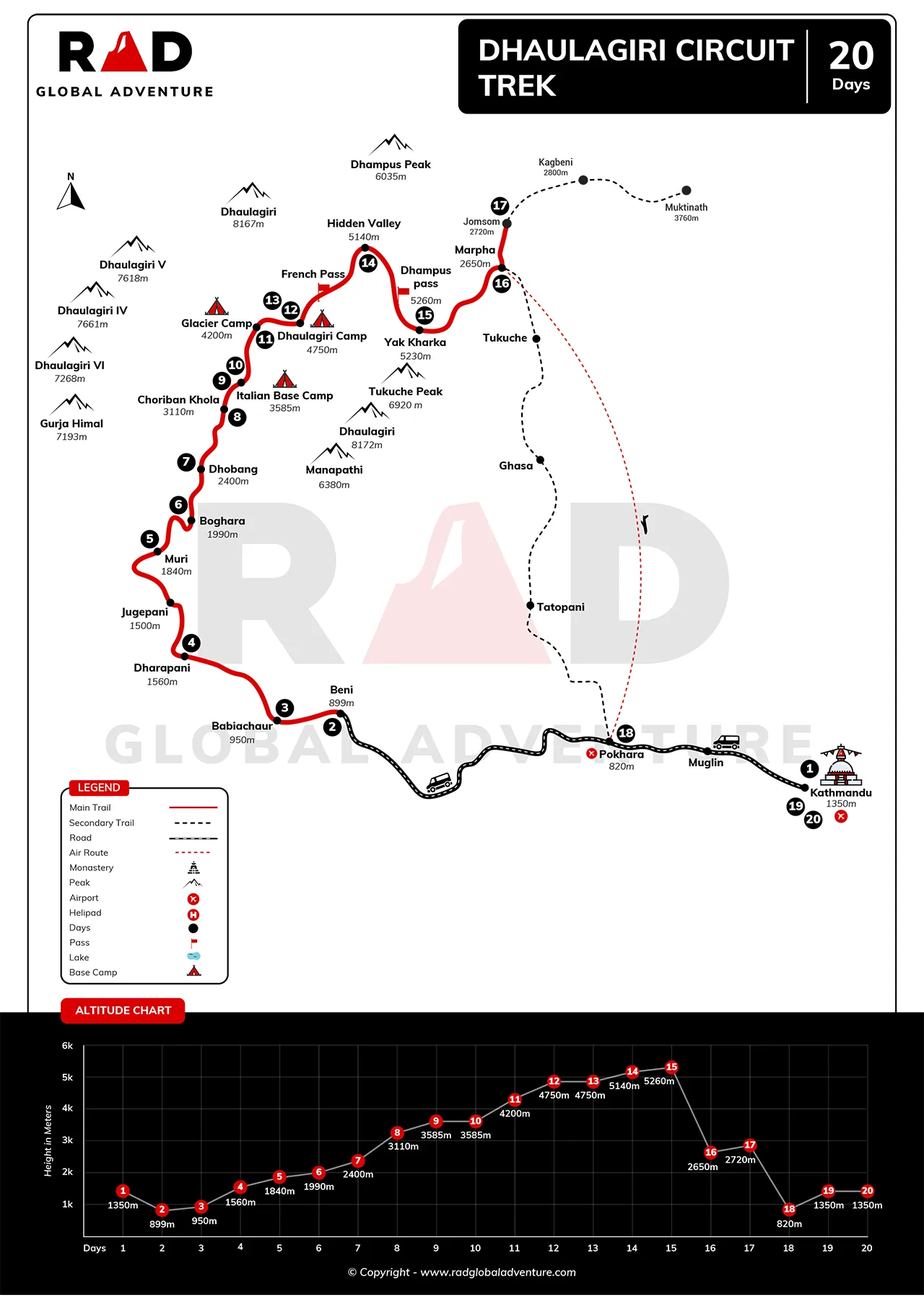
Route Map & Altitude Chart

Attractions and Highlights of Dhaulagiri Circuit Trek

The views of Dhaulagiri massif in panoramas

We can enjoy panoramic views of the Dhaulagiri massif on most of the vantage points during this trek (particularly the Dhaulagiri circuit trek). Its highest mountain, Dhaulagiri I (8,167 m, the 7th highest in the world), is prominent on the skyline, with snow caps exposed above high passes and campsites. Beside it appear Dhaulagiri II, III, V and Tukuche Peak which make an impressive landscape.

The range is wonderful at the sunrise and sunset in particular. Italian Base Camp to Dhaulagiri Base Camp You will be overwhelmed by the giant white peaks. These are the sights that characterize the beauty of the Dhaulagiri trek.

French Pass and Dhampus Pass

The two most exciting experiences on the Dhaulagiri circuit trek are the French pass (5360 m) and the Dhampus pass (5240 m). Every pass is quite a challenge and demands a steep climb at high altitude. The French Pass reward is a breathtaking 360 panorama view of the Himalayan giants such as Dhaulagiri and Nilgiri. Prayer flags are colored, and hang at the top, which is your victory.

Then, having a short rest, we will go down into the Hidden Valley. We will cross Dhampus Pass a few days later and once again climb into the clouds and then fall to Yak Kharka. These passes and the effort make the journey memorable.

Remote and mystic Hidden Valley

The Hidden Valley is an isolated high altitude basin between the French Pass and the Dhampus Pass along the Dhaulagiri circuit hike. It is mystic and remote. It is one of the most remote campsites in Nepal and it lies on a grassy plateau approximately 5,200 m.

It is surrounded by high mountains that form a Tibetan plateau. Ancient Buddhist prayer flags are flying everywhere and this gives it a spiritual aura. Here the silence is deep–you can only hear the wind and the silence of the mountain. Spending the night in the Hidden Valley under stars is unreal because we have entered another world beyond the clouds.

Italian, Glacier and Dhaulagiri Base Camp camps

This expedition has a number of classic high camps. The Italian Base Camp (3,660 m) is in a basin underneath the Chhonbardan Glacier and has a rugged mountain view. At a greater altitude is the Glacier Camp (4,210 m), where one pitches a tent on the rocky moraine towards the edge of the glacier.

The final high camp is Dhaulagiri Base Camp (4,740 m) which is situated within a natural amphitheater of giants. Every camp is an adventure: explorers settle in tents in star-lit nights in almost complete silence. It is chilly at night but the experience of sleeping against the great Dhaulagiri massif is incomparable. These camps are permanent places of visit in the “Dhaulagiri circuit route.

Forest to glacier and snow field landscapes

The Dhaulagiri circuit trek is one of the greatest attractions due to the unbelievable range of landscapes that we pass through. The track starts in sub-tropical foothills and proceeds through rhododendron and oak trees with the increase in altitude. The vegetation becomes thin above the tree line (around Dobang, 2,520 m) into alpine grasslands and colorful meadows.

Higher up, we will walk over rocky ground left by glaciers, then cross snowfields near the mountain passes. Glaciers and hanging icefalls become a normal occurrence. As you continue the trek, the fertile green valleys are replaced by dry and windy highlands, showing the drastic Nepalese mountain transformation.

The Cultural experiences of Magar villages

The trek path passes through some of the traditional Magar villages among other things, providing an insight into local Himalayan cultures. We can observe Magar men and women tilling terraced rice, wheat, and millet fields in places such as Dharapani, Muri, and Boghara. Children usually come out to meet trekkers with shy smiles.

Magar families operate tea houses where we can sit and talk over a hot cup of tea. Those experiences give us a glimpse of the simple mountain life: old wooden houses, village agriculture and village festivals (assuming the timing is right). These villages will be left behind with pleasant memories of Nepali hospitality.

Apple orchards in scenic Marpha village

Marpha is a beautiful village with a height of 2,670 m in the Kali Gandaki Valley that is characterized by terraced apple orchards and Tibetan architecture. There are traditional whitewashed houses and narrow stone streets.

Cool climatic conditions favor the production of apple fields of blossoms is lovely in spring and crispy fruit is crushed into well known apple brandy. You will probably taste local village Marpha brandy in village lodges. An ancient monastery and peaceful town centre provide a cultural break. Marpha is a scenic Himalayan town situated on the riverbank.

Descent into the Kali Gandaki Valley and Jomsom

We will pass through the high passes entering the beautiful Kali Gandaki Valley which is one of the deepest gorges in the world. The path lies along the rapid Kali Gandaki River, and to the right and left the Nilgiri and Dhaulagiri ranges rise sharply upwards. The valley brings out interesting rock formation and limestones walls. Soon we will finally arrive at Jomsom (2,720 m), a bustling river crossroads. Jomsom is a busy marketplace and a small airstrip compared to the quiet mountain camps. Here we may look back in the wild scenery we crossed and the deep gulch we have found.

Wilderness Trekking Experience

The Dhaulagiri Circuit Trek is a secluded and adventurous experience that makes it appear more like a genuine Himalayan adventure. The majority of the travel lays in the wilderness areas, where we will camp on the open moraines and high plateaus under the stars. No villages or lodges at the end of every day, like the more frequented trekking paths, but a yak-herder or a little tea house here and there.

Every night our guides and porters pitch tents in remote places with no modern amenities. It is this great feeling of being isolated that makes the journey seems like an independent journey that is far out of regular civilization.

Trip Information of Dhaulagiri Circuit Trek

Is this trek beginner friendly?

Dhaulagiri Circuit Trek is among the most difficult Nepal adventure experiences and should only be done by experienced or well prepared trekkers. It entails long walking days, steep climbs and high altitudes. Novices should first develop fitness and begin with easier trails and develop trekking experience.

The determined novices can also make it with several months of training and with appropriate assistance. The guides of RAD Global Adventure will provide a safe pace, proper acclimatization, and complete guidance during the trip.

Private vs Group Joining

You can either take part in a group set off or organize your own departure on the Dhaulagiri Circuit Trek. Group treks tend to have a size of 6-12 individuals which are cheaper and more social and suit individuals travelling alone. Whereas, private trips give you more freedom in your pace, schedule, and preferences, they are more expensive. They both are being assisted with professional guides, porters, or a dedicated crew to ensure that your trek is safe and enjoyable.

Trip Extension

Dhaulagiri Circuit Trek itinerary is extended by many trekkers in order to explore more about Nepal. It can be connected to Jomsom and either with the Annapurna Circuit, visit Poon Hill or Tatopani and even with a Chitwan National Park safari. Another option is Kathmandu Valley tours. RAD Global Adventure can customize these add-ons according to your interests. A good experience of cultural and natural diversity of Nepal outside of the mountains is by extending a trip.

Solo Travel

The Dhaulagiri Circuit Trek has the option of solo travelers on both personal trips as well as guided expeditions. RAD Global Adventure accepts individual trekkers and takes good care of them. The solo trekkers will never be alone on the trail, guides, porters, and teammates will always be there to give them safety and companionship. It’s safe for solo women and men with proper planning and guidance. It is always advisable to inform your family and friends about your schedule.

Photography & Drone Rules

One of the delights of the Dhaulagiri Circuit Trek is photography where there are unlimited vistas of mountains, glaciers, and valleys. Always respect the locals by requesting to take their picture. In certain areas, Drone flying must be pre-approved by the Civil Aviation Authority of Nepal (CAAN) or the local authorities or conservation park offices.

Rules are strictly enforced, RAD Global Adventure may recommend on the process of permits, but it is upon the travelers to secure official permission prior to flying. Never fly over other people, temples, wildlife or restricted areas.

Festivals & Culture Along the Trail

The Dhaulagiri Circuit Trek works through remote villages, but regardless of the season, there is a chance of seeing the Nepal festivals of color. During fall (Sept-Nov) there are family feasts and lights during Dashain and Tihar. During spring (March-April), there is Holi (festival of colors) that one can observe in towns.

In and around Jomsom and Upper Mustang, there is the popular Tiji Festival (May) which involves masked dances and rituals. It is not necessary, even in the absence of large festivals, to miss small local rituals at monasteries and shrines that add to the cultural experience.

Tips for First Time Nepal Visitors

Bring your passport/ permits with you on your Dhaulagiri Circuit Trek. In order to be on the safe side, always drink boiled water or bottled water. At towns dress modestly; on trail, trekking clothing is all right. In Nepal, we operate with Celsius and kilometers, so you need to be prepared to do measurements in meters.

Knowing a little Nepali, such as Namaste, makes the locals smile. Mountain facilities are basic and include squat toilets, few hot showers, and patchy internet, so bring some cash. Take your time, be adaptable and have fun.

Typical Daily Routine

Our days begin early on the Dhaulagiri Circuit Trek, at an average of 6-7 AM, with a hot breakfast. Then, we walk 5-7 hours long, having intervals of 5 minutes of rest and a lunch break. By mid-afternoon we arrive in our lodge or camping and we have time to relax, have tea or walk through the nearby trails. Dinner is served around 6–7 PM. Evenings are passed in the lodge or in the dining tent, in preparing the following day. Night starts early because of altitude and early start of the next day.

Mental Preparation & Trekking Mindset

The Dhaulagiri Circuit Trek is challenging and yet very satisfying. One should remain optimistic and patient, because weather and altitude can reduce progress. Look at the day you are in and not the journey. Stay loose, keep in touch with your guide and listen to your body.

Encourage team mates and being able to celebrate small achievements such as getting to a camp, or over a pass, boosts morale. This journey can be a life changing experience with the right mindset and determination.

Frequently Asked Questions

Pack warm layered clothes, a waterproof jacket, sturdy boots, hats, gloves, sunglasses, sunscreen, and a sleeping bag rated –10°C or lower. Gaiters can help in snowy areas.

Most groups have 6–12 trekkers plus guides and porters. Private treks can be arranged if you prefer.

Yes, several nights are camping (Italian Base Camp, Glacier Camp, Dhaulagiri Base Camp, Hidden Valley, Yak Kharka).

Your safety comes first. Guides can arrange help, including horses, porters, or helicopter evacuation if needed (with insurance).

No. Please bring enough Nepalese rupees before leaving Kathmandu, Pokhara, or Beni.

Bring US dollars or Euros to exchange. On the trail, only Nepalese rupees are accepted.

Yes, a warm sleeping bag (–10°C to –15°C) is essential for camping nights.

In villages, there are basic toilets. At high camps, we use simple pit toilets. Please carry toilet paper and sanitizer.

No special vaccines are required, but routine ones (tetanus, hepatitis, typhoid) are recommended. Ask your doctor about altitude medicine.

It’s best to avoid both at high altitude. You may enjoy a small drink in villages like Marpha after trekking.

We recommend booking at least 2–3 months in advance, especially for spring and autumn seasons.

Yes, Pokhara has daily flights to Kathmandu. It’s a convenient option after your trek.

Helicopters can be arranged in emergencies or for private charter, but they are costly.

This trek is very demanding. Only very fit and experienced children or older trekkers should attempt it, after consulting a doctor.

Trip Reviews

expert-image
Need Help? Ask to Travel Expert
Get a Trip Quote Customize This Trip Make an Inquiry
  • Best Deal
  • Flexible Schedule
  • Instant Booking
  • No Hidden Costs
trip-advisor
5.0
25 reviews