expert-image
Talk to a Travel Expert +977 9818264758

Bookings Now Open for Nepal Treks, Tours & Climbing – 2026 & 2027

View Details
Tilicho Lake

Annapurna Circuit with Tilicho Lake Trek

Based on 25 reviews
duration
Duration

15 Days

difficulty
Trip Difficulty

Moderate

max-altitude
Max. Altitude

5,416m

destination
Destination

Nepal

group-size
Group Size

2-16 People

start-end
Start / End

Kathmandu / Kathmandu

meals
Meals

Breakfast, Lunch & Dinner

accommodation
Accommodation

Hotel, Lodge

transportation
Transportation

Tourist Bus

expert-image
Need Help? Ask to Travel Expert
Get a Trip Quote Customize This Trip Make an Inquiry
  • Best Deal
  • Flexible Schedule
  • Instant Booking
  • No Hidden Costs
trip-advisor
5.0
25 reviews

Overview of Annapurna Circuit with Tilicho Lake Trek

The Annapurna Circuit with Tilicho Lake Trek is a 15-day Himalayan trek through Nepal’s most varied terrain. The trek circles the Annapurna range and makes a side trip to Tilicho Lake, one of the world’s highest glacial lakes.
The touring starts in the fertile valleys and terraced fields, then ascends to the alpine meadows and arid deserts at high altitudes. At 5,416 meters, Trekkers pass the stunning passage of Thorong La, where they are rewarded with the panoramic view of Annapurna, Dhaulagiri, and surrounding Himalayan peaks.

On the way, there are the villages of Gurung and Thakali, Buddhist monasteries, and Hindu holy shrines like Muktinath. All cultural destinations provide the experience of the Himalayan customs, which combine spirituality, hospitality, and ancient mountain traditions.

The trek provides both challenge and reward, involving daily walks of 5-7 hours. Trekkers get accustomed to the Manang Valley at an elevation of more than 3,500 meters, taking a bath in hot springs at Tatopani, acclimatizing in Manang, and ending the journey with a sunrise hike to Poon Hill.

Accommodation is in teahouses, which provide warm hospitality, hearty meals, and fellowship with fellow trekkers, which adds to an experience that makes memories last a lifetime. The Annapurna Circuit with Tilicho Lake Trek remains an iconic long-distance trail that combines an abundance of natural and cultural insight, and an authentic adventurous experience.

Good To Know

The Annapurna Circuit with Tilicho Lake Trek is moderate to strenuous trek involves walking 5-8 hours in steep mountainous terrain. The Tilicho trail section adds extra difficulty because of narrow trails, which require strength and proper balance.

Although there are no technical climbing requirements, good endurance and mental training are necessary. Novices will be able to do this trek with training and a guide. Additionally, previous trekking experience at higher altitudes is beneficial to make the journey rewarding and pleasurable.

There is a wide variation in the weather because of the changing altitude. The spring season (March-May) is characterized by blooming rhododendrons, cool nights, and hot days. Autumn (September-November) is characterized by fresh air, clear skies, and great mountain views, ideal months for the safe yet scenic trekking adventure.

Monsoon (June through August) is accompanied by heavy rain, devious paths, and landslides. The extreme cold seasons in winter (December-February) are characterized by heavy snowfall, causing snow closures at different locations. This means a winter trek can pose a great risk to those who plan the trip. Spring and autumn treks are safer and an unforgettable journey along the Annapurna Circuit with Tilicho Lake Trek.

Teahouses also offer hearty food, including both local and international foodstuffs. Rice, lentils, and vegetables together form a dish called dhal bhat (traditional Nepali food), which keeps trekkers going. You will find varied breakfast options, such as porridge, pancakes, noodles, and momos.

Tap or stream water is available but must be treated by boiling, filtering, or purification tablets. Take portable filters and purification tablets to treat water before drinking. Use reusable bottles to reduce plastic usage. Hot teas, in particular ginger or lemon, are beneficial for hydration and warming. Avoid alcohol at altitude.

Altitude sickness is a major concern during the trip. The trails roam at an altitude of 3,500 m and reach above 5,400 m. So, you might get symptoms such as nausea, dizziness, poor sleep, and headache. In Manang, the introduction of acclimatization days assists in the adaptation of the body.

Prevention includes slow ascending, hydration, and avoiding alcohol. Guides monitor your health daily. Severe altitude sickness symptoms necessitate immediate descent. Some trekkers bring Diamox (altitude sickness medicine), which can be used only with a medical prescription. With proper care and planning, you can complete the trip without any significant problems.

Preparation is key to having an enjoyable journey on the Annapurna Circuit. Cardiovascular strength and leg muscle strength are crucial to ascents and descents of many miles. Being physically fit with hiking, jogging, and climbing stairs is good training for a high-altitude trek.

Mental strength is equally important as physical strength for long, cold days and discomfort at times. The use of good boots, layered clothes, and sleeping bags added to safety. If you are trained, equipped, and have a vision, the trip turns into something you will always remember.

You can get a visa on arrival at both airports and at land frontiers. Nepal’s tourist visa fees are: 15 days = USD 30, 30 days = USD 50, and 90 days = USD 125. Many trekkers extend beyond 15 days, especially with side trips or delays, so planning for at least a 30-day visa are often practical. Additionally, be sure your passport has a minimum of six months’ validity.

For this trip, two permits are required, including the Annapurna Conservation Area Permit (ACAP) and the Trekkers’ Information Management System card (TIMS). TIMS oversees the safety of the trekkers, whereas conservation is specified with ACAP funding. These permits are normally organized by trekking agencies.

Having a medical check-up before trekking will ensure you are fit for the trip. Take advice from your guide for pace, acclimatization, and safety precautions. Mostly, trails are clearly indicated, but care should be taken where rocky inclines and steep descents are involved.

To prevent illness, always sanitize your hands, consume cooked food, and drink treated water. Guides carry first aid kits, and they can organize a rescue if necessary. The journey is generally safe with reasonable precautions, but trekkers should remain cautious of altitude and terrain.

The hike starts with a 6–7 hour drive from Kathmandu to Besisahar, followed by a 4–5 hour jeep ride on rough mountain tracks to Dharapani. Road conditions vary, so the total journey can take around 10–12 hours, with the view of beautiful hills and rivers. Later, a rough jeep ride of 4-5 hrs shortened the return route after Thorong La.

You can take a 30-minute flight from Kathmandu to Pokhara or a 6-7 hour bus ride. The road along the way is bumpy somewhere and paved somewhere. Add extra days in the schedule to adapt to the weather changes and changing road conditions.

You can trek in this area from different routes, but one of the most popular ways of doing it is the classic Annapurna Circuit with Tilicho Lake Trek. In case of time constraints, you can start the trek at Chame and leave flying straight out of Jomsom to Pokhara.

To increase the trek duration, you can visit Nar Phu Valley near Manang or Annapurna Base Camp after Ghorepani. You can also skip Tilicho Lake for an easier path with magnificent views.

Fundamental expenses such as meals, permits, guides, and accommodation are covered in the package. Though you need to budget some additional money for personal spending. Snacks, coffee, chocolate, or alcohol during the trek increases the cost of the trip.

Other extras involved in the trip are the cost of device charging, Wi-Fi, hot showers, and tipping. Standard practice in Nepal is to tip guides around USD 10–15 per day and porters around USD 5–10 per day, usually pooled and given at the end of the trek. You must also keep a budget for souvenirs in Manang or Jomsom.

The primary language in Nepal is Nepali. Gurung is common in lower valleys, Manangi (a Tibetan dialect) in Manang, and Thakali in Mustang. The culture is shown by the use of prayer flags and Tibetan script. Although it is varied, the English also speak well in the trekking regions and the lodges.

A simple way to build warmth with the locals is achieved by learning very basic Nepali phrases, such as Namaste or Dhanyabad. The simplest efforts are valued. When communication is limited in English, patience, clear speaking, and gestures help. Grins are usually better than words along the Annapurna Circuit with Tilicho Lake Trek.

Signal is provided on Ncell and Nepal Telecom networks in Chame, Manang, and Jomsom. Ncell has better coverage in lower valleys, while NTC (Nepal Telecom) is more reliable at higher points. In Kathmandu, purchase a SIM to have access to data, as reliable 3G or 4G can be found in the larger settlements.

Most teahouses will offer Wi-Fi for an additional charge, which is mostly slow, but suitable for messaging. Charging your electronic equipment will incur an additional charge as well, particularly on higher altitude treks using solar energy. It would be wise to take a power bank to ensure your devices continue to work.

Detail Itinerary

Your trip begins after arriving at Tribhuvan International Airport, Kathmandu. A representative of the company welcomes you and takes you to the hotel. After checking in, have some rest.

In case you feel energized, you can explore the surroundings of Thamel or explore Kathmandu Durbar Square. During the evening, you can attend a welcome dinner, where you will taste some real Nepali dishes and get acquainted with other trekkers before the adventure to come.

altitude-small

Max Altitude: 1,350m/4,429ft. (Kathmandu)

If our standard itinerary doesn't fully meet your needs, we are happy to tailor it to your specific preferences and requirements.

Includes and Excludes

What’s Included?

Transportation

  • International and domestic airport transfers
  • Private vehicle transfer Kathmandu – Besisahar – Dharapani
  • Local 4WD jeep transfer Besisahar – Dharapani
  • Private vehicle transfer Tatopani – Pokhara – Kathmandu
  • All private ground transport for sightseeing

Food and Accommodation

  • Full meals: breakfast, lunch & dinner on your choice during Trek
  • Breakfast in Kathmandu and Pokhara hotels
  • Seasonal fresh fruits deserts every day
  • Unlimited chlorine treated safe drinking water
  • Accommodation: Lodge / Teahouse (twin sharing) during trek
  • Hotel accommodation in Kathmandu and Pokhara after trek
  • Farewell dinner

Guide and Support Staff

  • An experienced English-speaking trekking guide
  • Porter service for luggage (one porter for every two trekkers)

Permit and Expenses

  • Annapurna Conservation Area Project (ACAP) entry permit
  • Trekkers’ Information Management System (TIMS) card
  • All local and government taxes
  • Guide and porter salaries, insurance, equipment, transport, food and lodging

Medical and Gear

  • Oxi-meter: to check , heart rating and oxygen saturation
  • A comprehensive first aid kit
  • Emergency rescue in case of severe illness or injury (costs covered by your insurance)
  • Trekking equipment: down filled sleeping bag, walking poles and duffel bag
  • Free luggage storage in Kathmandu

Others

  • Certificate of appreciation
  • Trekking route map and company t-shirt

What is not Included?

International Flights and Visa

  • International flights and visa
  • Domestic flights to/from Pokhara

Food and Accommodations

  • Meals in Kathmandu and Pokhara (except those included during trek)
  • Any hotel stays in Kathmandu and Pokhara before or after the trek

Travel and Medical Insurance

  • Comprehensive travel and medical insurance
  • Emergency rescue evacuation

Other Expenses

  • Personal expenses
  • Tips and gratuities
  • Personal trekking equipment
  • Unexpected expenses due to weather, flight cancellations, strikes, or natural causes

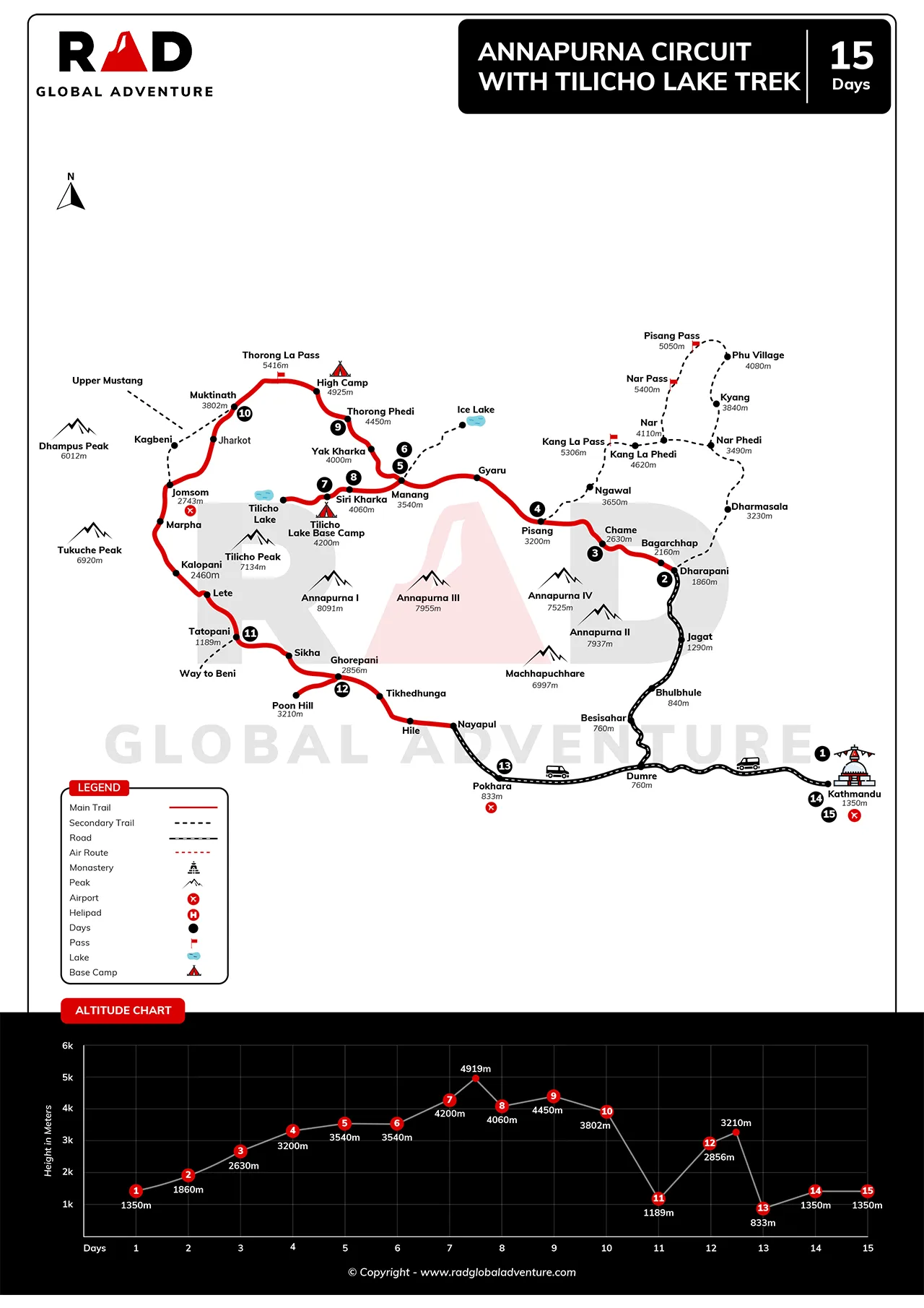
Route Map & Altitude Chart

Attractions and Highlights of Annapurna Circuit with Tilicho Lake Trek

Tilicho Lake

One of the greatest jewels of the Annapurna Circuit with Tilicho Lake Trek is Tilicho Lake, which is one of the highest in the world, at 4,919 m (16,138 ft).. The images of its sky-blue waters reflect snowy mountains, and it produces a surreal and almost spiritual effect.

The road to Tilicho passes through steep inclines and a landslide area, which requires time and effort. However, being on the stormy coast, the ice ridges around the place overwhelm trekkers with awe, achievement, and a very strong feeling of amazement.

Thorong La Pass

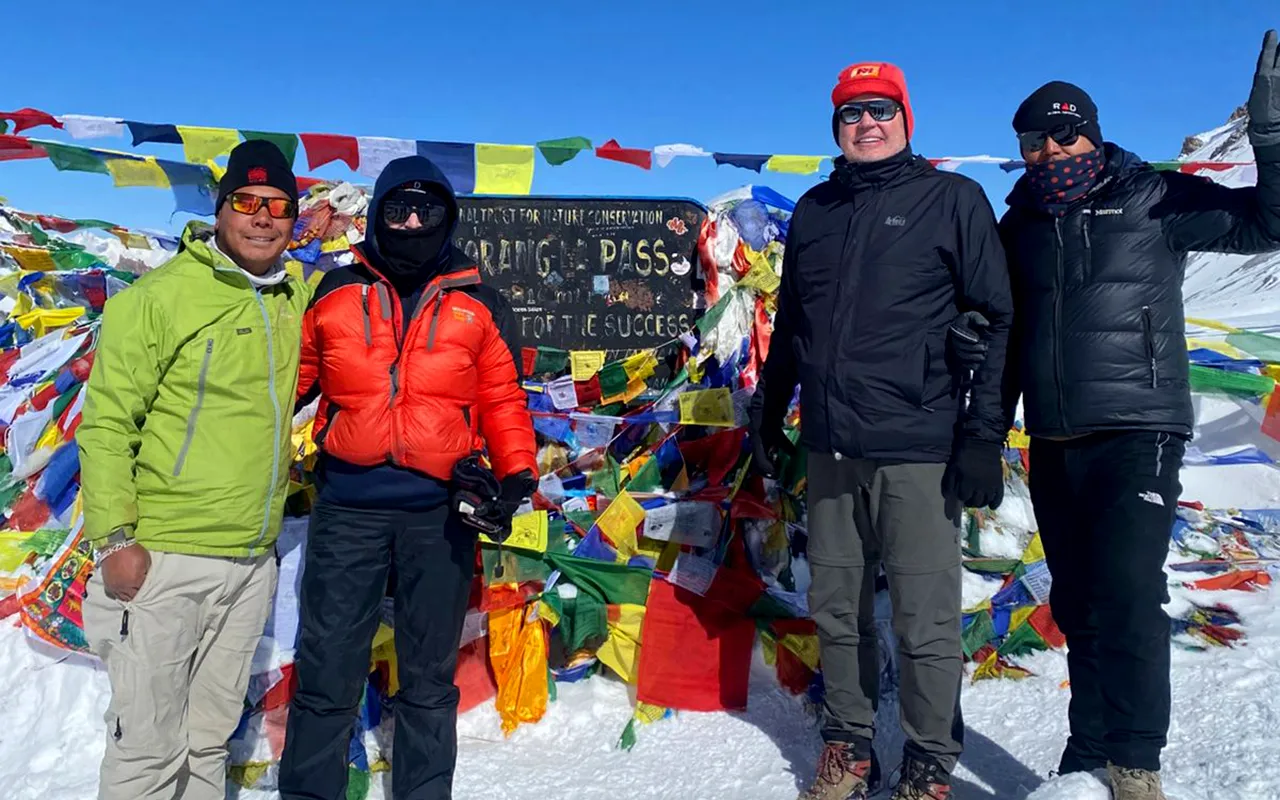
The peak of the trek is Thorong La, an altitude of 5,416m, making it one of the highest passes in the world. It is physically as well as emotionally challenging to cross the passes, topped off with fluttering prayer flags and mountain scenery.

The passage links Manang with Mustang, which has been traversed by pilgrims and traders for centuries. Trekkers often describe the summit as euphoric – cold winds whipping faces, peaks stretching endlessly, and the thrill of achieving something monumental.

Manang Valley

Manang Valley is located in the Annapurna rain shadow, a highland desert surrounded by Annapurna II, III, IV, Gangapurna, and Tilicho Peak. The Manang village is known to be a place that provides acclimatization, shopping centers, bakeries, and even an antique mountaineering museum for trekkers to visit.

It is standing on dramatic cliffs near Braga Monastery, which is more than 500 years old. Having strolled through the stone-paved streets of Manang, you will come across welcoming Manangi people with their Tibetan roots, trying on yak cheese, and immersing in the cultural and scenic performance.

Muktinath

The sacred pilgrimage location of Hindus and Buddhists is Located in Lower Mustang, Muktinath (3,800m) is one of Nepal’s most sacred pilgrimage sites. It has a sacred courtyard with 108 water spouts of icy water, a natural eternal flame, and a shrine, blending Hindu worship with Tibetan Buddhist meaning.

Pilgrims and trekkers congregate in the Ranipauwa bazaar, where prayer flags, bells, and chants intermingle. The blend of cultures, the sacred setting, and the mountains framing Muktinath make it more than a destination; it is a spiritual experience.

Poon Hill

At 3,210 m, Poon Hill is the best spot for views of the sunrise in the region. In the early morning when the sun peeks over the horizon, the Annapurnas, Dhaulagiri, and Machhapuchhre all go pink and gold.

It takes less than an hour to climb from Ghorepani, but the reward is great. The valleys are filled with clouds, while the snowy peaks rise above them. Trekkers frequently remark that this is one of their most beautiful mornings of the trek.

Diverse Landscapes

The trip offers dramatic sceneries of damp waterfalls, rice terraces, and banana trees in the lower valleys, replaced by pine woodland and dry alpine wasteland. Descending, you will reach the rare rhododendron forest and then to Tatopani and Ghorepani.

You will walk by the deepest gorge in the world, the Kali Gandaki, which is surrounded by Annapurna and Dhaulagiri. This phenomenal diversity leaves each day a new experience in the orchids of foggy forests, snow plains, and the moraine landforms near the Tilicho and Thorong La.

Cultural Encounters

The Annapurna circuit is rich in both culture and scenery. Gurung villages portray a picture of agricultural life and hospitality. Manang depicts a picture of Tibetan Buddhism with the use of mani walls, chortens, and prayer flags available at the stone-paved villages.

Driving to Mustang, you can embrace the culture of the Thakali, known for trade, Apple orchards, and food. Subsequently, the Magar villages near Ghorepani are also characterised by some particular traditions. Every experience deepens the trip, provides valuable connections and experiences about the lifestyle in the mountains in the Himalayas.

Trip Information of Annapurna Circuit with Tilicho Lake Trek

Is this trip beginner-friendly?

The journey is moderate to strenuous, which will involve endurance for longer day treks and higher elevation (above 5,000m). These fit beginners can make it, with training, acclimatization, and with guides included in the itinerary.

The Tilicho Lake provides an additional challenging option, which can be omitted. A lot of novices make it through the trek. It is completed through preparation, being patient, and having a supportive team, and even the novice will know it can be concluded as the most rewarding experience.

Private trip vs Group joining

Private tour offers flexibility, customized paces, and more personalized adventures, which are perfect for families or a few friends traveling together. Prices are higher, but the freedom of being independent is desirable to many. Times, paths, and speed are in your hands.

Trekking in groups comes with the benefits of common expenses, companionship, and the happiness of accomplishing certain goals as a group. They are not so flexible, yet they introduce friendships and enjoyable evenings in the teahouses.

Solo trek

Since 2023, solo independent trekking without a licensed guide is no longer permitted in the Annapurna region for safety reasons. Because the goal is to ensure safety and to have companionship, this process includes hiring a guide. This leads to a balance between freedom and safety.

It is risky but possible to hike alone for experienced hikers. The tracks are well marked, but the hiking height, health conditions, or mishaps are still issues. The best way to do the trek is by employing a porter-guide who is flexible and has cultural knowledge.

Photography & Drone Rules

The possibilities of photography are limitless, from glaciers and mountains to street scenes of local inhabitants. Never photograph without asking permission, and never disregard signs that say no photography in monasteries and places of worship.

In the Annapurna Conservation Area, drones are heavily restricted and often denied without special government clearance. Although they are still being flown by many trekkers, be cautious, avoid villages or wildlife, and respect tranquility. In many cases, the most remarkable pictures come from mindfulness and not technology.

Cultural Festivals on the Trail

When the time is right, the circuit is fleshed out with festivals. Dashain and Tihar bring family rituals and lights to villages, while Losar (the Tibetan New Year) occupies monasteries with dances and prayers. Every festival provides an insight into the Nepalese cultural fabric.

The Yartung horse race is also a spectacle in Manang and Mustang. Muktinath is also visited by pilgrims, especially during Janai Purnima. If you are fortunate, you are welcomed into the celebrations, singing, eating, and receiving blessings together as they make their way through the high Himalayas.

Tips for First-Time Nepal Visitors

Visas are available for travelers on arrival in Nepal. It is a good idea to bring cash like dollars (USD) or euros (EUR) in small bills. ATMs will be rarer along the trail, so remember to carry enough Nepali rupees before leaving Kathmandu or Pokhara to plan accordingly.

For health, drink only safe drinking water, keep your hands clean, and eat cooked meals during your stay. Learn Nepali phrases such as “Namaste” for greeting, taking off shoes outside of temples, dressing conservatively, and respecting traditions. And the most important piece of advice is to take the adventure in stride with open expectations.

Typical Daily Routine on the Trek

Each day starts off at around 6 AM with tea and breakfast before starting hiking. Most days involve 3–4 hours of walking in the morning and 2–3 hours in the afternoon, though some sections such as the hike to Tilicho Lake and the crossing of Thorong La Pass can take 8–10 hours.

Afternoons are for exploration, acclimatization hikes, and even for rest. Every evening is spent in warm dining rooms with meals, such as dal bhat, social conversations, and the following day briefs. By nightfall, trekkers rest under starlit skies, lulled by the sounds of rivers and winds.

Mental Preparation & Trekking Mindset

This trek involves physical as well as mental strain. Remaining positive, flexible, and patient changes hindrances into success. Taking the long routes and separating them into small objectives will enable you to exquisitely cope with heights, exhaustion, and changing climate with consistent dedication.

The experience is reinforced through team spirit. Help your fellow trekkers, listen to yourself, and obey your limits. Through an upright character, concentration, and personal invigoration, the trip made through the Annapurna Circuit, together with the Lake of Tilicho, evolves not only as a climb in the mountains, but also as a venture in the psyche.

Frequently Asked Questions

No technical climbing gear is required, but a good down sleeping bag, trekking poles, layered clothing, and insulated boots are essential. In winter, crampons or microspikes may be needed.

Yes, the paths are good and in clear conditions with well-marked signs.

Altitude sickness problems can be reduced by acclimatization, slowness, and hydration, though any serious symptoms demand instant descent.

ATMs may exist in Manang or Jomsom, but are unreliable—carry sufficient cash from Kathmandu or Pokhara, and WiFi with somewhat poor connection may be found on the trip.

In the mountains, the nights can fall below the freezing point. Thus, warm clothes and a good sleeping bag are essential.

There is a lack of a hot shower option, and if available, you have to pay a small charge. The vast majority of trekkers clean with wipes and occasionally do light laundry.

It is customary to tip around $10–15/day for guides and $7–10/day for porters, depending on group size and service quality.

Trip Reviews

expert-image
Need Help? Ask to Travel Expert
Get a Trip Quote Customize This Trip Make an Inquiry
  • Best Deal
  • Flexible Schedule
  • Instant Booking
  • No Hidden Costs
trip-advisor
5.0
25 reviews