expert-image
Talk to a Travel Expert +977 9818264758

Booking open for Nepal Trek 2025 & 2026

View Details
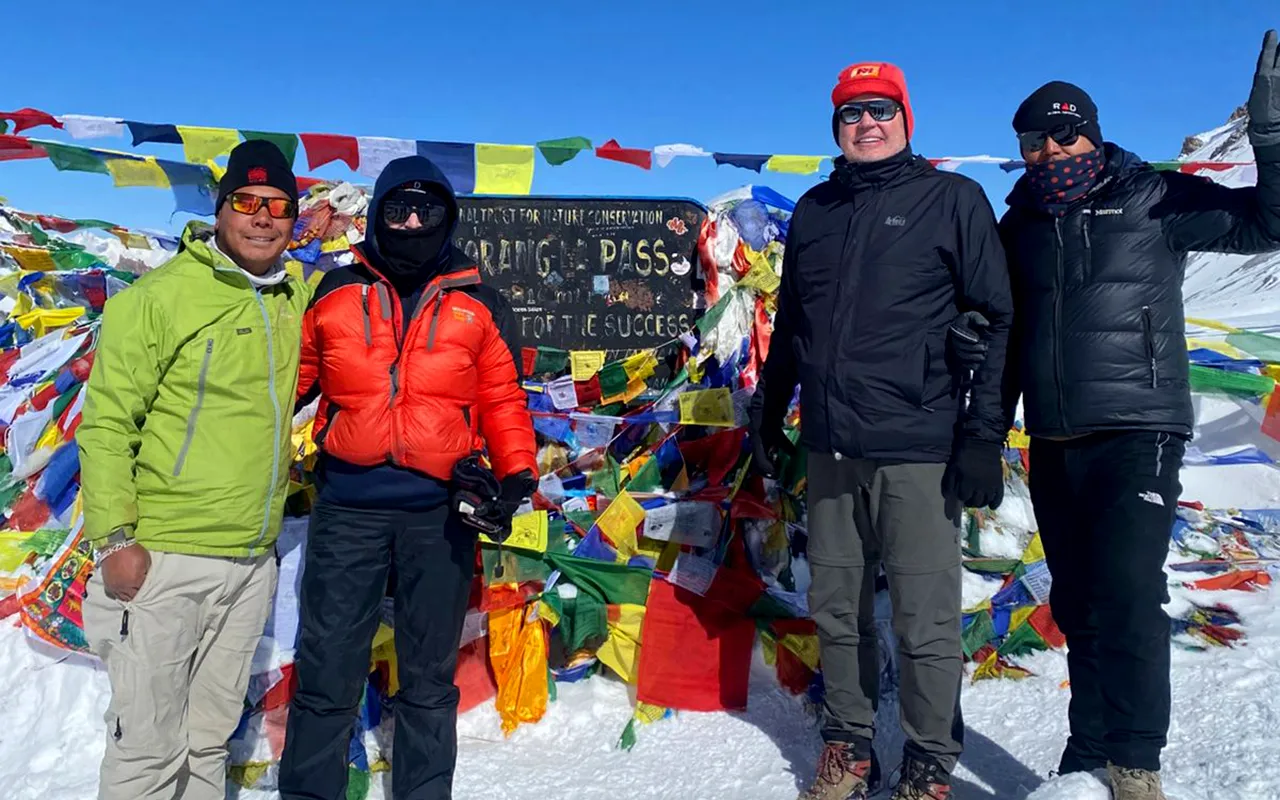
Way to Thorong La

Annapurna Circuit Trek

Based on 25 reviews
duration
Duration

18 Days

difficulty
Trip Difficulty

Moderate

max-altitude
Max. Altitude

5,416m

destination
Destination

Nepal

group-size
Group Size

2-16 pax

accommodation
Accommodation

Hotel, Lodge

transportation
Transportation

Bus , Flight

expert-image
Need Help? Ask to Travel Expert
Get a Trip Quote Customize This Trip Make an Inquiry
  • Best Deal
  • Flexible Schedule
  • Instant Booking
  • No Hidden Costs
trip-advisor
5.0
25 reviews

Overview of Annapurna Circuit Trek

The Annapurna Conservation Area is Nepal’s largest protected area, covering 7629 square km and ranging between 790 and 8091 meters. Its diverse terrain produces an extensive natural environment. This protected region incorporates the Annapurna Circuit Trek, which is considered to be one of Nepal’s most popular trekking routes.

The Thorong La Pass is the main destination at 5416 meters above sea level and takes 10 to 11 days to reach. The four massive Himalayan peaks: Annapurna I (8091 m), Annapurna South (7219 m), Machapuchare (6993 m), and Hiunchuli (6441 m), encircle the itinerary that we have proposed for this journey. This is a relatively isolated yet easily accessible circuit trek in Nepal.

There are a number of itineraries that can be taken, depending on the traveler’s preferred views, along with time limits.  After leaving Kathmandu, this journey proceeds to the town of Besisahar, followed by Jagat and Dharapani, and eventually, the Throng La Pass.  Our itinerary plan is designed to reduce the risk of altitude sickness, which can occur when a person climbs to elevations higher than 3500 meters above sea level.

The most-visited Annapurna Circuit Trek starts in the lush, steep hills before climbing to the Annapurna Himalayan range’s foothills.  You will be rewarded with breathtaking views of the surrounding peaks as we take you on a raw journey through the remote highlands of Nepal. It is impossible to describe the feeling of being in the heart of the Himalayas with just words.  You will be treated to unforgettable scenes of Annapurna I, the very first peak humans climbed, which was over 8,000 m.

The Annapurna Base Camp passes through hillside farmland, mixed forests, and multiple highland villages belonging to different ethnic groups. Each of the ethnicities has its own unique customs and traditions that reflect its beliefs and practices. The actual walking trail is a really peaceful experience, with the sounds of birdsong filling the air, waterfalls tumbling down the rugged slopes, and cool air blowing past onto your skin.

We have created a Annapurna circuit trek package that will offer you the best experience at a reasonable price. This trek article goes through every minute detail of the trek so that you know exactly what you are getting into and paying for. Let’s kick things off with some important things you should know about this journey.

Good To Know

The Annapurna Circuit Trek is graded as a moderately difficult journey. Although it is not ideal for beginners, they can join the trek if they are very well prepared, both physically and mentally. It’s not just about the altitude; it’s also about the long journey that requires great physicality and consistency.

The best time to go on the 19 days Annapurna circuit trek is the spring season. During this time of the year, the forests are lush, flowers bloom beautifully, and wildlife is more active, increasing our chances of encountering different species en route. The weather usually stays clear during this season, with great visibility in the air, offering clear views of the landscape.

There are a lot of food options throughout the trek, including local flavors and a few international ones. We always recommend trekkers to stay vegetarian for the full journey since some of the eateries do not have freezers to store meat for long. As for drinks, there are not that many options; however, you will get to choose from different types of tea.

As we will reach a maximum altitude of 5416 m above sea level, the Annapurna Circuit Trek features a certain level of altitude sickness risk. However, our 19 days Annapurna circuit trek guide will brief you on the preventive measures and also check your oxygen level every day to look for early signs.

The Annapurna Circuit Trek itinerary demands above-average physicality. Trekkers should not expect to get on this trek and have a good time if they are under-prepared. Your preparation period should range from 14 to 18 weeks, depending on your current physical form and lifestyle. Just simple cardio exercises and strength training will work wonders.

Upon arrival at Kathmandu, travelers are supposed to fill out a visa form and pay their visa fees to obtain a tourist visa. This will not be a part of the Annapurna Circuit Trek package. However, the permits required to do this trek will be covered by our trek package.

If you have any current health conditions that can be affected by high altitude, you should consult a doctor before joining the Annapurna Circuit Trek itinerary. Overall, you are very safe throughout the trek since the Annapurna region is one of the most well-defined and well-maintained trekking destinations.

All the ground transportation from the beginning to the end of the Annapurna Circuit Trek is a part of the trek package. Please note that your flight expenses are not a part of the package, whether it’s international or domestic. Airport drop-offs and pickups are also covered.

You are highly likely to receive phone network throughout the 19 days Annapurna circuit trek, but you will not have any at high altitude sites like Thorong Phedi and Thorong La Pass. You can choose between Ncell and NTC carriers; we recommend the latter, as they are proven to be more reliable in the hills.

One of the best alternative route options is to do the trek counter-clockwise, starting from Jomsom and ending at Besisahar. You can combine this 19 days Annapurna circuit trek with other nearby trekking destinations as well, such as the Tilicho Lake Trek. Or, you can add some villages as extra destinations en route.

The Annapurna Circuit Trek package covers many major expenses, but can not practically cover everything. Expenses such as flights, additional accommodation, internet, personal trekking equipment, emergency rescue evacuation, travel insurance, visa fees, tips for the crew members, etc., are not a part of the package.

Our guides are well-versed in English, while some of them are also good in Spanish, French, Japanese, and other languages. Our primary language throughout the 19 days Annapurna circuit trek will be English. If you want to chat with the locals, you must let the guide translate the conversation.

While phone networks are available, using the internet through a carrier might not be the best option, as they can be painfully slow. You can instead rely on the WiFi that the tea houses have. While they may charge you a couple of USD for the service, it is still the best way to stay connected.

Detail Itinerary

Arriving in Kathmandu counts as the first day of the Annapurna Circuit Trek. After you get your tourist visa approved, you will find one of our representatives waiting for you at the exit. He will take you to your designated accommodation for the night. Before you call it a night, we will have you meet the porters, guides, and the other trekkers in the group.

activity-small

Activity: Trek Preparation

accommodation-small

Accommodation: Hotel

meal-small

Meal: Breakfast

altitude-small

Max Altitude: 1,400m/4,593ft. (Kathmandu)

If our standard itinerary doesn't fully meet your needs, we are happy to tailor it to your specific preferences and requirements.

Includes and Excludes

What’s Included?

Transportation

  • International airport transfers
  • Kathmandu – Besisahar drive by private vehicle/tourist bus
  • Nayapul – Pokhara jeep transfer
  • Pokhara – Kathmandu drive

Food and Accommodation

  • Full meals: breakfast, lunch & dinner on your choice.
  • Supplementary snacks: energy bar and cookies
  • Seasonal fresh fruits deserts every day
  • Unlimited chlorine treated safe drinking water
  • Hotel in Kathmandu and pokhara with breakfast and bed plan

Guide and Support Staff

  • An experienced english-speaking trekking guide
  • Porter service for luggage (one porter for every two trekkers)

Permit and Expenses

  • Annapurna Conservation Area Permit (ACAP)
  • Trekkers’ Information Management System (TIMS) card
  • All local and government taxes
  • Guide and porter salaries, insurance, equipment, transport, food and lodging

Medical and Gear

  • Oxi-meter: To check , heart rating and oxygen saturation
  • A comprehensive first aid kit
  • Emergency rescue in case of severe illness or injury (costs covered by your insurance)
  • Trekking equipment: down filled sleeping bag, walking poles and duffel bag
  • Free luggage storage in Kathmandu

Others

  • Farewell dinner in Kathmandu
  • Certificate of appreciation
  • Trekking route map and company t-shirt

What is not Included?

International Flights and Visa

  • International flights and visa

Food and Accommodations

  • Meals in Kathmandu (except farewell dinner)
  • Any hotel stays in Kathmandu or Pokhara before or after the trek

Travel and Medical Insurance

  • Comprehensive travel and medical insurance
  • Emergency rescue evacuation

Other Expenses

  • Personal expenses
  • Tips and gratuities
  • Personal trekking equipment
  • Unexpected expenses due to weather, flight cancellations, strikes, or natural causes

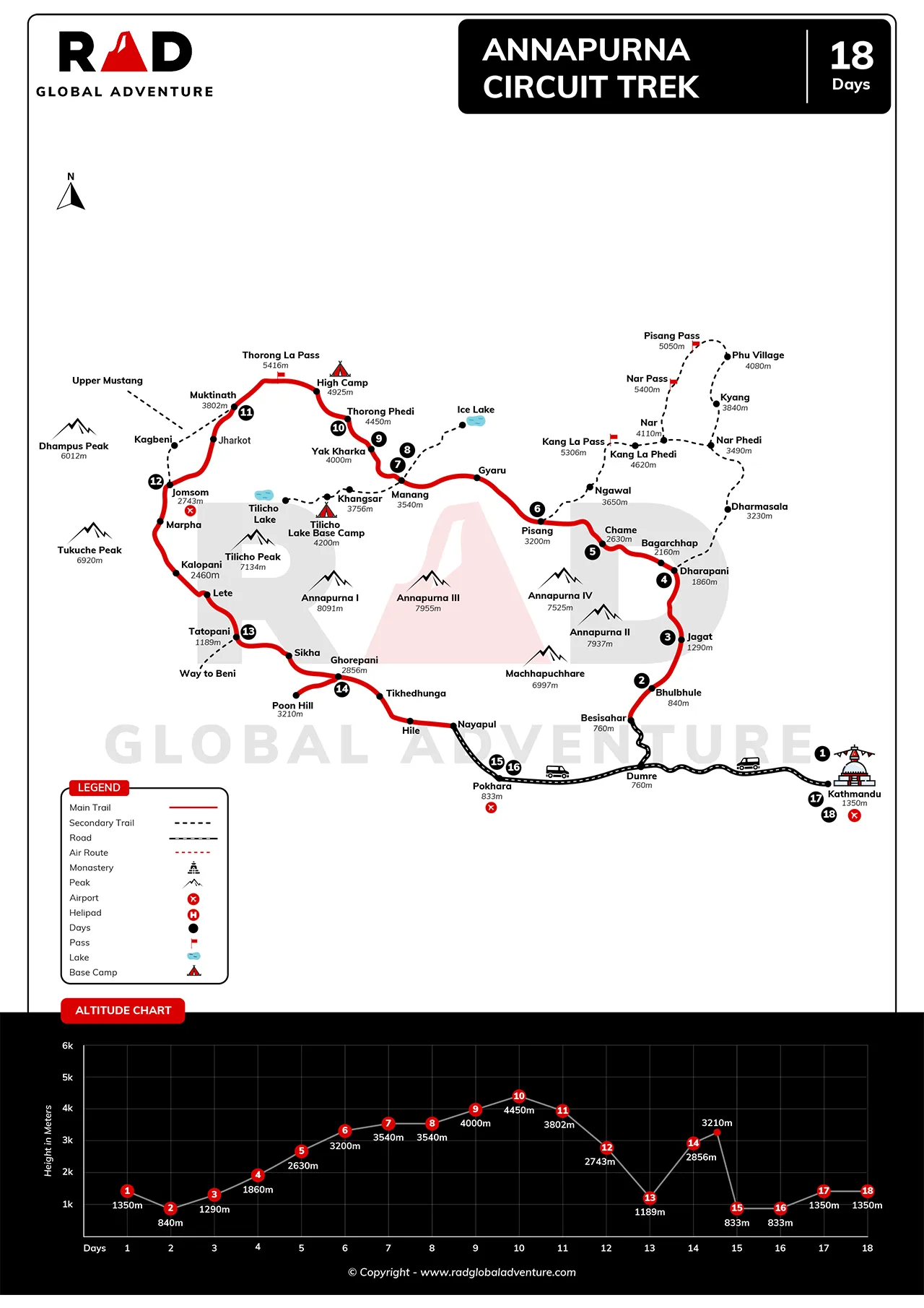
Route Map & Altitude Chart

Attractions and Highlights of Annapurna Circuit Trek

Journey Through Nepal’s Most Diverse Landscapes

The 19 days Annapurna circuit trek region is a mix of sub-tropical lowlands, hills, and high alpine vegetation. It is home to many peaks, some of which are among the top 10 highest peaks in the world. It also houses many different species of wildlife and birds. Although the chances of encountering animals are low, you will get to see many different birds along the route.

Cross the Legendary Thorong La Pass (5,416 m)

This is the highest point of the Annapurna Circuit trek itinerary, connecting Mustang to the Manang Valley. The climb to the top of the pass can be exciting as you have to zigzag through rocky slopes with a wide view of the valley beneath. A grand view of Dhaulagiri, Gangapurna, Annapurna II, Thorong Peak, Pisang Peak, and more awaits us at the top.

Explore Manang Valley

Sitting in the rain-shadow region of the Annapurana Himalayan range, the Manang valley is not affected by the monsoon season, making it one of the driest and arid regions of Nepal. Deeply influenced by Tibetan Buddhism, the Annapurna Circuit Trek region has many monasteries and traditional stone houses.

Experience Sacred Serenity at Muktinath Temple

The Muktinath Temple is one of the few temples that is highly revered by both Buddhists and Hindus. There are 108 water sports, pouring out ice-cold water all day long; as a test of faith, devotees attempt to walk or run through all the spouts. This can be an entertaining watch, plus a sacred experience if you decide to join in.

Taste Himalayan Flavors in Marpha

Marpha is perhaps mostly known for the apples it exports, along with the alcoholic drinks made from them. You can try fresh apples there, and a bunch of apple-based dishes like dried apple chips and apple pie. Marpha is also known for its Thakali Culture; you should try the authentic Thakali meal while you are there.

Soak in Natural Hot Springs at Tatopani

The natural hot springs at Tatopani feel like heaven on the first dip, after you have spent multiple weeks trekking in the rugged highlands. Located along the banks of the Kali Gandaki River, your body will feel rejuvenated from the stress of walking long hours every day.

Watch a Magical Sunrise from Poon Hill

After a short 45-minute hike from Ghorepani, we will witness one of the best sunrise scenes on the Annapurna Circuit Trek, from the viewpoint of Poon Hill. This scene features Annapurna South, Fishtail, Lamjung Himal, Nilgiri, and Annapurna I. On clear days, you will get to see more than 15 peaks from the top.

Step into Ghorepani – A Mountain Village Rich in History and Tradition

Ghorepani (translated to Horse Water) was once one of the main stops en route to Tibet. This charming village is dominated by Magar people, offers trekkers a glimpse into their rich culture and tradition. You will see many old-style houses made of clay, mud, and roofed with stone slabs.

Walk Beside the Marshyangdi and Kali Gandaki Rivers

At the start of the Annapurna Circuit Trek, we will be trekking alongside the Marsyangdi River, crossing many suspension bridges as we cover distance. Passing by rice farmlands, waterfalls, and tiny settlements, we will also trek the banks of the Kali Gandaki River. Descending into the Kali Gandaki River Valley, we have to get into the deepest gorge in the world.

Witness the Cultural Blend of Buddhism and Hinduism

While the Annapurna Circuit Trek region is heavily influenced by Tibetan Buddhism, there are many households and communities that are Hindu or Buddhist-Hindu. You will get to visit many monasteries along the way, but also the highly revered Hindu temple of Muktinath. Prayer flags can often be seen throughout the trek, along with small Hindu temples.

Unforgettable Panoramas – Annapurna I, Dhaulagiri, Manaslu, Machapuchhre, and Beyond

From villages like Manang and Pisang, we get to see Tilicho Peak, Gangapurna, Annapurna II, III, IV, and more. Additionally, Manaslu and Dhaulagiri peaks can be seen from the top of Thorong La Pass, along with Nilgiri, Tukuche, Fishtail, and Hiunchuli.

Trip Information of Annapurna Circuit Trek

Is this trip beginner-friendly?

While it does not make for an ideal trekking experience for beginners, it is still doable if they are very well-prepared. Beginners need to focus on physical preparation, particularly heavy cardio exercises, to prepare their bodies for the physical demands of the Annapurna Circuit Trek. Exercises like swimming, cycling, jogging, etc., are the best and simplest options, while if you are into the gym, you can do some lifting to strengthen your legs and also use the ladder machine for endurance training.

Private trip vs Group Joining

Our standard trek package is the group joining trek. This arrangement features random trekkers, forming a group in pairs. You will be sharing rooms with one of the trekkers in the group. However, private rooms can also be managed at a price, separate from the Annapurna Circuit Trek package. On the flip side, a private trek is where you do not have to share the experience with random people. You have the choice of doing the trek with your close ones, sharing an intimate experience with nature.

Trip Extension

There are a lot of great sites, villages, and viewpoints you can visit in the Annapurna region; the list is endless. If you have some particular places you want to visit, you can work out an itinerary with one of our trek experts to extend the Annapurna Circuit Trek. Or, you can just extend the Annapurna Circuit Trek by spending extra nights at the standard daily destinations. Sightseeing in Pokhara and Kathmandu for a whole day is also a viable option.

Solo trek on the Annapurna Circuit

Trekking solo is not the most chosen option on our Annapurna Circuit Trek package, but it is often the most intimate and personal experience that people can go for. You will be accompanied by our trek guide and a porter. While a trek guide is mandatory, you can choose not to hire a porter and carry all your luggage by yourself throughout the Annapurna Circuit Trek itinerary.

Photography & Drone Rules

You are free to take photos of the landscape, the temples, the monasteries, and other interesting things you see on the Annapurna Circuit Trek. However, it is often prohibited to take pictures of the interiors of religious sites. So, play by the rules and do not get in any trouble. Moreover, if you want to take pictures of the locals going about their daily lives, make sure they are okay with it. Lastly, using drones is prohibited without proper registration with CAAN and NTNC.

Cultural Festivals on the Trail

During the season of fall, you can experience the biggest festival in Nepal, Dashain. This festival falls during late September and early October. This festival lasts for 10 days, but the main celebration lasts for around 3 days. Dashain is closely followed by Tihar, with a time gap of 10 to 15 days. Tihar is the festival of light and arguably the second biggest festival celebrated in Nepal.

Tips for First-Time Nepal Visitors

  • If you are planning to visit Nepal during the peak travel seasons, we recommend applying for an e-visa via the official immigration website of Nepal. This will save you time at the airport.
  • Getting Nepalese SIM cards can be handy when you do not have WiFi connections available.
  • Cash is the only thing that will get you by in remote villages, so cash out plenty before you start the trek.
  • Power outages can be a slight issue infrequently; sometimes, you might not get to charge your devices.

Typical Daily Routine on the Trek

A typical trekking day starts with a filling and energizing breakfast at last night’s accommodation. After grabbing our belongings, we will begin the day’s trek following the lead of the Annapurna Circuit Trek guide. Our lunch will be served at one of the stops we make along the way; we will also have many water breaks throughout the day. Hydration is key to preventing altitude sickness.

Mental Preparation & Trekking Mindset

On this Annapurna Circuit Trek itinerary, you will be on the trails for weeks, going from one remote village to another, where just the basic facilities are offered. This can be trivial for a couple of days, but after weeks of living a considerably limited technological life, it can be a bit overwhelming. Also, your daily routine can start to get a little bland during the trekking days.

Frequently Asked Questions

Yes, hot showers are available throughout the Annapurna Circuit Trek. They are prepared on demand, costing about USD 2. However, at sites like Thorong Phedi, we recommend trekkers not to shower, as it will cost you more the higher we trek, and it is also relatively cold.

Including the acclimatization hikes, the average daily distance comes out to 15.3 km per day with lows of 8 km and highs of 23 km. The total trekking distance of the Annapurna Circuit Trek is 213.7 km with an average estimated duration of 5.4 to 6.4 hours per day. We will cover this distance over 14 trekking days.

Yes, renting gear is the best option when it comes to big gear, such as trekking poles. It is just not feasible to roam around with trekking poles hanging from your bag. You can use your personal crampons and microspikes if you want to; they are easier to carry around. Rental expenses are not a part of the Annapurna Circuit Trek package.

Mineral and bottled water are available throughout the trek; however, we always recommend trekkers carry water purification tablets. You have to rely on tablets to purify the water from taps and other sources throughout the trails.

You might experience power cuts a couple of times throughout a single day. However, the frequency is not fixed. While a solar charger is not that important for the Annapurna Circuit Trek itinerary, you can still bring it along.

Yes, we can arrange private jeeps for your travel to Besisahar; this will come at a price, separate from the cost of Annapurna Circuit Trek package. We can also upgrade your road transport from Pokhara to Kathmandu to a flight. This will save you hours of traveling.

Squat toilets are the standard in the 19 Days Annapurna Circuit Trek region. A couple of the tea houses along the way might have Western-style sitting toilets. Also, there are no attached bathrooms; it is just not a thing in the remote villages.

If there is a long trekking day ahead, trekkers usually have to start the day before the crack of dawn. If it gets too dark, we will provide headlamps for every trekker.

No, there are no ATMs along the way. Yes, you need to carry all the cash you need from either Besisahar or Kathmandu. Besisahar is the last place where you can find an ATM.

Yes, you can fly to Pokhara from Jomsom and end the trek early, but you will miss a scenic chunk of the Annapurna Circuit Trek. Flying out from Jomsom skips the trek to Ghorepani, Tatopani, and Poon Hill entirely.

Trip Reviews

expert-image
Need Help? Ask to Travel Expert
Get a Trip Quote Customize This Trip Make an Inquiry
  • Best Deal
  • Flexible Schedule
  • Instant Booking
  • No Hidden Costs
trip-advisor
5.0
25 reviews