Scenic Drive or Flight to Pokhara
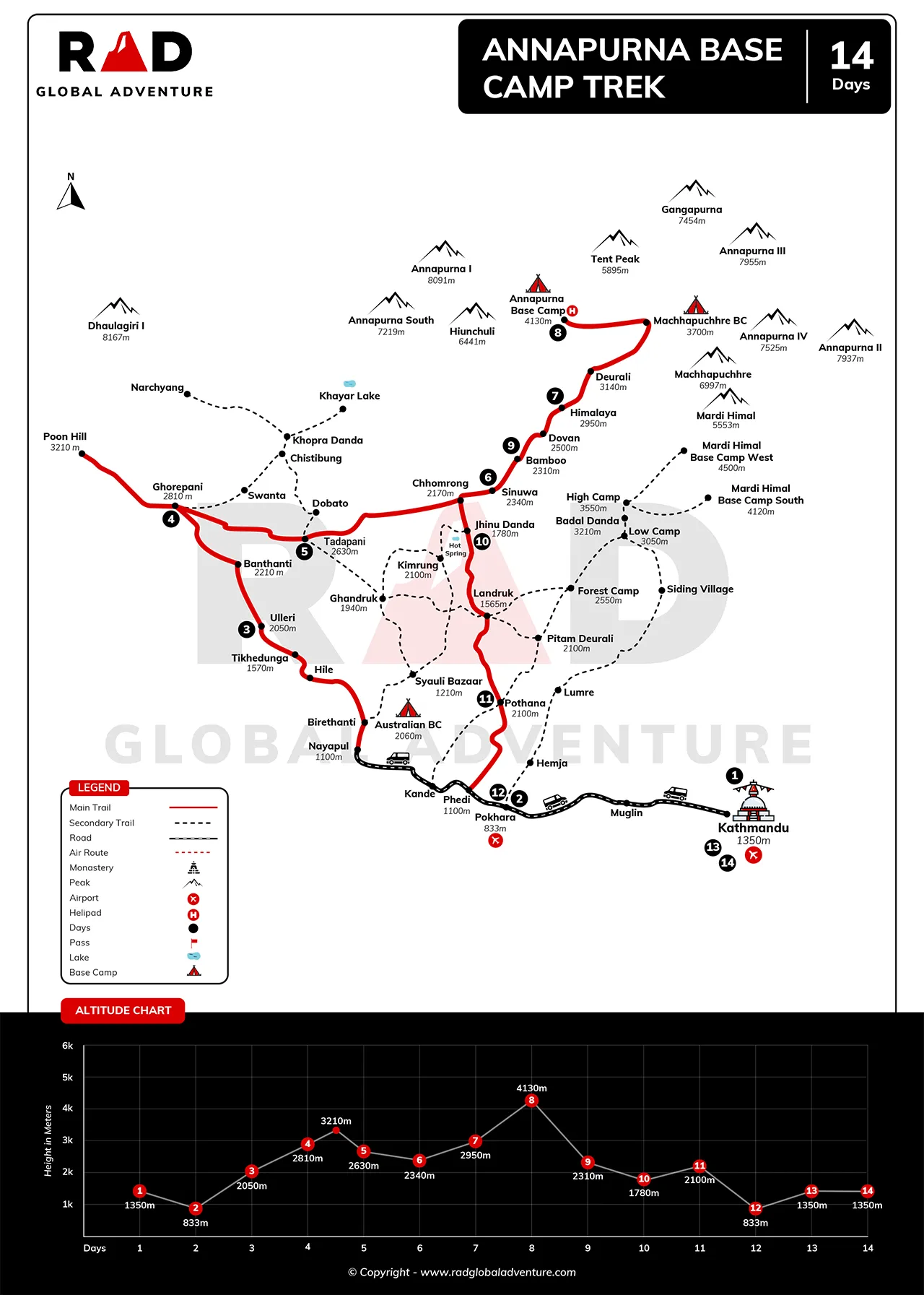
Starting our adventure we travel up to Pokhara either by road trip or flight. The road passes through sloping terraces and river valleys and gorges including Trishuli and Seti. A short flight will make the Himalayan mountains with snowy peaks appear to be visible above the clouds. Upon our arrival in Pokhara, the surface of Phewa Lake sparkles up the sight of sunset glowing Machhapuchhre (Fishtail) and Annapurna mountains.
The approach sets the perfect tone for the trek. Pokhara’s lakeside beauty with a backdrop of Annapurna South, Hiunchuli, and Machhapuchhre introduces us to the mountain landscapes we will explore during the Annapurna Base Camp Trek experience.
Himalayan Panorama and Sunrise at Poon Hill
Probably the most awaited moments of the trek must be sunrise at Poon Hill (3,210 m). We are out to hike before the first light of dawn to get the panoramic view and just after the first rays of sun we can see the Annapurna and Dhaulagiri ranges in a splash of yellow, orange and pink color.
The panorama view of 360 degrees is magnificent starting with Annapurna South, Hiunchuli, to Nilgiri and Dhaulagiri. That is why photographers and nature lovers refer Poon Hill sunrise as one of the best wonders of the Himalayas. Standing here, we understand why Annapurna Base Camp Trek is celebrated worldwide.
Gurung and Magar Villages
The Gurung and the Magar tribes of people are passed along the trail in their villages. The houses are built of stone, their roofs are terraced, and prayer flags are everywhere generating an ever-present timeless scene. In Ulleri, Landruk, or Ghandruk we visit rural communities where locals farm, weave baskets.
Nights provide warm welcome in family-owned teahouses, where we talk with villagers who have regenerate their tradition and pass it down through the generations. These cultural encounters enrich our trek, reminding us that Annapurna Base Camp Trek is not only about mountains but also about meaningful connections with people.
The Rhododendron and Bamboo forests with Wildlife
Rhododendrons grow in the form of pink, red, and white in the spring in hillsides. The path is bodyguard by oak, pine, and bamboo groves, which provide some relief in the form of shade and wilderness. We have an opportunity to listen to the voice of the Himalayan birds like Danphe, which is the national bird of Nepal, we may also see the langur monkey in the lower section.
Occasionally there are deer and wild boar along the path. Annapurna Base Camp trek is through lush surroundings which are like a Himalayan garden, including streams and moss studded rocks.
Annapurna Conservation area
The whole of our trek is within Annapurna Conservation Area (ACA), Nepal largest conservation area. This nature reserve is protecting habitats that encompass temperate woodlands to sub alpine fields. The ACA safeguards exotic animals like the musk deer and snow leopard, and also it preserves local cultures.
We get through checkpoints where our permits are bearing conservation interests The succession of prayer flags, chorten and environmental signs remind us that our steps help us preserve both culture and nature. Respecting the ACA is part of the responsibility we carry during Annapurna Base Camp Trek.
Base Camp of Machhapuchhre 3,700 m
Machhapuchhre Base Camp (MBC) is one of the stops that we make before arriving in Annapurna Base Camp. Looking in this direction we lift our eyes to that holy Fishtail peak, to which no one is allowed to climb. Machhapuchhre in the north rises above us as Annapurna South and Gandharvachuli come into the scene. A visit to MBC revives the memory of how beautiful the Annapurna Sanctuary is going to be.
Base Camp of Annapurna (4,130 m)
The Annapurna Base Camp(ABC) will be the highest point of our hike at 4,130 m. Here we are enclosed by an amphitheatre of giants-Annapurna I (8,091 m), Annapurna South, Hiunchuli, Lachhapuchhre and Gandharvachuli. The flat glacial moraine is graced with prayer flags and silence of the sanctuary is divine.
We are sad at the sunset and sunrise moments, when mountains turn into different colors in the magic light. Standing here is the true reward of the Annapurna Base Camp Trek journey—a once-in-a-lifetime moment to treasure.
Hot springs at Jhinu Danda
On our way down we briefly stop at Jhinu Danda a village that is graced with natural hot springs. The stone pools are hidden by the riverside and covered with jungle, it provides us with relaxing warmth on our tired muscles.
Locals hold the belief in the healing powers of the waters, and in our case it feels like nature spa after several days of the walking. After hiking, the hot springs of Jhinu will treat you in a very soothing way; it will not be a forgettable experience.
Tea house Trekking and local hospitality
The Annapurna is a teahouse trekking destination. We spend our nights in local family run mountain lodges. Dining halls kept warm by wood fires turn into social spaces where trekkers share meals and stories.
Meals are plain but good, dal bhat, soups, noodles and the owners are invariably friendly. Rooms are simple but the experience is charming. Teahouse culture can remain memorable because of card games, storytelling, and the sound of mountains outside. Hospitality itself becomes a highlight of Annapurna Base Camp Trek.
Sacred Trails, Chortens and Prayer Flags
The path is spiritual in nature. We pass chortens, mani walls and bridges stipped with prayer flags. Villagers make zigzag blessings on pathways and lit images of the butter lamps at the shrines. Buddhist and Hindu religions are incorporated into normal living. When we tourists walk through these holy grounds we can better understand the culture of the Himalayas.
Foods and Culture in Locals
Food on the trek reflects the local culture. Dal bhat provides energy and Tibetan momos and soups are just to add variety to it. Breakfasts can contain porridge, eggs, or pancakes and drunken warm tea. Dining out in teahouses is not only a source of food, it is living life.
In between meals we might hear Gurung or Magar music, or view villagers weaving thread or baskets. Every encounter is a reminder that Annapurna Base Camp Trek blends nature with living culture.
 English
 Dutch
Dutch Japanese
 Hindi
Hindi Italian
 Spanish
 French
 German
 Chinese
 Korean
 Arabic
 Hebrew
 Russian
 Portuguese
 Danish
 Czech
Czech Polish
 Swedish