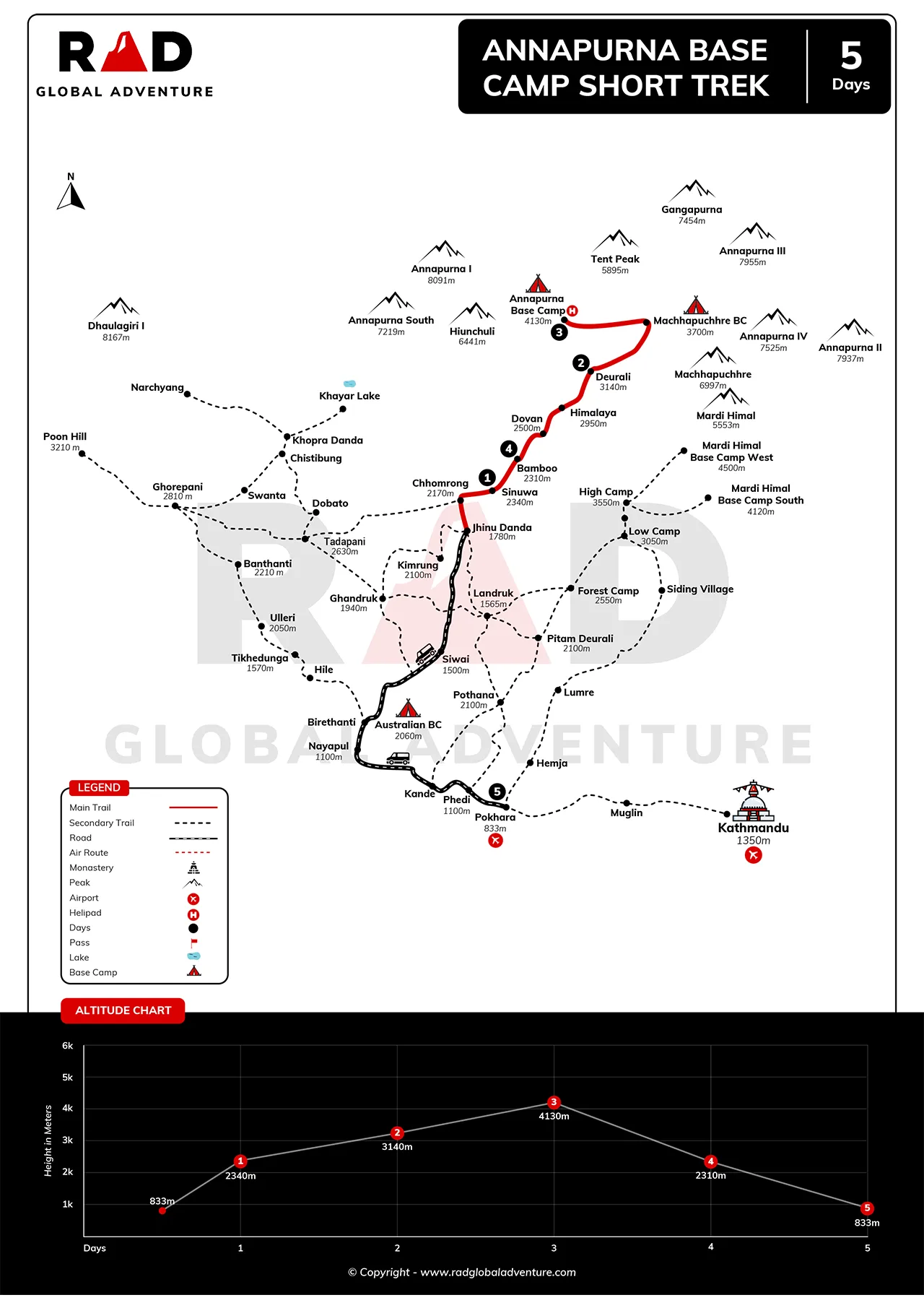
Annapurna Base Camp (4,130 m)
The base camp of Annapurna is a high glacial basin at 4130 meters. The trekkers are surrounded by Machhapuchre, Gangapurna, Annapurna I, and Hiunchuli, surrounded by tall mountains that create a peaceful and inspiring setting.
The views of the sunrise and sunset here are unforgettable, and the mountains are lit in golden light. An overnight stay will enable the trekkers to see the changing colors, hike to the glacier edges, and experience the quiet of this Himalayan holy sanctuary.
Panoramas of Annapurna, Machhapuchhre, Hiunchuli & Gangapurna
The pathway unfolds slowly, giving magnificent views. Deurali, the north side of Hiunchul, takes up most of the horizon. Machhapuchhre Base Camp offers a close look at the iconic “Fishtail” before one reaches the amphitheater of Annapurna Base Camp.
It is these panoramas that attract several visitors to this five-day trek. Trekker can see a variety of Himalayan giants that typically take weeks when on other trails within a very short period of time. Cameras are not able to capture everything, but memories are left inscribed forever.
Scenic Drive Pokhara–Jhinu
You start your journey with a drive through Pokhara to Jhinu in the direction of the valley of Modi Khola. In the process, terraced fields, waterfalls, and the traditional villages depict the rural life of Nepal. The highway stretches up the mountain at a pace that allows one to have occasional views of snow-covered Annapurna South.
This trek is a two-hour trip that creates anticipation before it starts. One final sight of the mountains comes by the same route as the trek ends, mixing a sense of nature with the richness of culture.
Jhinu Danda Hot Springs
Trekkers often enjoy a soak in the hot springs in Jhinu Danda on the last day of their trek. The warm water helps relax tired and sore muscles, while the area that surrounds the springs helps to provide a tranquil, refreshing atmosphere after several long days of trekking in the Annapurna region.
Hot springs are also used as a social area. Trekker and locals mingle with each other, exchanging anecdotes about life in the mountains. This last ford is believed to be the best ending of the short trek experience of Annapurna Base Camp.
Gurung & Magar Village Culture
Villages along the trail showcase Gurung and Magar traditions. Stone buildings, which have slate roofs, colorful gardens, and subsistence farming, are examples that show centuries of life in this area. Festivals showcase the colorful heritage of the communities through traditional music and dances.
Local family-run tea houses expose visitors to the local flavors and hospitality. Courteous relationships with people in the villages, eating together, hearing legends, etc., transform the hiking trip not just about mountains, but also about cultural exchange and human contact.
Rhododendron, Oak & Bamboo Forest Trails
There are the lower sections of the trails that go through beautiful forests. During spring, rhododendrons flower in red, pink, and white, and the groves of oak and bamboo also give shelter and harbor the birds.
As one continues uphill, the forest clears out to alpine meadows over 3,000 meters. This ecological change brings out the biodiversity of the Annapurna Sanctuary. These woodland walks are very popular among trekkers because they consider them to be one of the most enchanting sections of the voyage.
Sunrise & Sunset Over Annapurna Peaks
Annapurna Peak is in orange and pink at dawn when first light strikes the eastern side. The shadows are replaced by the Hiunchuli and Annapurna South. Machhapuchhre is cleaved into the scene, which forms one of the most photographed panoramas in the Himalayas.
Evenings are full of golden light dying in silver moonlit mountains. This daily cycle of the sunrise and sunset turns into something sacred, which portrays calmness and motivation. Unstable autumn and spring skies are ideal environments for these magic shows.
Machhapuchhre Base Camp’s Glaciers & Waterfalls
At an elevation of 3,700 meters, the Machhapuchhre Base Camp is glacier-laden. Waterfalls are falling down cliffs, chilly streams cut gullies, and avalanches are occasionally heard in the distance.
Trekkers often detour to viewpoints overlooking the glacier tongue. These are frozen rivers that feed the Modi Khola, which nourish the villages below. The visit to this location highlights the beauty of nature and the necessity of nature to be in the formation of the mountains and the lives of people.
Varied Terrain from Valleys to Alpine Meadows
This trek summarizes a variety of landscapes within a 5-day timeframe. It begins in subtropical valleys as you cross terraced rice paddies and traverse local villages. The trail is a gentle ascent and begins to envelop the trekkers in oak and rhododendron forest.
Above 3000m, the forests transition to rocky moraines as you reaches base camp. Each ecological transition brings new sights, sounds, and scents. This guarantees a steady distraction that prevents the trek from becoming mundane and minimizes the chance for monotony during your time in the mountains.
 English
 Dutch
Dutch Japanese
 Hindi
Hindi Italian
 Spanish
 French
 German
 Chinese
 Korean
 Arabic
 Hebrew
 Russian
 Portuguese
 Danish
 Czech
Czech Polish
 Swedish